
 Buy Crypto
- Markets
 Futures
- Spot
- Copy Trade
- Earn
- More
Aztec Public Sale: Will Anyone Foot the Bill After 7 Years of Waiting?

Original Article Title: "Aztec Public Sale: Will Anyone Be Buying After 7 Years of Waiting?"
Original Article Author: 1912212.eth, Foresight News
On November 13, the zero-knowledge privacy technology project Aztec announced the launch of the AZTEC token sale, with a total of 15.47 billion tokens, accounting for 14.95% of the total supply, and accepting ETH as payment. Regarding the sale mechanism, the project stated that it would prioritize real-time price discovery and fair participation opportunities. The initial price was set at a $3.5 billion FDV, approximately 75% lower than the implied network valuation based on the latest equity financing. Participants could mint Soul-Bound NFTs to confirm their participation status.
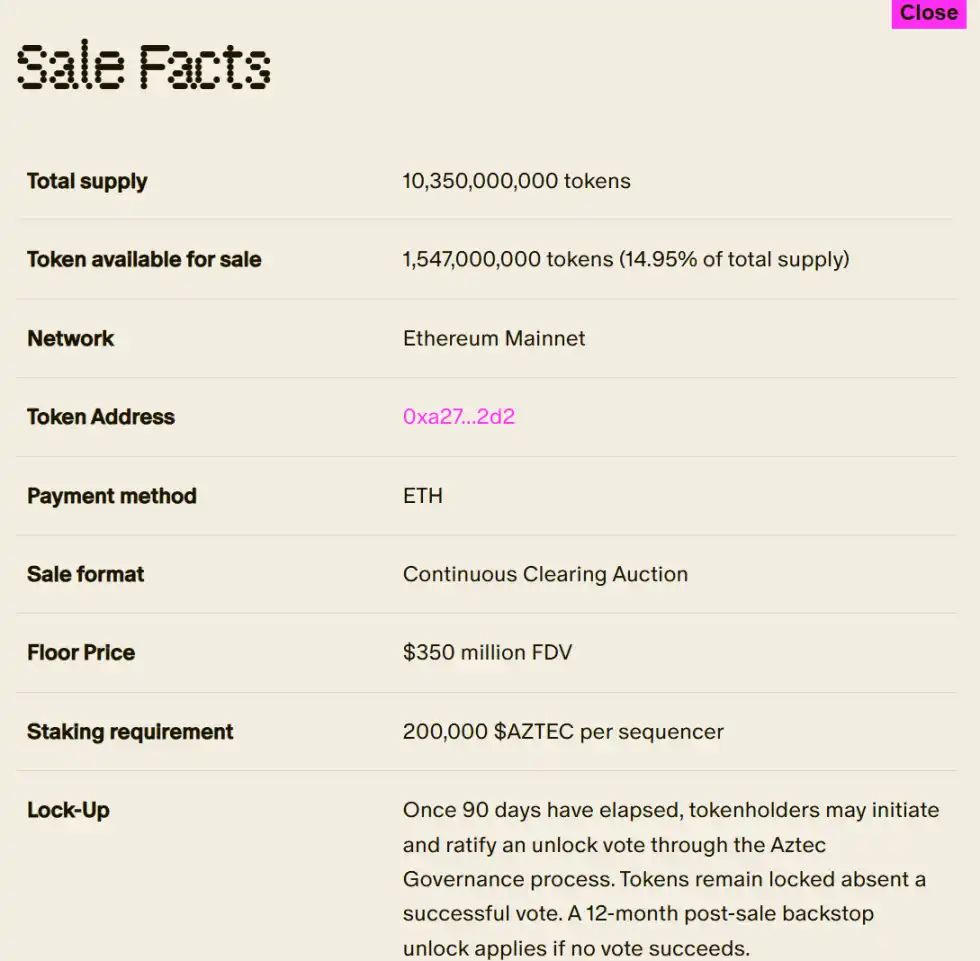
Registration and bidding for early participants will start today (November 13) at 3 p.m. (CET), with early participants enjoying a day of exclusive early access before opening bidding to the public. On December 1, AZTEC will be distributed to contributors and Genesis bidders; on December 2, all NFT holders can participate in the auction bidding.
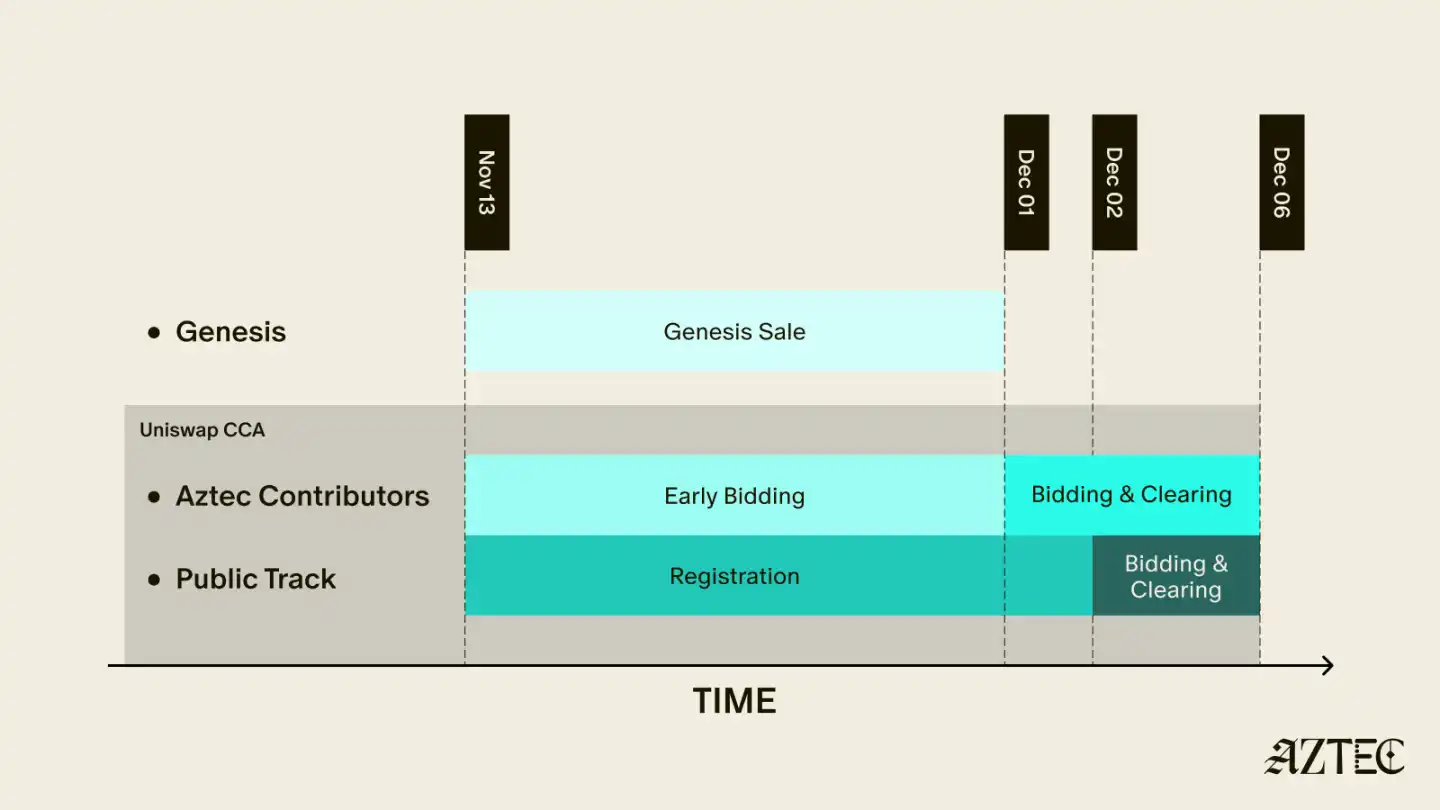
The public auction will take place from December 2 to December 6, 2025, during which tokens can be withdrawn and staked.
This sale does not have an airdrop phase and does not have a special allocation mechanism. Over 300,000 addresses have been whitelisted, and these addresses will qualify for first-day bidding. The sale is open to global users, including U.S. citizens.
Contributor Qualification Verification Rules
Participants who have been involved in one or more of the following:
· Aztec testnet sequencers and verifiers
· ETH solo stakers, including selected StakeCat ETH operators, Obol Silver, Rocketpool, LidoCSM, and Stakers Union.
· zk.money users
· Active community members
· Uniswap traders (selecting 3000 from the past 30 days' active traders)
· Nansen's Ice, North, and Star tiers.
This also includes Genesis Sorter Nodes, as well as top 200 high-quality node operators who have demonstrated exceptional performance on the Aztec testnet.
Auction Method: Continuous Clearing Auction Protocol
Uniswap has announced the launch of the "Continuous Clearing Auction Protocol (CCA)," a customizable protocol designed to bootstrap liquidity and token issuance on Uniswap v4. The protocol, designed in partnership with Aztec, features a ZK Passport module to enable private and verifiable participation.
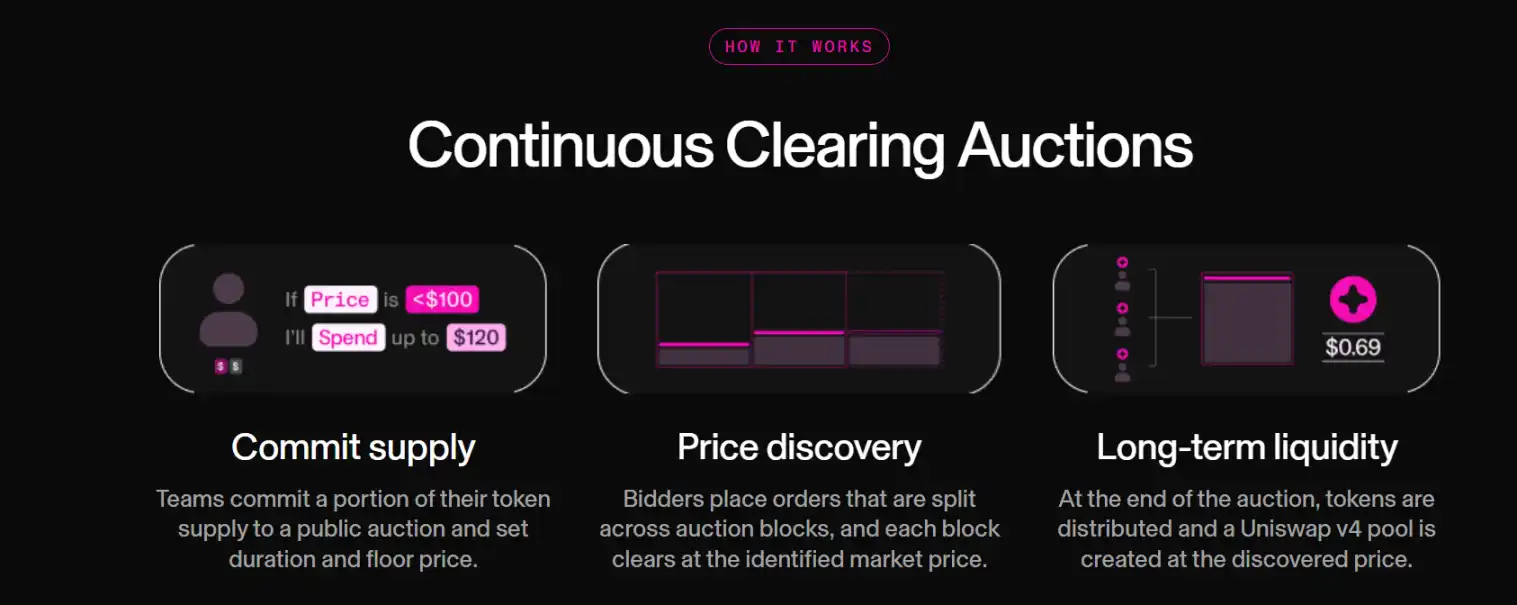
The team commits a portion of token supply to a public auction with a set duration and reserve price. Bidders participate in price discovery, with their orders being split in the auction block and settled at the agreed-upon market price.
Upon the conclusion of the Continuous Liquidity Auction, tokens will be distributed, and a Uniswap V4 liquidity pool will be created at the discovered price.
Tokenomics
The Aztec whitepaper reveals that the total initial supply of AZTEC is 10,350,000,000 tokens, distributed as follows: 27.26% allocated to investors and early supporters, 21.06% allocated to the core team, 11.71% allocated to the foundation, 10.73% allocated to ecosystem grants, 14.95% allocated to Phase 2 public auction, 1.93% allocated to Phase 1 Genesis Sorter Sale, 2.44% allocated to Bilateral Sales, 2.64% allocated to Uniswap V4 Liquidity Pool, 4.89% allocated to future incentives, and 2.41% allocated to Y1 Network Rewards.
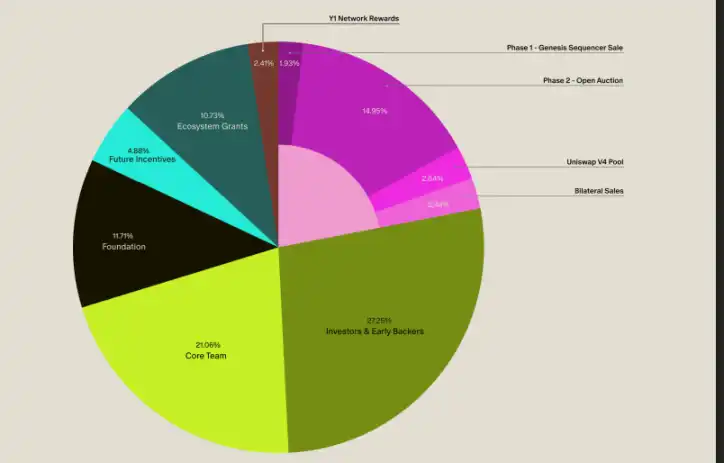
The total token sale allocation accounts for 21.96%, equivalent to 2,272,500,000 tokens. These tokens will be held by token holders and the foundation at launch.
The token features include
· Sorter Staking: The token will be used for securing the network through staking by Aztec validators, known as "sorters," who are responsible for block generation on the Aztec network. Token holders not operating as sorters can choose to delegate their tokens to sorters.
· Governance: Token holders can participate in the governance of the Aztec Network ("Aztec Governance").
· Execution Environment: If the network is upgraded in the future through Aztec Governance to support a smart contract execution environment, the token will be used to pay transaction fees on the Aztec Network.
12 months after the start date of the token sale (November 13, 2025)
· Aztec Governance may adjust the total token supply, including issuing additional tokens annually up to a certain percentage cap;
· If the execution environment is enabled, transaction fees may be adjusted through a self-governed mechanism similar to Ethereum's EIP-1559.
Upon completion of the token sale, the Uniswap v4 liquidity pool may provide secondary market liquidity, with the foundation planning to inject 273 million tokens into the pool. The token sale contract will automatically inject the corresponding tokens into the liquidity pool based on the ETH ratio paid by the purchasers. The liquidity pool will be controlled by Aztec Governance and will be locked in an immutable smart contract for at least 90 days after launch, with the option to lift the restriction through governance voting thereafter. Additionally, the token may be listed for trading on other decentralized exchange protocols or centralized exchanges.
7-Year Wait
Since the end of 2018, Aztec completed a $2.1 million seed funding round, followed by another funding round in September 2019. In January 2020, the Aztec Network went live. Amidst the ZK zero-knowledge and L2 craze, in December 2021, a $17 million Series A funding round was completed with Paradigm as the lead investor and participation from celebrities like Vitalik. Subsequently, in December 2022, a $100 million Series B funding round was completed with a16z leading the round.
However, the lineup of prestigious investors did not result in the growth of the protocol.
In March 2023, the Aztec Network announced the gradual shutdown of the DeFi privacy bridge project Aztec Connect. It would disable deposits into the Aztec Connect contract from zk.money and other frontends (such as zkpay.finance) and completely abandon the Aztec Connect contract a year later, ceasing all Rollup functionalities. The decision was primarily driven by business considerations, according to its leadership.
In May 2025, it launched its public testnet, initially attracting many airdrop enthusiasts. However, the recent release of the tokenomics revealed that Aztec did not have any airdrop allocation.
BTC has fallen below $100,000, signaling a market downturn. The extent to which investors will step in to buy the dip remains uncertain, posing a real test for Aztec.
You may also like

From "Kimchi Premium" to Bithumb's Rectification: An Interpretation of the Current Situation in the South Korean Crypto Market

How to Automate Your Workflow with AI (No Code Required)
Conversation with Pantera Founder: Bitcoin Has Reached Escape Velocity, Traditional Assets Are Being Left Behind

Is it still worth buying Circle on the callback?

BIT Launches Landmark "Same Name Virtual Account" Feature: Ushering in a New Era of OTC Trading that is Convenient, Efficient, and Compliant

Further Oracle Integration Reveals Polymarket's Ambitions

CoinGlass: 2026 Q1 Cryptocurrency Market Share Research Report

Tiger Research: Analysis of the Current Situation of Retail Investors in Nine Major Asian Markets

Forbes: Does quantum technology threaten the encryption industry? But it is more likely an opportunity

What Is Auto Earn? How To Claim Extra Free Crypto On Auto Earn 2026
What is Auto Earn and how do you use it? This guide explains how Auto Earn works and how balance increases and referrals may qualify for extra rewards during Auto Earn Boost Fest.
Auto Earn Compared 2026: Which Exchange Gives The Most Extra Bonus?
What is Auto Earn in crypto? Compare Kraken, OKX, Bybit, Binance, and WEEX Auto Earn features in 2026 and see which platforms provide additional promotional rewards beyond standard yield mechanisms.

Nearly $300M Targeting U.S. Midterm Elections, Tether Exec Leads Crypto Industry's Second-Largest Political Fund

Anthropic's Triple Moment: Code Leak, Government Standoff, and Weaponization
OpenAI and Anthropic both announced acquisitions on the same day, causing dual IPO anxiety.

Forbes: Quantum Technology Threatens the Crypto Industry? But It's More Likely an Opportunity

Rhythm X Zhihu Hong Kong Event Recruitment Skills, Register Now for a Chance to Showcase Live

CLARITY Act 2026 Update: Stablecoin Yield Ban, Senate Compromise, and What It Means for Crypto Markets
The CLARITY Act may reshape stablecoin yield rules, DeFi incentives, and crypto liquidity in 2026. Learn the latest Senate updates, timeline changes, and what the regulation could mean for crypto traders.


 App
App