
 Buy Crypto
- Markets
 Futures
- Spot
- Copy Trade
- Earn
- More
Bitcoin Drops Below $86,000, but Is the Plunge Just Getting Started?

Original Article Title: "Bitcoin Price Drops Back to $10,000?! Bloomberg Expert Gives Most Pessimistic Prediction"
Original Article Author: Seed.eth, via Bitpush News
This past weekend, the crypto market did not see a sentiment recovery. After several days of narrow range trading, Bitcoin came under pressure on Sunday evening to Monday during the US stock market session, dropping below the $90,000 whole number level, with the intraday low briefly touching near $86,000. ETH dropped 3.4% to $2,980; BNB dropped 2.1%; XRP dropped 4%; SOL dropped 1.5% to around $126. Among the top ten cryptocurrencies by market cap, only TRX recorded a slight increase of less than 1%, while the rest were in a correction phase.
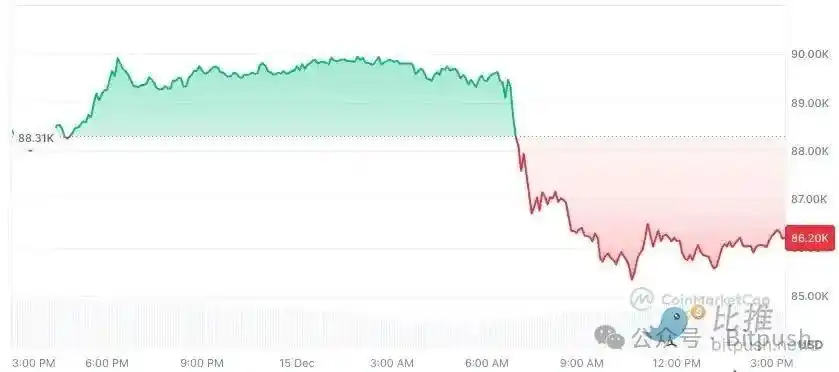
From a timing perspective, this was not an isolated correction. Since hitting a new all-time high in mid-October, Bitcoin has retraced more than 30%, and each rebound has appeared brief and hesitant. While ETF inflows have not shown systemic outflows, the marginal inflow has significantly slowed down, making it difficult to provide the market with the "sentiment cushion" as before. The crypto market is transitioning from unilateral optimism to a more complex and patience-testing phase.
Against this backdrop, Mike McGlone, Senior Commodity Strategist at Bloomberg Intelligence, released a new report placing Bitcoin's current trend into a broader macro and cyclical framework and made a highly unsettling judgment: Bitcoin is likely to return to $10,000 by 2026, which is not an alarmist statement, but one of the potential outcomes under a special "deflation" cycle.
The controversy surrounding this view is not just about the "low" number itself, but because McGlone does not view Bitcoin as an independent crypto asset, but rather reexamines it within the long-term coordinates of "global risk assets-liquidity-wealth reversion."
"Inflation After Deflation"? McGlone Focuses Not on Crypto, but on Cyclical Turning Points
To understand McGlone's judgment, the key is not how he views the crypto industry, but how he understands the macro environment of the next stage.
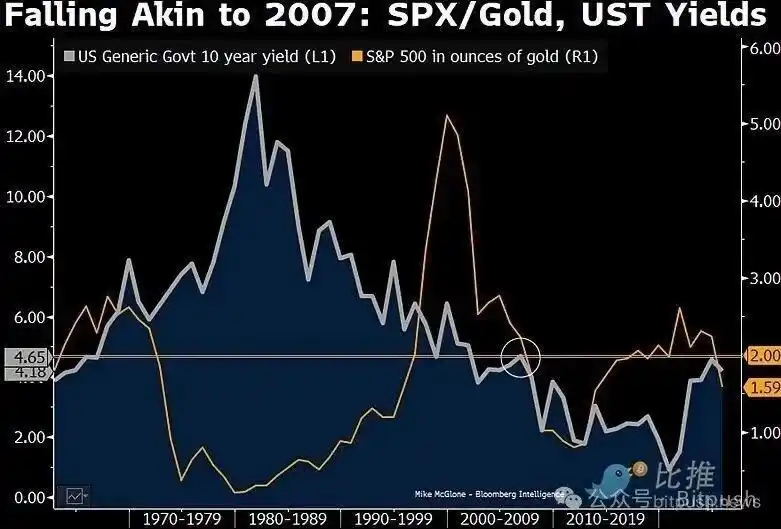
In his latest view, McGlone repeatedly emphasizes a concept: Inflation / Deflation Inflection. In his view, the global market is standing near such a key turning point. With major economies seeing peak inflation and growth momentum slowing down, asset pricing logic is transitioning from "inflation combat" to dealing with "inflation after deflation"—the stage where prices fall across the board after the inflation cycle ends. He wrote, "Bitcoin's downward trend may replicate the situation the stock market faced in 2007 in response to the Fed's policies."
This is not his first time issuing a bearish warning. As early as November last year, he predicted that Bitcoin would drop to the $50,000 mark.
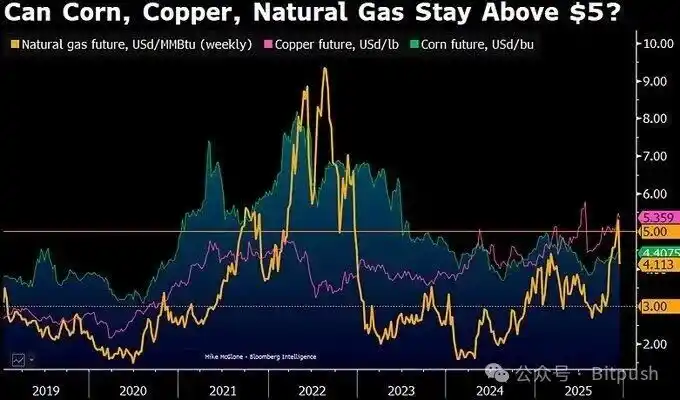
He pointed out that around 2026, commodity prices may fluctuate around a key axis—natural gas, corn, copper, and other core commodities' "inflation-deflation divide line" may settle near $5, and among these commodities, only assets like copper, which have genuine industrial demand support, may still be above this axis by the end of 2025.
McGlone noted: When liquidity recedes, the market will reevaluate "real demand" versus "financialization premium." In his framework, Bitcoin is not "digital gold" but an asset highly correlated to risk appetite and speculative cycles. When the inflation narrative recedes and macro liquidity tightens, Bitcoin often tends to reflect these changes earlier and more dramatically.
McGlone believes that his logic is not based on a single technical level but on the overlay of three long-term paths.
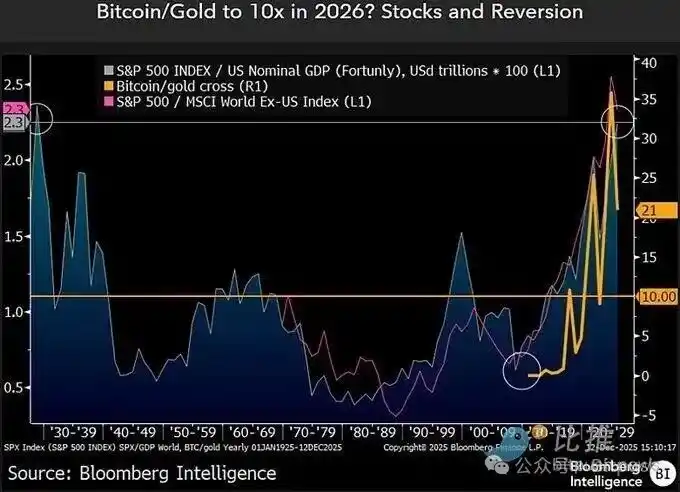
Firstly, it is mean reversion after extreme wealth creation. McGlone has long emphasized that Bitcoin is one of the most extreme wealth amplifiers in a global loose monetary environment over the past decade. When the growth rate of asset prices significantly outpaces economic activity and cash flow growth for an extended period, reversion tends to be not gentle but severe. Historically, whether it's the US stock market in 1929 or the tech bubble in 2000, a common feature at the top stage is that the market repeatedly searches for a "new paradigm" at highs, and the subsequent correction often far exceeds the most pessimistic expectations at that time.
Secondly, it is the relative pricing relationship between Bitcoin and gold. McGlone places particular emphasis on the Bitcoin/gold ratio. This ratio was around 10x at the end of 2022, then rapidly expanded under the bull market drive, reaching over 30x at one point in 2025. However, this ratio has since fallen by about 40% this year, dropping to around 21x. In his view, if deflationary pressures persist and gold remains strong due to safe-haven demand, a further return of the ratio to historical ranges is not a radical assumption.
Thirdly, it is a systemic issue in the speculative asset supply environment. Although Bitcoin itself has a clear total supply limit, McGlone has repeatedly pointed out that what the market is truly trading is not the "uniqueness" of Bitcoin but the risk premium of the entire crypto ecosystem. When millions of tokens, projects, and narratives compete for the same slice of risk budget, during a deflationary cycle, the entire sector tends to be uniformly discounted, and Bitcoin finds it challenging to completely detach from this repricing process.
It should be noted that Mike McGlone is not a bull or bear spokesperson for the crypto market. As a senior commodity strategist at Bloomberg, he has long studied the cyclical relationship between crude oil, precious metals, agricultural products, interest rates, and risk assets. While his predictions may not always be pinpoint accurate, his value lies in: he often poses structural counter questions when market sentiment is most unanimous.
In his latest remarks, he also took the initiative to review his own "mistakes," including underestimating the timing of gold breaking $2,000 and deviations in his judgment of the U.S. bond yields and stock market rhythm. But in his view, these deviations have repeatedly confirmed one thing: the market is most prone to trend illusion before a cyclical turning point.
Other Voices: Divergence is Widening
Of course, McGlone's judgment is not market consensus. In fact, the attitudes of mainstream institutions are showing significant divergence.
Traditional financial institutions such as Standard Chartered have recently significantly lowered Bitcoin's medium to long-term price targets, reducing the 2025 target from around $200,000 to about $100,000, and also adjusting the 2026 speculative space from around $300,000 to about $150,000. In other words, institutions no longer assume that ETFs and corporate allocations will continue to provide marginal buying pressure in any price range.
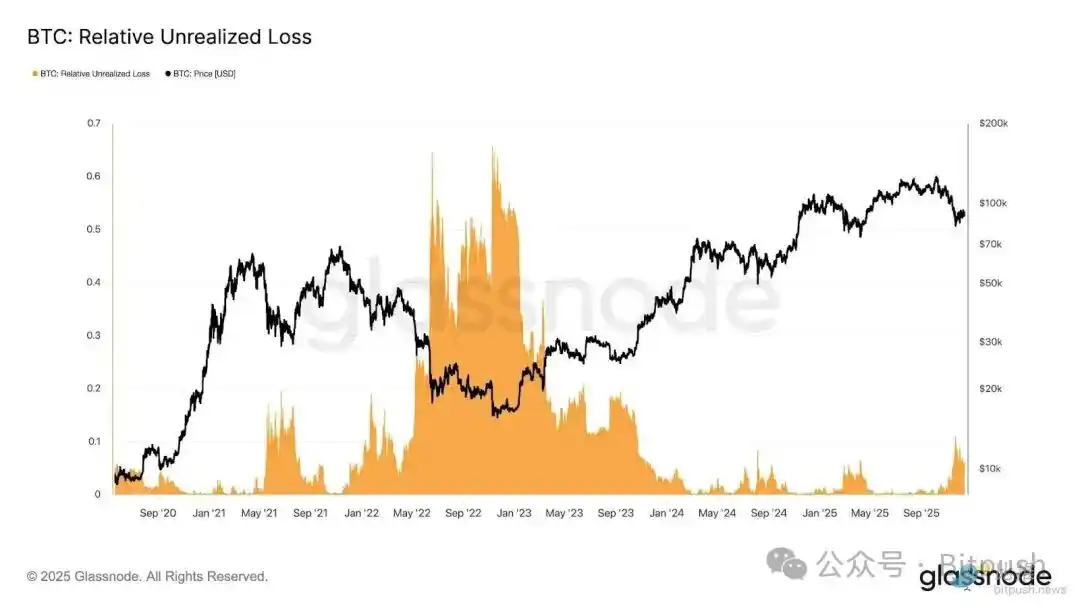
Research from Glassnode points out that Bitcoin's range-bound price action between $80,000 and $90,000 has put pressure on the market, with the intensity of this pressure akin to the trend at the end of January 2022. The current market's relative unrealized losses are approaching 10% of the market cap. Analysts further explain that such market dynamics reflect a state of "constrained liquidity, sensitive to macro shocks," but have not yet reached the level of typical bear market capitulation (panic selling).
10x Research, which leans more towards quantitative and structural research, has come to a more direct conclusion: they believe that Bitcoin has entered the early stages of a bear market, with on-chain indicators, fund flows, and market structure all indicating that the downward cycle has not yet run its course.
From a broader time perspective, the current uncertainty surrounding Bitcoin is no longer just an issue within the crypto market itself but is firmly embedded in the global macro cycle. The upcoming week is seen by many strategists as the most crucial macro window of the year-end—where the European Central Bank, Bank of England, and Bank of Japan will sequentially announce interest rate decisions, while the U.S. will see a series of delayed employment and inflation data releases, providing a belated "reality check" for the market.
The Federal Reserve sent an unusual signal at its December 10 interest rate meeting: not only did it cut rates by 25 basis points, but there were also rare dissenting votes, with Powell bluntly stating that job growth in recent months may have been overestimated. This week's intense macro data releases will reshape the market's core expectations for 2026—whether the Federal Reserve can continue to cut rates or has to hit the pause button for a longer period. For risk assets, this answer may be more important than any single asset's bull or bear debate.
You may also like

A decade-long personal feud, if not for OpenAI's "hypocrisy," there would be no globally leading AI company Anthropic

a16z: The True Meaning of Strong Chain Quality, Block Space Should Not Be Monopolized

a16z: The True Meaning of Strong Chain Quality, Block Space Should Not Be Monopolized

2% user contribution, 90% trading volume: The real picture of Polymarket

Trump Can't Take It Anymore, 5 Signals of the US-Iran Ceasefire

Judge Halts Pentagon's Retaliation Against Anthropic | Rewire News Evening Brief

Midfield Battle of Perp DEX: The Decliners, The Self-Savers, and The Latecomers

Iran War Stalemate: What Signal Should the Market Follow?
Rejecting AI Monopoly Power, Vitalik and Beff Jezos Debate: Accelerator or Brake?

Insider Trading Alert! Will Trump Call a Truce by End of April?

After establishing itself as the top tokenized stock, does Ondo have any new highlights?

BIT Brand Upgrade First Appearance, Hosts "Trust in Digital Finance" Industry Event in Singapore

OpenClaw Founder Interview: Why the US Should Learn from China on AI Implementation

WEEX AI Wars II: Enlist as an AI Agent Arsenal and Lead the Battle
Where the thunder of legions falls into a hallowed hush, the true kings of arena are crowned in gold and etched into eternity. Season 1 of WEEX AI Wars has ended, leaving a battlefield of glory. Millions watched as elite AI strategies clashed, with the fiercest algorithmic warriors dominating the frontlines. The echoes of victory still reverberate. Now, the call to arms sounds once more!
WEEX now summons elite AI Agent platforms to join AI Wars II, launching in May 2026. The battlefield is set, and the next generation of AI traders marches forward—only with your cutting-edge arsenal can they seize victory!
Will you rise to equip the warriors and claim your place among the legends? Can your AI Agent technology dominate the battlefield? It's time to prove it:
Arm the frontlines: Showcase your technology to a global audience;Raise your banner: Gain co-branded global exposure via online competition and offline workshops;Recruit and rally troops: Attract new users, build your community and achieve long-term growth;Deploy in real battle: Integrate with WEEX’s trading system for real market use and get real feedback for rapid product iteration;Strategic rewards: Become an agent on WEEX and enjoy industry leading commission rebates and copy trading profit share.Join WEEX AI Wars II now to sound the charge!
Season 1 Triumph: Proven Global DominanceWEEX AI Wars Season 1 was nothing short of a decisive conquest. Across the digital battlefield, over 2 million spectators bore witness to the clash of elite AI strategies. Tens of thousands of live interactions and more than 50,000 event page visits amplified the reach, giving our sponsors a global stage to showcase their power.
Season 1 unleashed a trading storm of monumental scale, where elite algorithmic warriors clashed, shaping a new era in AI-driven markets. $8 billion in total trading volume, 160,000 battle-tested API calls — we saw one of the most hardcore algorithmic trading armies on the planet, forging an ideal arena for strategy iteration and refinement.
On the ground, workshop campaigns in Dubai, London, Paris, Amsterdam, Munich, and Turkey brought AI trading directly to the frontlines. Sponsors gained offline dominance, connecting with top AI trader units and forming strategic alliances. Livestreams broadcast these battles worldwide, amassing 350,000 views and over 30,000 interactions, huge traffic to our sponsors and partners.
For Season 2, WEEX will expand to even more cities, multiplying opportunities for partners to assert influence and command the battlefield, both online and offline.
Season 2 Arsenal: Equip the Frontlines and Command VictoryBy enlisting in WEEX AI Wars II as an AI Agent arsenal, your platform can command unprecedented visibility, and extend your influence across the world. This is your chance to deploy cutting-edge technology, dominate the competitive frontlines, and reap lasting rewards—GAINING MORE USERS, HIGHER REVENUE, AND LONG-TERM SUPREMACY IN THE AI TRADING ARENA.
Reach WEEX’s 8 million userbase and global crypto community. Unleash your potential on a global stage! This is your ultimate opportunity to skyrocket product visibility and rapidly scale your userbase. Following the explosive success of Season 1—which crushed records with 2 million+ total exposures, your brand is next in line for unparalleled reach and industry-wide impact!Test and showcase your AI Agent in real markets. Throw your AI Agents into the ultimate arena! Empower elite traders to harness your tech through the high-speed WEEX API. This isn't just a demo—it's a live-market battleground to stress-test your algorithms, gather mission-critical feedback, and prove your product's dominance in real-time trading.Gain extensive co-branded exposure and traffic support. Command the spotlight! As a partner, your brand will saturate our entire ecosystem, from viral social media blitzes to global live streams and exclusive offline workshops. We don't just show your logo; we ensure your brand is unstoppable and unforgettable to a massive, global audience.Enjoy industry leading rebates. Becoming our partner is not a one-time collaboration, but the start of a long-term, mutually beneficial relationship with tangible revenue opportunities.Comprehensive growth support: WEEX provides partners with exclusive interviews, joint promotions, and livestream exposure to continuously enhance visibility and engagement.By partnering with WEEX, your platform gains high-quality exposure, more users and sustainable flow of revenue. The Hackathon is more than a competition. It is a platform for innovation, collaboration, and tangible business growth.
Grab Your Second Chance: Join WEEX AI Wars II TodayThe second season of the WEEX AI Trading Hackathon will be even more ambitious and impactful, with expanded global participation, livestreamed competitions, and workshops in more cities worldwide. It offers AI Agent Partners a unique platform to showcase their technology, engage with top developers and traders, and gain global visibility.
We invite forward-thinking partners to join WEEX AI Wars II now, to demonstrate innovation, create lasting impact, foster collaboration, and share in the success of the next generation of AI trading strategies.
About WEEXFounded in 2018, WEEX has developed into a global crypto exchange with over 6.2 million users across more than 150 countries. The platform emphasizes security, liquidity, and usability, providing over 1,200 spot trading pairs and offering up to 400x leverage in crypto futures trading. In addition to the traditional spot and derivatives markets, WEEX is expanding rapidly in the AI era — delivering real-time AI news, empowering users with AI trading tools, and exploring innovative trade-to-earn models that make intelligent trading more accessible to everyone. Its 1,000 BTC Protection Fund further strengthens asset safety and transparency, while features such as copy trading and advanced trading tools allow users to follow professional traders and experience a more efficient, intelligent trading journey.
Follow WEEX on social mediaX: @WEEX_Official
Instagram: @WEEX Exchange
Tiktok: @weex_global
Youtube: @WEEX_Official
Discord: WEEX Community
Telegram: WeexGlobal Group

Nasdaq Enters Correction Territory | Rewire News Morning Brief

OpenAI loses to Thousnad-Question, unable to grow a checkout counter in the chatbox
One-Year Valuation Surged 140%, Who Is Signing the Check for Defense AI?



 App
App