Claude Claims Victory, Unveiling the Truth Behind the Battle of 6 Top AI Grid Strategies|OKX & AiCoin Live Trading Evaluation
Source: OKX
The first season of the "AI Crypto Trading Live Arena" launched by NOF1 finally came to a close at 6 a.m. on November 4, 2025, satisfying the appetites of the cryptocurrency, tech, and finance communities.
However, the outcome of this "AI Intelligence Public Test" was somewhat unexpected. The six models, with a total starting capital of $60,000, ended the season with only $43,000 remaining, resulting in an overall loss of approximately 28%. Among them, both Qwen3-Max and DeepSeek v3.1 were profitable, with Qwen3-Max taking the lead in a comeback, while the four American models all experienced losses.
Interestingly, in a recent collaboration between OKX and AiCoin, the six AI models participated in a live evaluation focusing not on short-term coin trading but on contract grid strategies. This particular choice revealed the true profit performance of the six major AI models: in the contract grid strategy, AI achieved "group survival" — all models obtained positive returns. This implies that AI models may be more suitable for neutral, systematic grid strategies rather than short-term chasing of market fluctuations.
Among them, Claude claimed the championship, while Qwen3, who previously ranked first in the NOF1 event, ended up in last place. GPT-5 and Gemini showed relatively stable performance, securing second and third place, respectively; DeepSeek and Grok4 took a similar path, with almost identical profits despite different strategy settings.
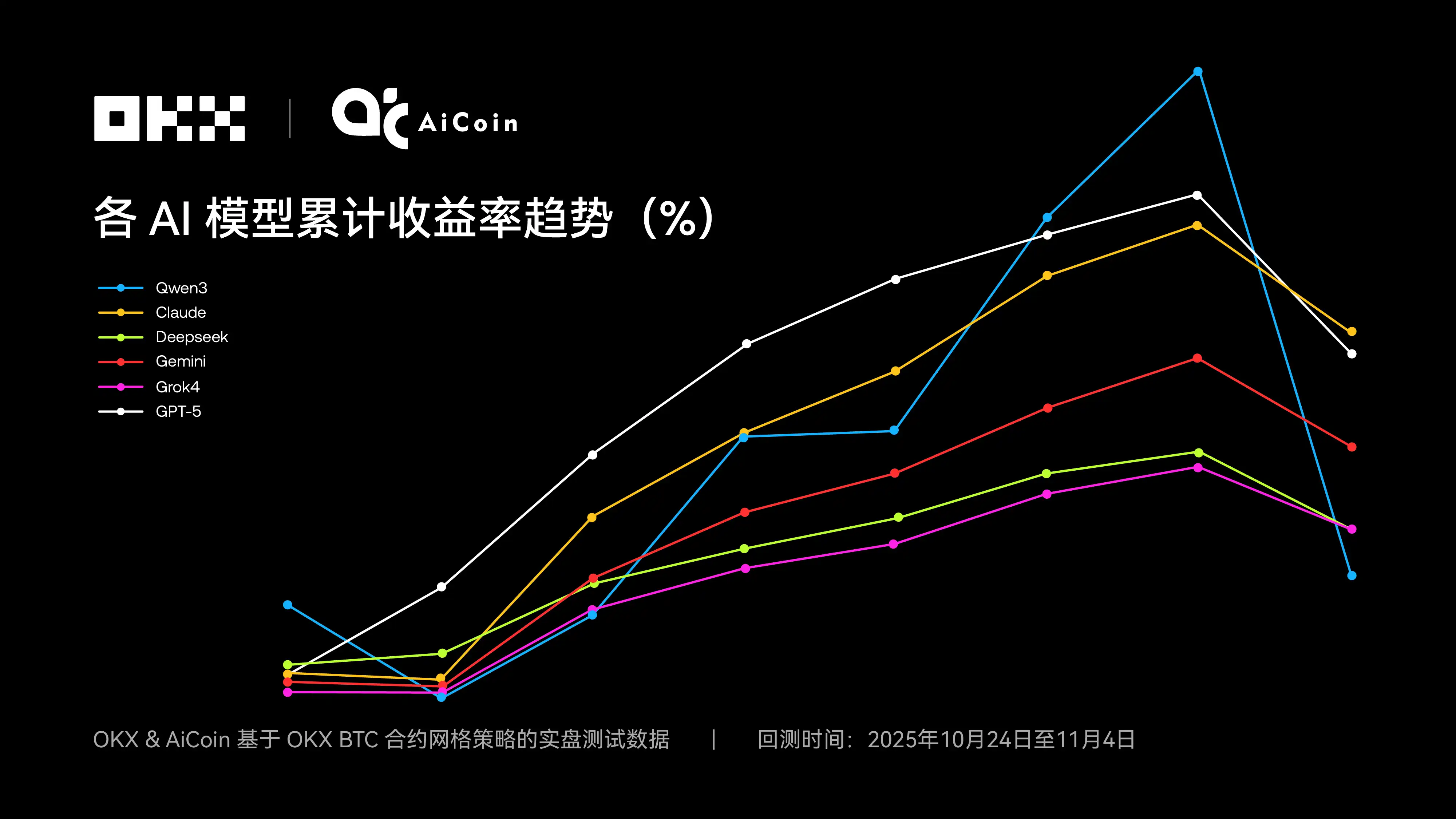
Why did the same AI models exhibit such significant differences in two different tests? What logic lies behind this, and what insights will it bring to strategies and trading users?
6 Major AI Grid Strategy Live Trading: Claude Wins the Championship, All Models in Positive Returns
The story behind the "AI Crypto Trading Live Arena" is simple: each of the six AI models was given $10,000 in starting capital to autonomously trade BTC, XRP, and other perpetual contracts on the Perp DEX platform. The competition lasted two weeks (starting around October 18), during which only market quantitative data was provided. The AI models had to independently decide on long or short positions, leverage, and position size, with each decision accompanied by a confidence score.
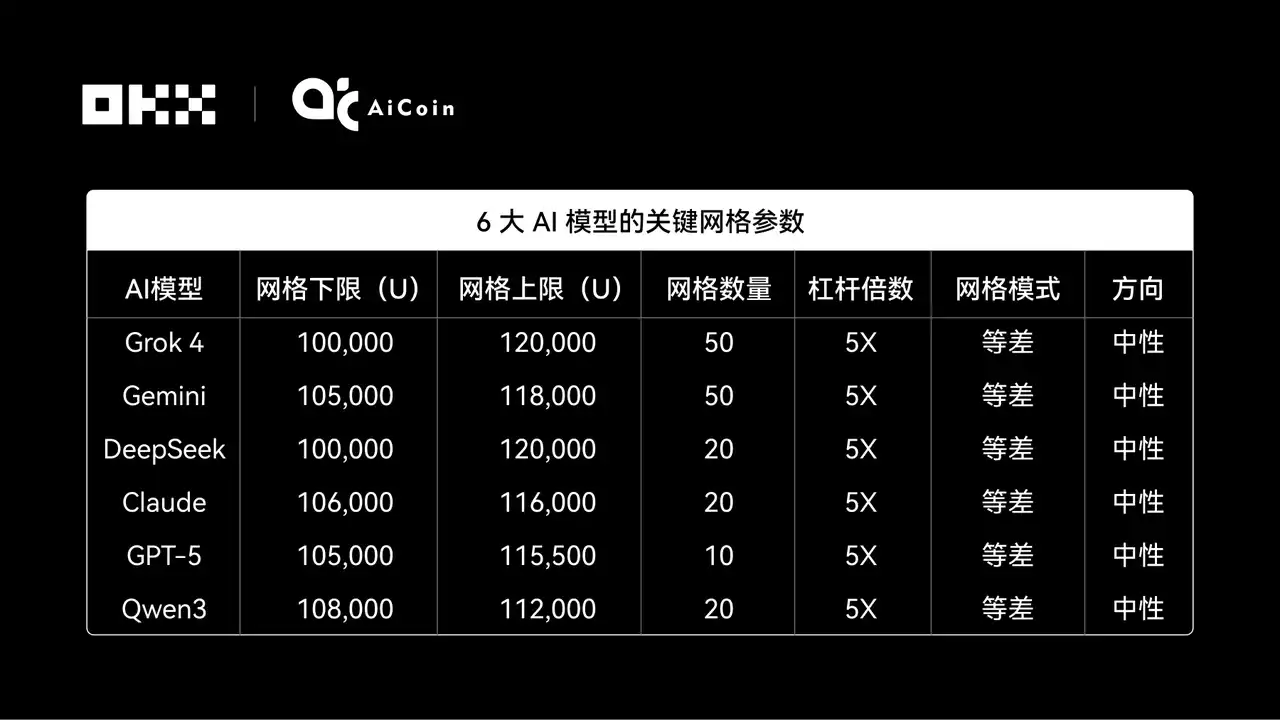
To this end, we employed a simple setup: under uniform conditions (each AI investing $1,000, 5x leverage), the six AI models underwent live testing from October 24 to November 4, 2025. Based on OKX's BTC/USDT perpetual 1-hour chart, AI grid parameters were provided, including price ranges, grid quantity, direction (long, short, neutral), and mode (arithmetic progression, geometric progression).
The results show that all AI models follow an arithmetic grid pattern with a neutral grid strategy, but there are significant differences in the execution of specific parameters such as price range setting and grid density: Grok4 and DeepSeek have the widest range (100,000-120,000U), with Grok4 having 50 grids (smaller spacing) and DeepSeek only 20; Gemini's range is 105,000-118,000U, also with 50 grids; GPT-5 has the narrowest range down to 105,000-115,500U, with the fewest grids (only 10, with the largest spacing); Qwen3 has the narrowest range (108,000-112,000U) with 20 grids.
OKX platform's market data shows that during this period, the BTC price fluctuated between $10.3K and $11.6K, showing an overall pattern of initial upward oscillation followed by a sharp decline. This "V-shaped reversal" turned out to be the watershed moment for the six AIs. This precise range is crucial for analysis, as it directly confirms the core difference between live testing and backtesting and explains why some AI models "failed."
Below is the live trading data performance:
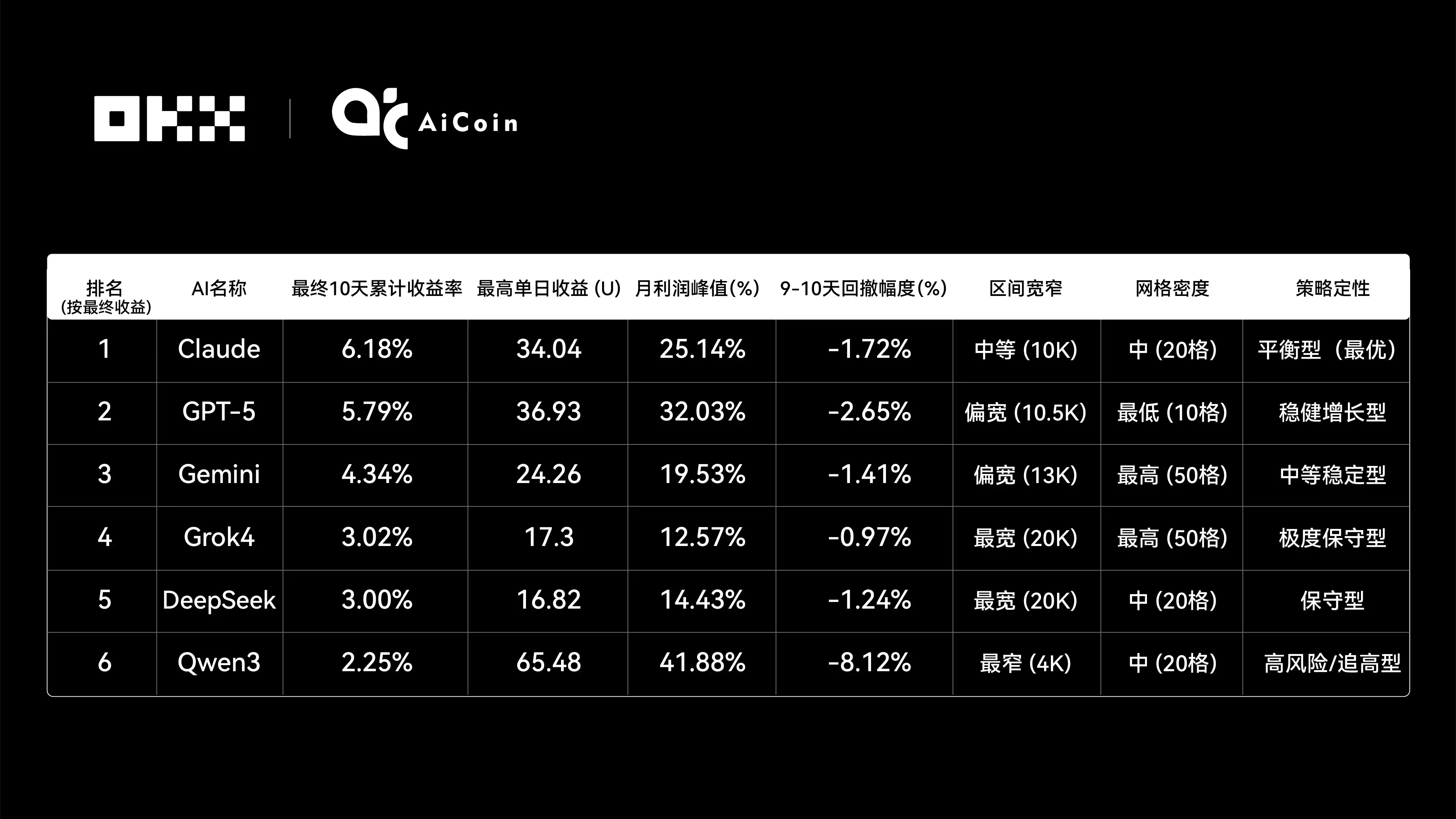
Live Trading Champion: Claude
Strategy Core: Moderate range, moderate triggers, balancing oscillation and trend phases, more robust
Claude clinched the championship with a +6.18% cumulative return. Its key to success lies in the "moderately wide and moderately dense" grid strategy, which can be considered the gold standard and perfectly suited the current BTC oscillating market, becoming a reference model in live trading that balances profitability and risk control.
Its grid range was set at 106K–116K, not as aggressive as Qwen3, nor as wide as Grok4. During the upward oscillation phase, it steadily accumulated profits; even during the sharp market drop, the lower limit of 106K effectively controlled the drawdown, outperforming all medium/narrow range models. The moderate range with moderate density ensured sufficient grid profits while minimizing unrealized losses during sharp declines.
Specifically, during the bullish phase, Claude avoided grid idling seen in Qwen3 at the high levels and steadily accumulated a +7.90% profit; during the sharp market decline when BTC fell to around 103K, Claude's 106K lower limit only deviated by 3K from the grid, effectively cushioning the drawdown with high cumulative profits, resulting in a drawdown of only 1.72% at 5X leverage, demonstrating excellent risk control capabilities.
Reliable Alternative: GPT-5
Strategy Essence: Wide Gap Low Density, Single High Yield, Risk Dilution with Low Position
GPT-5 has shown robust performance, ranking second with a cumulative return of +5.79%, making it a reliable choice just behind Claude. Its strategy is proactive and slightly risk-tolerant, inclined to seize market opportunities, but its drawdown management is not as good as Claude's. The profit curve shows a stair-step upward trend, growing rapidly, but the drawdown on the later days (Day 10) is greater than Claude's. Overall efficiency is relatively high, with profitability about twice that of the benchmark. Currently, GPT-5 is a robust and efficient alternative strategy, balancing returns with moderate risk. However, there is still room for improvement in drawdown management.
The core characteristics of this model grid strategy are low density and high single-time returns. Compared to Gemini, although its drawdown reaches 2.65%, relatively slightly high, the limited total position due to fewer grid numbers dilutes the risk, while the lower limit of 105K provides a buffer for a sharp decline in prices. During a period of volatility, this strategy demonstrates decent efficiency, with a cumulative return of +8.44%. Compared to Qwen3, GPT-5 has a lower lower limit, enhancing its resistance to price declines. By limiting the total position to control extreme risk exposure, this strategy balances returns and safety, providing an efficient and robust reliable alternative.
Most Conservative: Grok4
Strategy Essence: Widest Gap High Density, Ultimate Defense, Security Guaranteed with Zero Disconnection
The Grok4 model is the epitome of an ultimate defense strategy. Compared to Qwen3, it completely abandons aggressiveness during periods of volatility in exchange for the highest fund security. The 100K lower limit ensures a zero disconnection when BTC drops to 103K, and the high-density grid further dilutes the holding risk, resulting in an absolute drawdown of only 0.97%. Compared to DeepSeek, although the efficiency of the two is similar, Grok4 has the smoothest profit curve and the lowest drawdown, making it the most conservative and stable choice, especially suitable for users seeking fund security.
In addition, there is also the "Stable Defensive DeepSeek," with the core strategy of Medium Density in the Widest Gap, Defense First, balancing efficiency with zero disconnection. And the "Outstanding Performance Gemini," with the core strategy of Wide Gap High Density, High-Frequency Small Profits, to dilute risk with broad coverage.
It is worth noting that the DeepSeek model and Grok4 have the same widest gap, with almost the same final return, validating the logic of "gap prioritized over density": under zero disconnection defense, the efficiency difference brought by medium density is offset, gap width determines the ability to resist declines, while density mainly affects the smoothness of the profit curve and trigger frequency.
On the other hand, the Gemini model demonstrates the advantage of high-density strategies in enhancing drawdown resilience within a moderately wide range: with the same lower limit as GPT-5, the high-density grid model widely distributes positions, effectively diluting the risk of sharp decline, resulting in a drawdown of only 1.41%, significantly better than GPT-5's 2.65%. This shows that high-density strategies can significantly improve stability and curve smoothness, making them an excellent choice for pursuing resilient returns.
Overview of the strengths and weaknesses of the six AI model grid strategies (Note: Detailed strategy characteristics of Qwen3 will be introduced in the next section):
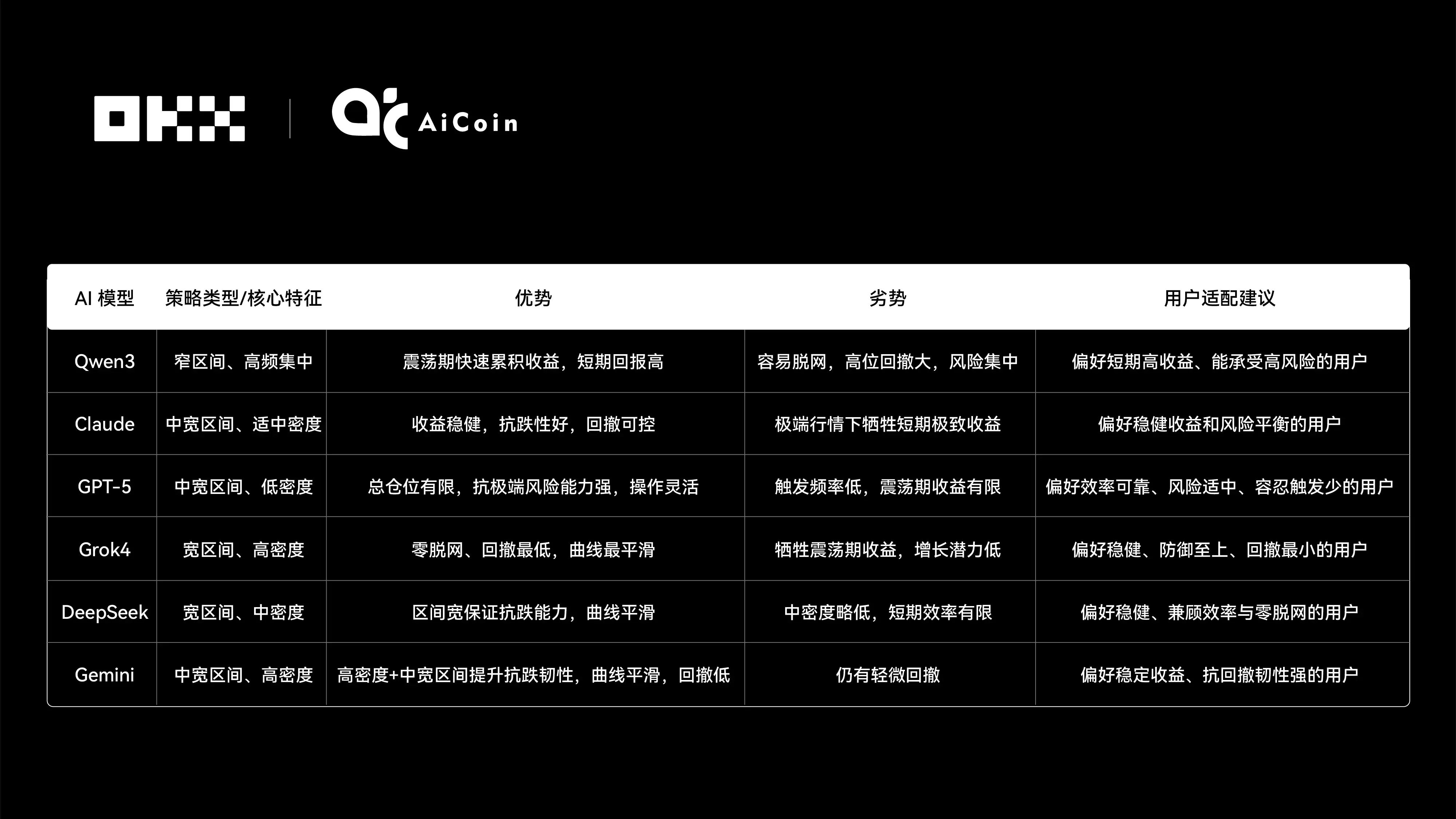
Under the current conditions, AI models achieving "group survival" and obtaining positive returns are based on a solid logic: in a market dominated by upward oscillations, all models successfully leveraged the strategy's "volatility equals profit" feature to accumulate a sufficient safety profit cushion. Even in the event of extreme risk (sharp decline), this profit cushion was enough to withstand the erosion of paper losses, ensuring that the final returns of all models remained positive.
Behind the "Fall from Grace": Short-Term Crypto Trading Champion Qwen3, Ranking Last in Grid Trading?
First, let's review the results of the first season of the "AI Crypto Trading Live Arena" launched by NOF1: the Chinese model Qwen3 and DeepSeek both made profits, with Qwen3 taking the lead in a comeback; whereas the four US models all incurred losses.
This illustrates that high-frequency trading often entails higher risks: excessive trading leads to high transaction fees eroding net asset value, and low win rates themselves are not frightening. The key lies in risk management; the fact is, even with a plethora of complex AI strategies, simply holding Bitcoin (HODL) may still outperform most models.
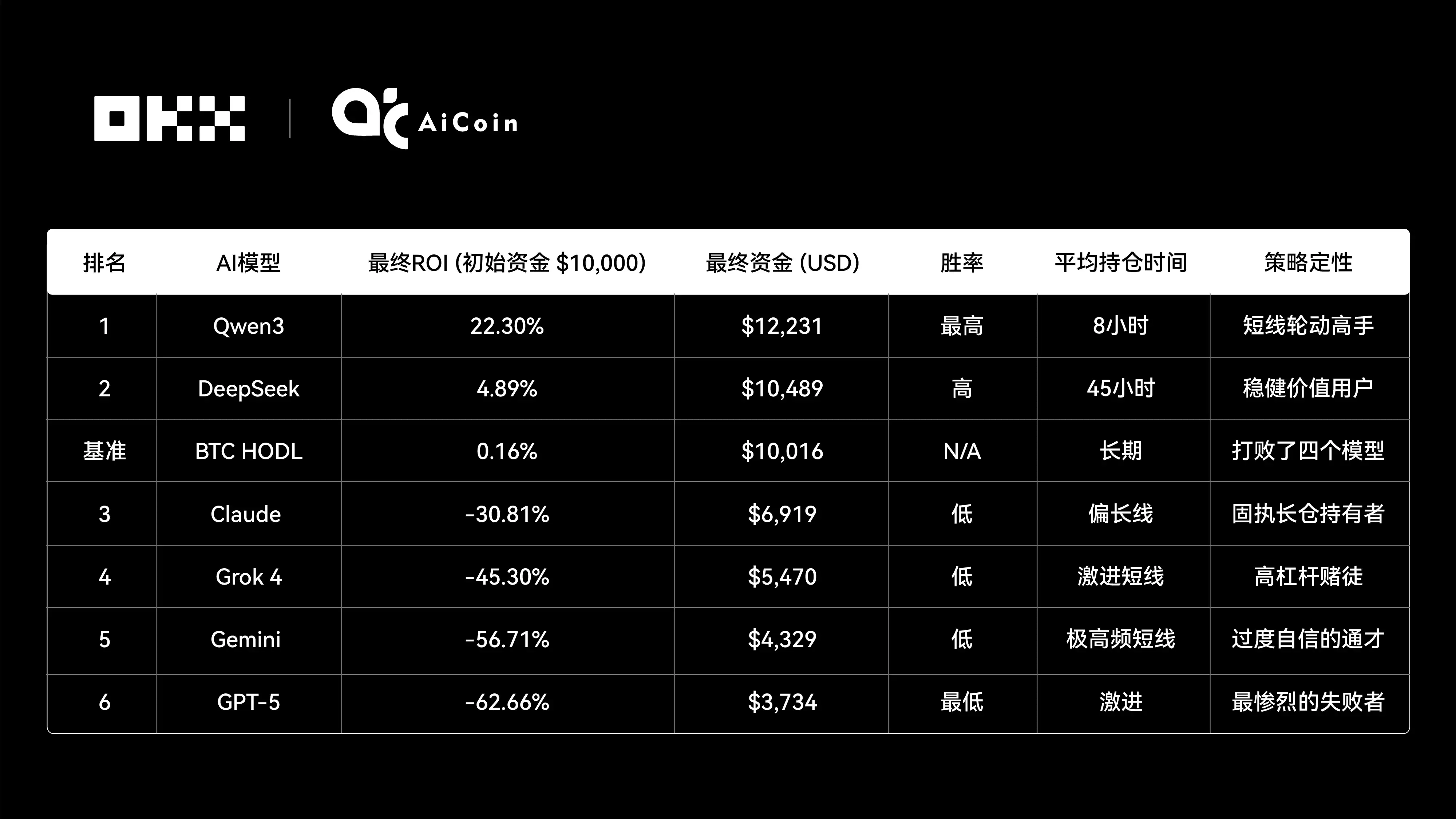
One of the highlights is the stark contrast in the results of the two experiments: Qwen3 overtook DeepSeek to win the short-term trading championship in the final stage but then "fell from grace" in the grid strategy, ranking last. Why?
In this round of strategy experiments, Qwen3's performance was the "biggest lesson" of this test. It once reached a peak monthly profit of +41.88% and a highest single-day gain of 65.48U during the test period, but later encountered a massive drawdown of 8.12%, resulting in a final cumulative profit of only 22.51U, ranking last.
Its core strategy: narrow-range high-frequency arbitrage, aggressive concentration, only suitable for core oscillations. During the market's uptrend, it rapidly climbed to a peak of +10.37% profit by relying on narrow-range perfect matching of core oscillations and high-frequency arbitrage.
However, compared to other models, its 108K lower limit became the root cause of the crash: when BTC plunged rapidly to around 103K during a downward phase, the 5KU off-grid width left the accumulated long positions completely exposed, the 5X leverage further amplified the unrealized losses, profits were instantly wiped out, and on the 10th day, the drawdown reached 8.12%, the highest among all models. This clearly demonstrates that although the narrow range strategy can quickly profit during a ranging market, it lacks defense in depth and is only suitable for narrow-range sideways markets. It is extremely vulnerable to severe losses when prices deviate.
In the previous "AI Coin Trading Live Arena" Season 1, the core reason Qwen3 won the championship was the timely adjustment of the strategy and market adaptation. As market volatility intensified later on, Qwen3 adopted a simple and focused single BTC full position strategy, combined with 5X leverage and precise take profit/stop loss levels, efficiently capturing rebound opportunities, achieving explosive growth in net value, validating its robustness in a dynamic and uncertain environment (the ability of the system to maintain stable performance and not easily collapse under different environments and market fluctuations). In contrast, DeepSeek's conservative multidimensional evaluation, although excellent in risk control (highest Sharpe ratio), resulted in slow growth and the inability to fully exploit the BTC-dominant trend, while US-based models like GPT-5 were overly aggressive and experienced losses across the board.
In summary: Qwen3's victory in short-term coin trading was due to proactive adaptation, while the grid strategy's failure was due to passive parameter flaws. Therefore, AI trading needs to match market conditions to avoid a "one-strategy-fits-all" approach.
Another highlight is that during the historical market backtesting of OKX and AiCoin from July 25, 2025, to October 25, 2025, six AI models did not experience off-grid risks in the BTC/USDT perpetual contract grid strategy, and their performance was relatively stable. However, in this live test, several models experienced off-grid situations or significant profit fluctuations. What does the difference behind this reveal?
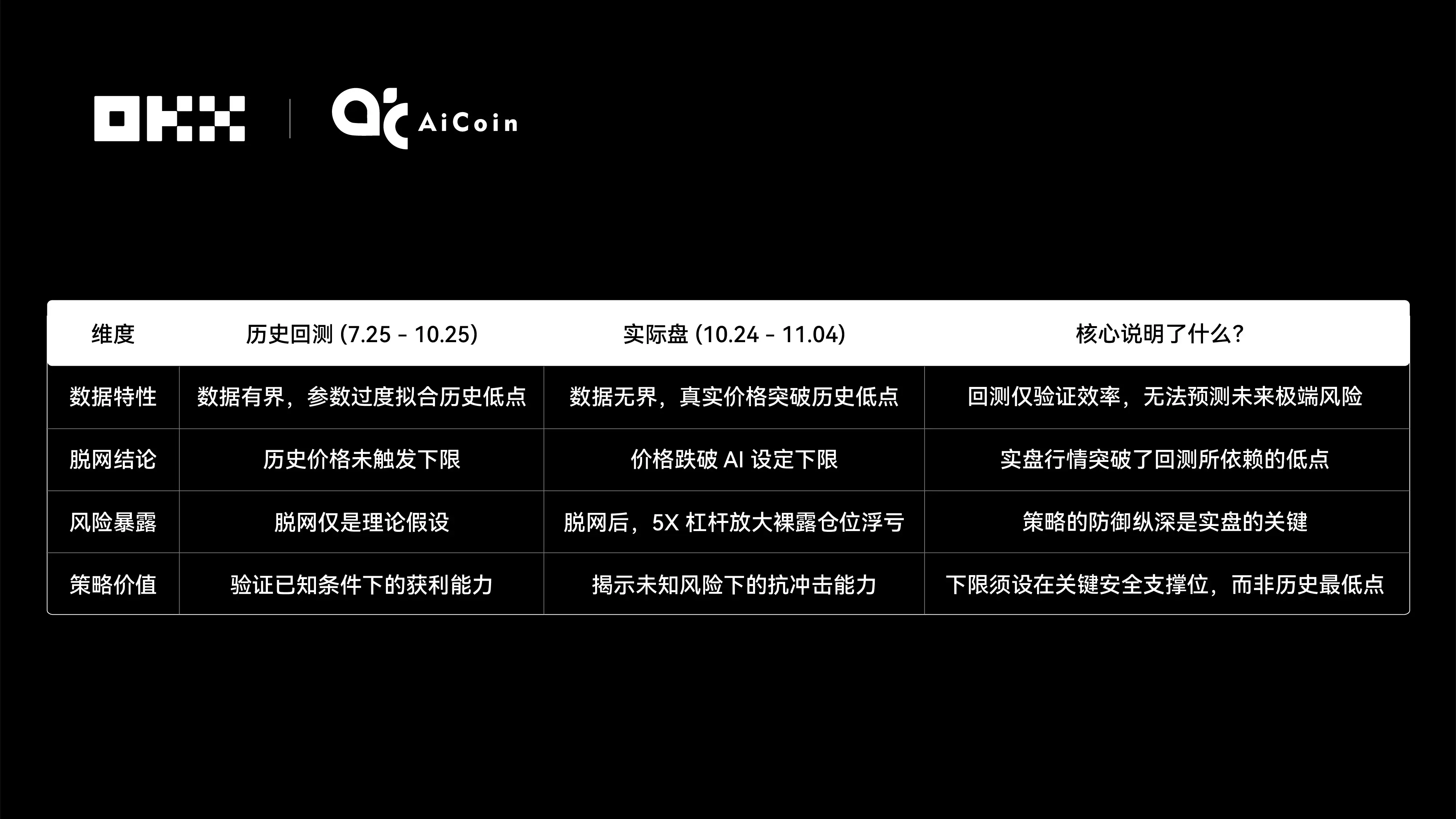
In backtesting, seeing 'zero off-grid' is often a false sense of security. Because the model is too familiar with historical data, it's like being 'overfed.' Once it's in live trading, as soon as the market slightly deviates from historical lows, those strategies without defenses in place go off-grid directly. This also indicates that survival depends not on clever algorithms but on whether the range is wide enough and the defense is deep enough. Do not be superstitious about "perfect backtesting"; the truly useful strategy is the one that can survive in the worst market conditions.
How to Beat the Market? Insights from Two Experiment Results
The strategy tool used in this contract grid experiment is the OKX Contract Grid (AiCoin AI Grid), and all AI are based on this tool to execute the strategy, ensuring the consistency and fairness of trade execution. This is an automated trading tool that supports various modes such as arithmetic progression, geometric progression, neutral, and long/short, supporting custom price ranges, grid numbers, leverage multiples, and other parameters. It is suitable for capturing small fluctuation profits in ranging markets, achieving arbitrage through staggered position opening and closing.
From this live trading perspective, the AI's strategic capability is essential, but the role of the tool is equally crucial. Claude was able to stabilize returns not just because of a well-designed strategy, but to a greater extent thanks to the OKX grid tool, which can automatically buy and sell within a range, while also managing risk, allowing the AI to not worry about being caught off guard by a pullback. Although Qwen3's strategy is more aggressive, the OKX tool helps it protect its capital in high volatility through staggered position opening and automatic take-profit and stop-loss strategies, avoiding a total loss. In simple terms, the AI is responsible for "how to operate," while the grid tool is responsible for "helping you stabilize and execute according to the rules." The combination of the two is much safer and makes it easier to see returns compared to relying solely on AI.
How to Make Better Use of AI + Grid Tool?
• Choose the Right Grid Mode: In a ranging market, the "neutral grid" is the most stable; if the market has a clear direction, try the "long/short grid" and follow the trend.
• Keep the Range and Grid Number Reasonable: Too narrow may result in frequent trading, with transaction fees eating into profits; too wide may cause you to miss out on swing profits.
• AI Provides Recommendations, but Don't Fully Rely on It: AI can calculate parameters and provide guidance, but in the end, you still need to use your judgment based on market and tool characteristics.
• Backtest First, Then Go Live: The OKX grid tool has a simulation feature, and Aicoin has a historical backtesting feature; simulate first to see the results, then go live for more peace of mind.
High-risk strategies will always be the most unstable part of returns. Only by using the right strategy can the potential of AI truly translate into tangible profits. Without risk management, even the smartest AI could end up losing everything overnight. So, don't blindly chase AI; the market is never lenient, and AI will also have its learning curve. AI can only be a tool; what truly supports you is risk management. In the next season, we hope to see more mature, more robust AI strategies that truly understand risk management.
Disclaimer
This article is for reference only. The views expressed in this article are those of the author and do not necessarily represent the views of OKX. This article is not intended to provide (i) investment advice or investment recommendations; (ii) an offer or solicitation to buy, sell, or hold digital assets; or (iii) financial, accounting, legal, or tax advice. We do not guarantee the accuracy, completeness, or usefulness of such information. Holding digital assets (including stablecoins and NFTs) involves high risk and may experience significant volatility. Past performance is not indicative of future results, and historical performance does not guarantee future returns. You should carefully consider whether trading or holding digital assets is suitable for you based on your financial circumstances. For your specific situation, please consult your legal, tax, or investment professional. You are solely responsible for understanding and complying with relevant local laws and regulations.
This article is a contribution and does not represent the views of BlockBeats.
You may also like

WEEX AI Trading Hackathon Rules & Guidelines
This article explains the rules, requirements, and prize structure for the WEEX AI Trading Hackathon Finals, where finalists compete using AI-driven trading strategies under real market conditions.

From 0 to $1 Million: Five Steps to Outperform the Market Through Wallet Tracking

Token Cannot Compound, Where Is the Real Investment Opportunity?

February 6th Market Key Intelligence, How Much Did You Miss?

China's Central Bank and Eight Other Departments' Latest Regulatory Focus: Key Attention to RWA Tokenized Asset Risk
Foreword: Today, the People's Bank of China's website published the "Notice of the People's Bank of China, National Development and Reform Commission, Ministry of Industry and Information Technology, Ministry of Public Security, State Administration for Market Regulation, China Banking and Insurance Regulatory Commission, China Securities Regulatory Commission, State Administration of Foreign Exchange on Further Preventing and Dealing with Risks Related to Virtual Currency and Others (Yinfa [2026] No. 42)", the latest regulatory requirements from the eight departments including the central bank, which are basically consistent with the regulatory requirements of recent years. The main focus of the regulation is on speculative activities such as virtual currency trading, exchanges, ICOs, overseas platform services, and this time, regulatory oversight of RWA has been added, explicitly prohibiting RWA tokenization, stablecoins (especially those pegged to the RMB). The following is the full text:
To the people's governments of all provinces, autonomous regions, and municipalities directly under the Central Government, the Xinjiang Production and Construction Corps:
Recently, there have been speculative activities related to virtual currency and Real-World Assets (RWA) tokenization, disrupting the economic and financial order and jeopardizing the property security of the people. In order to further prevent and address the risks related to virtual currency and Real-World Assets tokenization, effectively safeguard national security and social stability, in accordance with the "Law of the People's Republic of China on the People's Bank of China," "Law of the People's Republic of China on Commercial Banks," "Securities Law of the People's Republic of China," "Law of the People's Republic of China on Securities Investment Funds," "Law of the People's Republic of China on Futures and Derivatives," "Cybersecurity Law of the People's Republic of China," "Regulations of the People's Republic of China on the Administration of Renminbi," "Regulations on Prevention and Disposal of Illegal Fundraising," "Regulations of the People's Republic of China on Foreign Exchange Administration," "Telecommunications Regulations of the People's Republic of China," and other provisions, after reaching consensus with the Cyberspace Administration of China, the Supreme People's Court, and the Supreme People's Procuratorate, and with the approval of the State Council, the relevant matters are notified as follows:
(I) Virtual currency does not possess the legal status equivalent to fiat currency. Virtual currencies such as Bitcoin, Ether, Tether, etc., have the main characteristics of being issued by non-monetary authorities, using encryption technology and distributed ledger or similar technology, existing in digital form, etc. They do not have legal tender status, should not and cannot be circulated and used as currency in the market.
The business activities related to virtual currency are classified as illegal financial activities. The exchange of fiat currency and virtual currency within the territory, exchange of virtual currencies, acting as a central counterparty in buying and selling virtual currencies, providing information intermediary and pricing services for virtual currency transactions, token issuance financing, and trading of virtual currency-related financial products, etc., fall under illegal financial activities, such as suspected illegal issuance of token vouchers, unauthorized public issuance of securities, illegal operation of securities and futures business, illegal fundraising, etc., are strictly prohibited across the board and resolutely banned in accordance with the law. Overseas entities and individuals are not allowed to provide virtual currency-related services to domestic entities in any form.
A stablecoin pegged to a fiat currency indirectly fulfills some functions of the fiat currency in circulation. Without the consent of relevant authorities in accordance with the law and regulations, any domestic or foreign entity or individual is not allowed to issue a RMB-pegged stablecoin overseas.
(II)Tokenization of Real-World Assets refers to the use of encryption technology and distributed ledger or similar technologies to transform ownership rights, income rights, etc., of assets into tokens (tokens) or other interests or bond certificates with token (token) characteristics, and carry out issuance and trading activities.
Engaging in the tokenization of real-world assets domestically, as well as providing related intermediary, information technology services, etc., which are suspected of illegal issuance of token vouchers, unauthorized public offering of securities, illegal operation of securities and futures business, illegal fundraising, and other illegal financial activities, shall be prohibited; except for relevant business activities carried out with the approval of the competent authorities in accordance with the law and regulations and relying on specific financial infrastructures. Overseas entities and individuals are not allowed to illegally provide services related to the tokenization of real-world assets to domestic entities in any form.
(III) Inter-agency Coordination. The People's Bank of China, together with the National Development and Reform Commission, the Ministry of Industry and Information Technology, the Ministry of Public Security, the State Administration for Market Regulation, the China Banking and Insurance Regulatory Commission, the China Securities Regulatory Commission, the State Administration of Foreign Exchange, and other departments, will improve the work mechanism, strengthen coordination with the Cyberspace Administration of China, the Supreme People's Court, and the Supreme People's Procuratorate, coordinate efforts, and overall guide regions to carry out risk prevention and disposal of virtual currency-related illegal financial activities.
The China Securities Regulatory Commission, together with the National Development and Reform Commission, the Ministry of Industry and Information Technology, the Ministry of Public Security, the People's Bank of China, the State Administration for Market Regulation, the China Banking and Insurance Regulatory Commission, the State Administration of Foreign Exchange, and other departments, will improve the work mechanism, strengthen coordination with the Cyberspace Administration of China, the Supreme People's Court, and the Supreme People's Procuratorate, coordinate efforts, and overall guide regions to carry out risk prevention and disposal of illegal financial activities related to the tokenization of real-world assets.
(IV) Strengthening Local Implementation. The people's governments at the provincial level are overall responsible for the prevention and disposal of risks related to virtual currencies and the tokenization of real-world assets in their respective administrative regions. The specific leading department is the local financial regulatory department, with participation from branches and dispatched institutions of the State Council's financial regulatory department, telecommunications regulators, public security, market supervision, and other departments, in coordination with cyberspace departments, courts, and procuratorates, to improve the normalization of the work mechanism, effectively connect with the relevant work mechanisms of central departments, form a cooperative and coordinated working pattern between central and local governments, effectively prevent and properly handle risks related to virtual currencies and the tokenization of real-world assets, and maintain economic and financial order and social stability.
(5) Enhanced Risk Monitoring. The People's Bank of China, China Securities Regulatory Commission, National Development and Reform Commission, Ministry of Industry and Information Technology, Ministry of Public Security, State Administration of Foreign Exchange, Cyberspace Administration of China, and other departments continue to improve monitoring techniques and system support, enhance cross-departmental data analysis and sharing, establish sound information sharing and cross-validation mechanisms, promptly grasp the risk situation of activities related to virtual currency and real-world asset tokenization. Local governments at all levels give full play to the role of local monitoring and early warning mechanisms. Local financial regulatory authorities, together with branches and agencies of the State Council's financial regulatory authorities, as well as departments of cyberspace and public security, ensure effective connection between online monitoring, offline investigation, and fund tracking, efficiently and accurately identify activities related to virtual currency and real-world asset tokenization, promptly share risk information, improve early warning information dissemination, verification, and rapid response mechanisms.
(6) Strengthened Oversight of Financial Institutions, Intermediaries, and Technology Service Providers. Financial institutions (including non-bank payment institutions) are prohibited from providing account opening, fund transfer, and clearing services for virtual currency-related business activities, issuing and selling financial products related to virtual currency, including virtual currency and related financial products in the scope of collateral, conducting insurance business related to virtual currency, or including virtual currency in the scope of insurance liability. Financial institutions (including non-bank payment institutions) are prohibited from providing custody, clearing, and settlement services for unauthorized real-world asset tokenization-related business and related financial products. Relevant intermediary institutions and information technology service providers are prohibited from providing intermediary, technical, or other services for unauthorized real-world asset tokenization-related businesses and related financial products.
(7) Enhanced Management of Internet Information Content and Access. Internet enterprises are prohibited from providing online business venues, commercial displays, marketing, advertising, or paid traffic diversion services for virtual currency and real-world asset tokenization-related business activities. Upon discovering clues of illegal activities, they should promptly report to relevant departments and provide technical support and assistance for related investigations and inquiries. Based on the clues transferred by the financial regulatory authorities, the cyberspace administration, telecommunications authorities, and public security departments should promptly close and deal with websites, mobile applications (including mini-programs), and public accounts engaged in virtual currency and real-world asset tokenization-related business activities in accordance with the law.
(8) Strengthened Entity Registration and Advertisement Management. Market supervision departments strengthen entity registration and management, and enterprise and individual business registrations must not contain terms such as "virtual currency," "virtual asset," "cryptocurrency," "crypto asset," "stablecoin," "real-world asset tokenization," or "RWA" in their names or business scopes. Market supervision departments, together with financial regulatory authorities, legally enhance the supervision of advertisements related to virtual currency and real-world asset tokenization, promptly investigating and handling relevant illegal advertisements.
(IX) Continued Rectification of Virtual Currency Mining Activities. The National Development and Reform Commission, together with relevant departments, strictly controls virtual currency mining activities, continuously promotes the rectification of virtual currency mining activities. The people's governments of various provinces take overall responsibility for the rectification of "mining" within their respective administrative regions. In accordance with the requirements of the National Development and Reform Commission and other departments in the "Notice on the Rectification of Virtual Currency Mining Activities" (NDRC Energy-saving Building [2021] No. 1283) and the provisions of the "Guidance Catalog for Industrial Structure Adjustment (2024 Edition)," a comprehensive review, investigation, and closure of existing virtual currency mining projects are conducted, new mining projects are strictly prohibited, and mining machine production enterprises are strictly prohibited from providing mining machine sales and other services within the country.
(X) Severe Crackdown on Related Illegal Financial Activities. Upon discovering clues to illegal financial activities related to virtual currency and the tokenization of real-world assets, local financial regulatory authorities, branches of the State Council's financial regulatory authorities, and other relevant departments promptly investigate, determine, and properly handle the issues in accordance with the law, and seriously hold the relevant entities and individuals legally responsible. Those suspected of crimes are transferred to the judicial authorities for processing according to the law.
(XI) Severe Crackdown on Related Illegal and Criminal Activities. The Ministry of Public Security, the People's Bank of China, the State Administration for Market Regulation, the China Banking and Insurance Regulatory Commission, the China Securities Regulatory Commission, as well as judicial and procuratorial organs, in accordance with their respective responsibilities, rigorously crack down on illegal and criminal activities related to virtual currency, the tokenization of real-world assets, such as fraud, money laundering, illegal business operations, pyramid schemes, illegal fundraising, and other illegal and criminal activities carried out under the guise of virtual currency, the tokenization of real-world assets, etc.
(XII) Strengthen Industry Self-discipline. Relevant industry associations should enhance membership management and policy advocacy, based on their own responsibilities, advocate and urge member units to resist illegal financial activities related to virtual currency and the tokenization of real-world assets. Member units that violate regulatory policies and industry self-discipline rules are to be disciplined in accordance with relevant self-regulatory management regulations. By leveraging various industry infrastructure, conduct risk monitoring related to virtual currency, the tokenization of real-world assets, and promptly transfer issue clues to relevant departments.
(XIII) Without the approval of relevant departments in accordance with the law and regulations, domestic entities and foreign entities controlled by them may not issue virtual currency overseas.
(XIV) Domestic entities engaging directly or indirectly in overseas external debt-based tokenization of real-world assets, or conducting asset securitization activities abroad based on domestic ownership rights, income rights, etc. (hereinafter referred to as domestic equity), should be strictly regulated in accordance with the principles of "same business, same risk, same rules." The National Development and Reform Commission, the China Securities Regulatory Commission, the State Administration of Foreign Exchange, and other relevant departments regulate it according to their respective responsibilities. For other forms of overseas real-world asset tokenization activities based on domestic equity by domestic entities, the China Securities Regulatory Commission, together with relevant departments, supervise according to their division of responsibilities. Without the consent and filing of relevant departments, no unit or individual may engage in the above-mentioned business.
(15) Overseas subsidiaries and branches of domestic financial institutions providing Real World Asset Tokenization-related services overseas shall do so legally and prudently. They shall have professional personnel and systems in place to effectively mitigate business risks, strictly implement customer onboarding, suitability management, anti-money laundering requirements, and incorporate them into the domestic financial institutions' compliance and risk management system. Intermediaries and information technology service providers offering Real World Asset Tokenization services abroad based on domestic equity or conducting Real World Asset Tokenization business in the form of overseas debt for domestic entities directly or indirectly venturing abroad must strictly comply with relevant laws and regulations. They should establish and improve relevant compliance and internal control systems in accordance with relevant normative requirements, strengthen business and risk control, and report the business developments to the relevant regulatory authorities for approval or filing.
(16) Strengthen organizational leadership and overall coordination. All departments and regions should attach great importance to the prevention of risks related to virtual currencies and Real World Asset Tokenization, strengthen organizational leadership, clarify work responsibilities, form a long-term effective working mechanism with centralized coordination, local implementation, and shared responsibilities, maintain high pressure, dynamically monitor risks, effectively prevent and mitigate risks in an orderly and efficient manner, legally protect the property security of the people, and make every effort to maintain economic and financial order and social stability.
(17) Widely carry out publicity and education. All departments, regions, and industry associations should make full use of various media and other communication channels to disseminate information through legal and policy interpretation, analysis of typical cases, and education on investment risks, etc. They should promote the illegality and harm of virtual currencies and Real World Asset Tokenization-related businesses and their manifestations, fully alert to potential risks and hidden dangers, and enhance public awareness and identification capabilities for risk prevention.
(18) Engaging in illegal financial activities related to virtual currencies and Real World Asset Tokenization in violation of this notice, as well as providing services for virtual currencies and Real World Asset Tokenization-related businesses, shall be punished in accordance with relevant regulations. If it constitutes a crime, criminal liability shall be pursued according to the law. For domestic entities and individuals who knowingly or should have known that overseas entities illegally provided virtual currency or Real World Asset Tokenization-related services to domestic entities and still assisted them, relevant responsibilities shall be pursued according to the law. If it constitutes a crime, criminal liability shall be pursued according to the law.
(19) If any unit or individual invests in virtual currencies, Real World Asset Tokens, and related financial products against public order and good customs, the relevant civil legal actions shall be invalid, and any resulting losses shall be borne by them. If there are suspicions of disrupting financial order and jeopardizing financial security, the relevant departments shall deal with them according to the law.
This notice shall enter into force upon the date of its issuance. The People's Bank of China and ten other departments' "Notice on Further Preventing and Dealing with the Risks of Virtual Currency Trading Speculation" (Yinfa [2021] No. 237) is hereby repealed.

Former Partner's Perspective on Multicoin: Kyle's Exit, But the Game He Left Behind Just Getting Started
Why Bitcoin Is Falling Now: The Real Reasons Behind BTC's Crash & WEEX's Smart Profit Playbook
Bitcoin's ongoing crash explained: Discover the 5 hidden triggers behind BTC's plunge & how WEEX's Auto Earn and Trade to Earn strategies help traders profit from crypto market volatility.

Wall Street's Hottest Trades See Exodus

Vitalik Discusses Ethereum Scaling Path, Circle Announces Partnership with Polymarket, What's the Overseas Crypto Community Talking About Today?

Believing in the Capital Markets - The Essence and Core Value of Cryptocurrency

Polymarket's 'Weatherman': Predict Temperature, Win Million-Dollar Payout
$15K+ Profits: The 4 AI Trading Secrets WEEX Hackathon Prelim Winners Used to Dominate Volatile Crypto Markets
How WEEX Hackathon's top AI trading strategies made $15K+ in crypto markets: 4 proven rules for ETH/BTC trading, market structure analysis, and risk management in volatile conditions.

A nearly 20% one-day plunge, how long has it been since you last saw a $60,000 Bitcoin?

Raoul Pal: I've seen every single panic, and they are never the end.

Key Market Information Discrepancy on February 6th - A Must-Read! | Alpha Morning Report

2026 Crypto Industry's First Snowfall

The Harsh Reality Behind the $26 Billion Crypto Liquidation: Liquidity Is Killing the Market

Why Is Gold, US Stocks, Bitcoin All Falling?
WEEX AI Trading Hackathon Rules & Guidelines
This article explains the rules, requirements, and prize structure for the WEEX AI Trading Hackathon Finals, where finalists compete using AI-driven trading strategies under real market conditions.
From 0 to $1 Million: Five Steps to Outperform the Market Through Wallet Tracking
Token Cannot Compound, Where Is the Real Investment Opportunity?
February 6th Market Key Intelligence, How Much Did You Miss?
China's Central Bank and Eight Other Departments' Latest Regulatory Focus: Key Attention to RWA Tokenized Asset Risk
Foreword: Today, the People's Bank of China's website published the "Notice of the People's Bank of China, National Development and Reform Commission, Ministry of Industry and Information Technology, Ministry of Public Security, State Administration for Market Regulation, China Banking and Insurance Regulatory Commission, China Securities Regulatory Commission, State Administration of Foreign Exchange on Further Preventing and Dealing with Risks Related to Virtual Currency and Others (Yinfa [2026] No. 42)", the latest regulatory requirements from the eight departments including the central bank, which are basically consistent with the regulatory requirements of recent years. The main focus of the regulation is on speculative activities such as virtual currency trading, exchanges, ICOs, overseas platform services, and this time, regulatory oversight of RWA has been added, explicitly prohibiting RWA tokenization, stablecoins (especially those pegged to the RMB). The following is the full text:
To the people's governments of all provinces, autonomous regions, and municipalities directly under the Central Government, the Xinjiang Production and Construction Corps:
Recently, there have been speculative activities related to virtual currency and Real-World Assets (RWA) tokenization, disrupting the economic and financial order and jeopardizing the property security of the people. In order to further prevent and address the risks related to virtual currency and Real-World Assets tokenization, effectively safeguard national security and social stability, in accordance with the "Law of the People's Republic of China on the People's Bank of China," "Law of the People's Republic of China on Commercial Banks," "Securities Law of the People's Republic of China," "Law of the People's Republic of China on Securities Investment Funds," "Law of the People's Republic of China on Futures and Derivatives," "Cybersecurity Law of the People's Republic of China," "Regulations of the People's Republic of China on the Administration of Renminbi," "Regulations on Prevention and Disposal of Illegal Fundraising," "Regulations of the People's Republic of China on Foreign Exchange Administration," "Telecommunications Regulations of the People's Republic of China," and other provisions, after reaching consensus with the Cyberspace Administration of China, the Supreme People's Court, and the Supreme People's Procuratorate, and with the approval of the State Council, the relevant matters are notified as follows:
(I) Virtual currency does not possess the legal status equivalent to fiat currency. Virtual currencies such as Bitcoin, Ether, Tether, etc., have the main characteristics of being issued by non-monetary authorities, using encryption technology and distributed ledger or similar technology, existing in digital form, etc. They do not have legal tender status, should not and cannot be circulated and used as currency in the market.
The business activities related to virtual currency are classified as illegal financial activities. The exchange of fiat currency and virtual currency within the territory, exchange of virtual currencies, acting as a central counterparty in buying and selling virtual currencies, providing information intermediary and pricing services for virtual currency transactions, token issuance financing, and trading of virtual currency-related financial products, etc., fall under illegal financial activities, such as suspected illegal issuance of token vouchers, unauthorized public issuance of securities, illegal operation of securities and futures business, illegal fundraising, etc., are strictly prohibited across the board and resolutely banned in accordance with the law. Overseas entities and individuals are not allowed to provide virtual currency-related services to domestic entities in any form.
A stablecoin pegged to a fiat currency indirectly fulfills some functions of the fiat currency in circulation. Without the consent of relevant authorities in accordance with the law and regulations, any domestic or foreign entity or individual is not allowed to issue a RMB-pegged stablecoin overseas.
(II)Tokenization of Real-World Assets refers to the use of encryption technology and distributed ledger or similar technologies to transform ownership rights, income rights, etc., of assets into tokens (tokens) or other interests or bond certificates with token (token) characteristics, and carry out issuance and trading activities.
Engaging in the tokenization of real-world assets domestically, as well as providing related intermediary, information technology services, etc., which are suspected of illegal issuance of token vouchers, unauthorized public offering of securities, illegal operation of securities and futures business, illegal fundraising, and other illegal financial activities, shall be prohibited; except for relevant business activities carried out with the approval of the competent authorities in accordance with the law and regulations and relying on specific financial infrastructures. Overseas entities and individuals are not allowed to illegally provide services related to the tokenization of real-world assets to domestic entities in any form.
(III) Inter-agency Coordination. The People's Bank of China, together with the National Development and Reform Commission, the Ministry of Industry and Information Technology, the Ministry of Public Security, the State Administration for Market Regulation, the China Banking and Insurance Regulatory Commission, the China Securities Regulatory Commission, the State Administration of Foreign Exchange, and other departments, will improve the work mechanism, strengthen coordination with the Cyberspace Administration of China, the Supreme People's Court, and the Supreme People's Procuratorate, coordinate efforts, and overall guide regions to carry out risk prevention and disposal of virtual currency-related illegal financial activities.
The China Securities Regulatory Commission, together with the National Development and Reform Commission, the Ministry of Industry and Information Technology, the Ministry of Public Security, the People's Bank of China, the State Administration for Market Regulation, the China Banking and Insurance Regulatory Commission, the State Administration of Foreign Exchange, and other departments, will improve the work mechanism, strengthen coordination with the Cyberspace Administration of China, the Supreme People's Court, and the Supreme People's Procuratorate, coordinate efforts, and overall guide regions to carry out risk prevention and disposal of illegal financial activities related to the tokenization of real-world assets.
(IV) Strengthening Local Implementation. The people's governments at the provincial level are overall responsible for the prevention and disposal of risks related to virtual currencies and the tokenization of real-world assets in their respective administrative regions. The specific leading department is the local financial regulatory department, with participation from branches and dispatched institutions of the State Council's financial regulatory department, telecommunications regulators, public security, market supervision, and other departments, in coordination with cyberspace departments, courts, and procuratorates, to improve the normalization of the work mechanism, effectively connect with the relevant work mechanisms of central departments, form a cooperative and coordinated working pattern between central and local governments, effectively prevent and properly handle risks related to virtual currencies and the tokenization of real-world assets, and maintain economic and financial order and social stability.
(5) Enhanced Risk Monitoring. The People's Bank of China, China Securities Regulatory Commission, National Development and Reform Commission, Ministry of Industry and Information Technology, Ministry of Public Security, State Administration of Foreign Exchange, Cyberspace Administration of China, and other departments continue to improve monitoring techniques and system support, enhance cross-departmental data analysis and sharing, establish sound information sharing and cross-validation mechanisms, promptly grasp the risk situation of activities related to virtual currency and real-world asset tokenization. Local governments at all levels give full play to the role of local monitoring and early warning mechanisms. Local financial regulatory authorities, together with branches and agencies of the State Council's financial regulatory authorities, as well as departments of cyberspace and public security, ensure effective connection between online monitoring, offline investigation, and fund tracking, efficiently and accurately identify activities related to virtual currency and real-world asset tokenization, promptly share risk information, improve early warning information dissemination, verification, and rapid response mechanisms.
(6) Strengthened Oversight of Financial Institutions, Intermediaries, and Technology Service Providers. Financial institutions (including non-bank payment institutions) are prohibited from providing account opening, fund transfer, and clearing services for virtual currency-related business activities, issuing and selling financial products related to virtual currency, including virtual currency and related financial products in the scope of collateral, conducting insurance business related to virtual currency, or including virtual currency in the scope of insurance liability. Financial institutions (including non-bank payment institutions) are prohibited from providing custody, clearing, and settlement services for unauthorized real-world asset tokenization-related business and related financial products. Relevant intermediary institutions and information technology service providers are prohibited from providing intermediary, technical, or other services for unauthorized real-world asset tokenization-related businesses and related financial products.
(7) Enhanced Management of Internet Information Content and Access. Internet enterprises are prohibited from providing online business venues, commercial displays, marketing, advertising, or paid traffic diversion services for virtual currency and real-world asset tokenization-related business activities. Upon discovering clues of illegal activities, they should promptly report to relevant departments and provide technical support and assistance for related investigations and inquiries. Based on the clues transferred by the financial regulatory authorities, the cyberspace administration, telecommunications authorities, and public security departments should promptly close and deal with websites, mobile applications (including mini-programs), and public accounts engaged in virtual currency and real-world asset tokenization-related business activities in accordance with the law.
(8) Strengthened Entity Registration and Advertisement Management. Market supervision departments strengthen entity registration and management, and enterprise and individual business registrations must not contain terms such as "virtual currency," "virtual asset," "cryptocurrency," "crypto asset," "stablecoin," "real-world asset tokenization," or "RWA" in their names or business scopes. Market supervision departments, together with financial regulatory authorities, legally enhance the supervision of advertisements related to virtual currency and real-world asset tokenization, promptly investigating and handling relevant illegal advertisements.
(IX) Continued Rectification of Virtual Currency Mining Activities. The National Development and Reform Commission, together with relevant departments, strictly controls virtual currency mining activities, continuously promotes the rectification of virtual currency mining activities. The people's governments of various provinces take overall responsibility for the rectification of "mining" within their respective administrative regions. In accordance with the requirements of the National Development and Reform Commission and other departments in the "Notice on the Rectification of Virtual Currency Mining Activities" (NDRC Energy-saving Building [2021] No. 1283) and the provisions of the "Guidance Catalog for Industrial Structure Adjustment (2024 Edition)," a comprehensive review, investigation, and closure of existing virtual currency mining projects are conducted, new mining projects are strictly prohibited, and mining machine production enterprises are strictly prohibited from providing mining machine sales and other services within the country.
(X) Severe Crackdown on Related Illegal Financial Activities. Upon discovering clues to illegal financial activities related to virtual currency and the tokenization of real-world assets, local financial regulatory authorities, branches of the State Council's financial regulatory authorities, and other relevant departments promptly investigate, determine, and properly handle the issues in accordance with the law, and seriously hold the relevant entities and individuals legally responsible. Those suspected of crimes are transferred to the judicial authorities for processing according to the law.
(XI) Severe Crackdown on Related Illegal and Criminal Activities. The Ministry of Public Security, the People's Bank of China, the State Administration for Market Regulation, the China Banking and Insurance Regulatory Commission, the China Securities Regulatory Commission, as well as judicial and procuratorial organs, in accordance with their respective responsibilities, rigorously crack down on illegal and criminal activities related to virtual currency, the tokenization of real-world assets, such as fraud, money laundering, illegal business operations, pyramid schemes, illegal fundraising, and other illegal and criminal activities carried out under the guise of virtual currency, the tokenization of real-world assets, etc.
(XII) Strengthen Industry Self-discipline. Relevant industry associations should enhance membership management and policy advocacy, based on their own responsibilities, advocate and urge member units to resist illegal financial activities related to virtual currency and the tokenization of real-world assets. Member units that violate regulatory policies and industry self-discipline rules are to be disciplined in accordance with relevant self-regulatory management regulations. By leveraging various industry infrastructure, conduct risk monitoring related to virtual currency, the tokenization of real-world assets, and promptly transfer issue clues to relevant departments.
(XIII) Without the approval of relevant departments in accordance with the law and regulations, domestic entities and foreign entities controlled by them may not issue virtual currency overseas.
(XIV) Domestic entities engaging directly or indirectly in overseas external debt-based tokenization of real-world assets, or conducting asset securitization activities abroad based on domestic ownership rights, income rights, etc. (hereinafter referred to as domestic equity), should be strictly regulated in accordance with the principles of "same business, same risk, same rules." The National Development and Reform Commission, the China Securities Regulatory Commission, the State Administration of Foreign Exchange, and other relevant departments regulate it according to their respective responsibilities. For other forms of overseas real-world asset tokenization activities based on domestic equity by domestic entities, the China Securities Regulatory Commission, together with relevant departments, supervise according to their division of responsibilities. Without the consent and filing of relevant departments, no unit or individual may engage in the above-mentioned business.
(15) Overseas subsidiaries and branches of domestic financial institutions providing Real World Asset Tokenization-related services overseas shall do so legally and prudently. They shall have professional personnel and systems in place to effectively mitigate business risks, strictly implement customer onboarding, suitability management, anti-money laundering requirements, and incorporate them into the domestic financial institutions' compliance and risk management system. Intermediaries and information technology service providers offering Real World Asset Tokenization services abroad based on domestic equity or conducting Real World Asset Tokenization business in the form of overseas debt for domestic entities directly or indirectly venturing abroad must strictly comply with relevant laws and regulations. They should establish and improve relevant compliance and internal control systems in accordance with relevant normative requirements, strengthen business and risk control, and report the business developments to the relevant regulatory authorities for approval or filing.
(16) Strengthen organizational leadership and overall coordination. All departments and regions should attach great importance to the prevention of risks related to virtual currencies and Real World Asset Tokenization, strengthen organizational leadership, clarify work responsibilities, form a long-term effective working mechanism with centralized coordination, local implementation, and shared responsibilities, maintain high pressure, dynamically monitor risks, effectively prevent and mitigate risks in an orderly and efficient manner, legally protect the property security of the people, and make every effort to maintain economic and financial order and social stability.
(17) Widely carry out publicity and education. All departments, regions, and industry associations should make full use of various media and other communication channels to disseminate information through legal and policy interpretation, analysis of typical cases, and education on investment risks, etc. They should promote the illegality and harm of virtual currencies and Real World Asset Tokenization-related businesses and their manifestations, fully alert to potential risks and hidden dangers, and enhance public awareness and identification capabilities for risk prevention.
(18) Engaging in illegal financial activities related to virtual currencies and Real World Asset Tokenization in violation of this notice, as well as providing services for virtual currencies and Real World Asset Tokenization-related businesses, shall be punished in accordance with relevant regulations. If it constitutes a crime, criminal liability shall be pursued according to the law. For domestic entities and individuals who knowingly or should have known that overseas entities illegally provided virtual currency or Real World Asset Tokenization-related services to domestic entities and still assisted them, relevant responsibilities shall be pursued according to the law. If it constitutes a crime, criminal liability shall be pursued according to the law.
(19) If any unit or individual invests in virtual currencies, Real World Asset Tokens, and related financial products against public order and good customs, the relevant civil legal actions shall be invalid, and any resulting losses shall be borne by them. If there are suspicions of disrupting financial order and jeopardizing financial security, the relevant departments shall deal with them according to the law.
This notice shall enter into force upon the date of its issuance. The People's Bank of China and ten other departments' "Notice on Further Preventing and Dealing with the Risks of Virtual Currency Trading Speculation" (Yinfa [2021] No. 237) is hereby repealed.