
 Buy Crypto
- Markets
 Futures
- Spot
- Copy Trade
- Earn
- More
Crypto Market Macro Research: U.S. Government Shutdown Leads to Liquidity Crunch, Triggering Structural Shift in Crypto Market

Source: Huobi
Abstract
In November 2025, the crypto market experienced a structural inflection point: after the fiscal tide receded and interest rates peaked, liquidity flowed back to the private sector, risk assets diverged, the US Treasury General Account (TGA) remained inflow-only due to a US government shutdown, with the balance expanding from around $800 billion to over $1 trillion, effectively draining about $200 billion of liquidity from the market, intensifying funding stress in the banking system. BTC became a stable collateral layer, while ETH served as a settlement hub; incremental funds flowed towards a narrative of "Narrative x Technology x Distribution" to L2, AI/Robotics/DePIN/x402, InfoFi, DAT, and Presales, Memecoins. Total market capitalization decline corresponded with a decrease in the fear index, indicating a mid-term turnover and value allocation zone. The main risks lie in regulatory uncertainty, on-chain complexity and multi-chain fragmentation, information asymmetry, and emotional spiral. The next 12 months will be a period of "structural bull" rather than a broad-based bull run, focusing on mechanism design, distribution efficiency, and attention operations; prioritize disciplined allocation around the main themes such as AI x Crypto, DAT, etc., through early-stage distribution and closed-loop execution.
I. Macro Economic Overview
In November 2025, the global crypto market is at a structural inflection point: not a full-fledged new bull run, nor a defensive posture in a downward abyss, but a key window for "moving from virtual to real, returning from narrative to technology, and shifting from pure speculation to structural participation." The root cause driving this inflection is not in a single price or single policy, but in the overall switch of the macro paradigm. Over the past two years, the post-pandemic era's demand management dominated by fiscal expansion has gradually receded, the neutral tightening cycle of monetary policy has significantly peaked, the direct traction of liquidity by the government has weakened, and the private sector has regained dominance in capital allocation. The reassessment of the new technology narrative and production functions has begun to influence the underlying logic of asset pricing. The policy focus has shifted from "subsidies and transfer payments driving nominal demand" to "efficiency and technological progress driving potential growth rates." In this transition, the market is willing to pay a premium for assets with "verifiable cash flow and technological growth curves," while targets relying on "high leverage, strong pro-cyclical trends, and valuation expansion alone" appear more cautious.
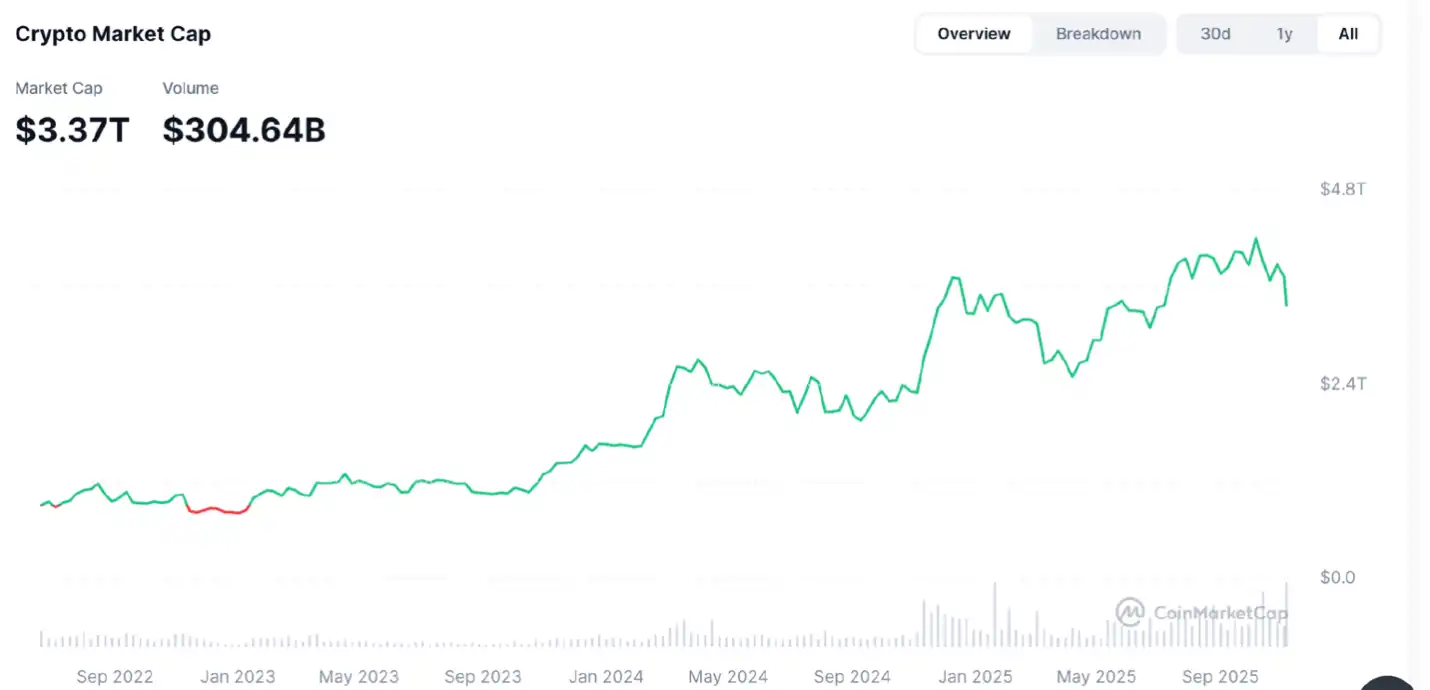
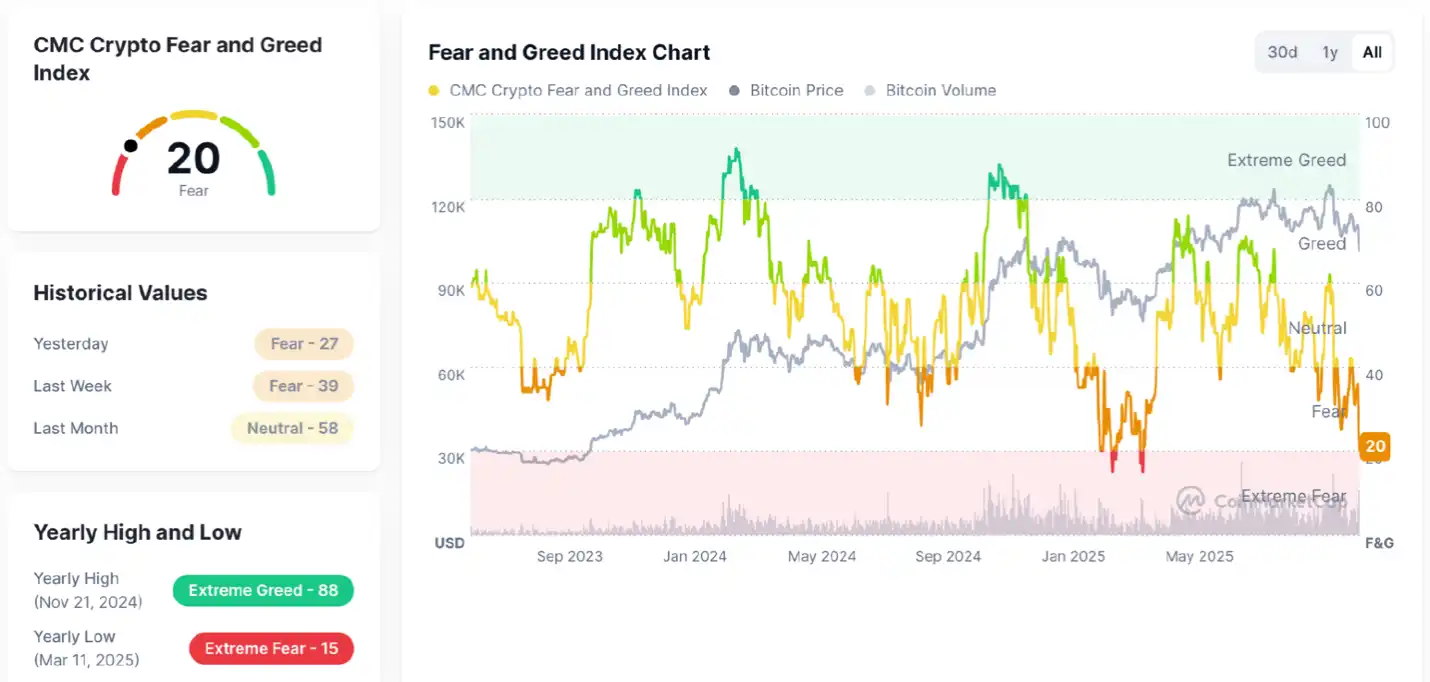
According to the latest data, the current total market capitalization of the crypto market is about $3.37 trillion, experiencing a retreat from previous highs, indicating fund outflows in a phase and reduced risk appetite; coupled with the fear index falling to 20 (fear), indicating weak sentiment. Overall, the market is still in a mid-term pullback within the long-term uptrend: the uptrend from 2023 to 2025 remains intact, but short-term uncertainties in macro expectations, profit-taking, and liquidity contraction have led the market into a phase of consolidation and digestion. In general, the trend is not bad, sentiment is cooling, in the "fear pullback zone," more like a turnover and divergence period in the bull market.
The current Cryptocurrency Market Sentiment Index (Fear & Greed Index) is 20, indicating a significant level of fear, continuing to weaken compared to last week and last month. Combining this with the chart, it can be observed that the price of Bitcoin has experienced a high-level pullback over the past few months, with market sentiment swiftly shifting from "greed" to "fear," accompanied by a decrease in trading volume, indicating a wait-and-see attitude towards funds and reduced risk appetite. However, this area has simultaneously returned to a historical mid-term bottom or value accumulation range—worse sentiment often signals the start of long-term fund accumulation. In other words: short-term pessimism and volatility intensify; in the medium to long term, for contrarian funds, the fear zone often breeds opportunities.
From a macroeconomic perspective, taking the United States as an example, following the Fed's aggressive rate hikes from 2023 to 2025, although inflation has not fully returned to its long-term anchor point, the marginal stickiness of core prices, supply-side repairs, and a decline in inventory cycles have collectively contributed to a structural easing of inflation. Policy communication has transitioned from a "higher for longer" hawkish signal to a "data-dependent wait-and-slightly-loose" path, causing the interest rate expectations curve to shift downward. Meanwhile, the U.S. Treasury has engaged in a "second correction" to the aftermath of large-scale deficits and short-duration issuance during the pandemic: budget constraints are tightening, term structure is being optimized, and marginal reductions in subsidies and transfers imply a flow of liquidity from the public sector back to the private sector. This flow, however, is not unconditional flooding but rather a redistribution through market-driven credit and stock-bond risk premiums into more efficient and growth-oriented asset categories. On the other hand, the U.S. government's shutdown is creating a historic record, with the U.S. Treasury's General Account (TGA) being unable to outflow due to the government shutdown issue, causing the balance to swell from around $800 billion to over $1 trillion, essentially withdrawing about $200 billion in liquidity from the market, exacerbating funding stress in the banking system. This explains why traditional markets are experiencing pressure in high leverage cycle assets, while underlying technology, AI chains, and digital infrastructure are receiving a higher "valuation tolerance": the former relies on low rates and high nominal demand tailwinds, while the latter relies on production function improvements and total factor productivity leaps, shifting favor from "price-driven" to "efficiency-driven."
This macro shift is manifested in asset differentiation: on one hand, the tail impact of high interest rates persists, with credit spreads not converging to extremely low levels; funds are still keeping their distance from targets without profit support, uncertain future cash flows, and high leverage on their balance sheets. On the other hand, sectors with visible cash flows, high demand elasticity, and technology-curve alignment are receiving active fund allocations. Translated into crypto assets, this shift is moving from the previous "Bitcoin unilateral blood-sucking rise" single-core logic to a multi-core logic of "Bitcoin stability - fund sinking - narrative rotation acceleration." With Bitcoin's increased institutional ownership, improved spot ETF channels, and optimized on-chain derivative structures, volatility has significantly diminished, gradually taking on the role of a "risk-free collateral base": not an absolute risk-free asset but rather the "most liquid, transparent trading, and most stable collateral" relative to the entire market. Ethereum has not experienced a breakout equivalent to Bitcoin's, but its systemic importance in settlement layers and developer ecosystems has positioned it to play a role as a "risk liquidity drain" - when market risk appetite returns, funds no longer stay in large market cap assets but flow through ETH and L2 to earlier and more elastic ecosystem assets. Therefore, the most prominent structural trend in November can be summarized using three sets of inequalities: rotation> clustering, active participation> passive holding, hotspot capture> large market value waiting. Funds' behavior has shifted from "waiting for opportunities to come" to "organized pursuit"; the key trading ability has transitioned from "value discovery" to "narrative identification + liquidity tracking + mechanism anticipation." Within all narratives, the most substantial additions are gained by simultaneously meeting the demands of "technology-driven and attention momentum": Layer-2, due to its high rate of new listings per unit of time, cost advantage, and incentive design, has become the most effective "innovation distribution channel"; AI/Robotics/DePIN, due to their connection with real production functions and their association with the machine-to-machine (M2M) economy, possess early-stage high "curve convexity"; InfoFi, as an exploration of knowledge and data value monetization, aligns with the era's law of "attention as a scarce element"; Memecoins represent the ultimate interpretation of "attention monetization," enabling rapid monetization of emotions and social capital at very low friction costs; NFT-Fi has transitioned from "avatar hype" to a more practical paradigm of "on-chain rights and cash flow," using financial structured tools to release new scenarios for collateral, leasing, and revenue sharing; while Presales stay in a sweet spot of "low valuation - weak distribution - high return convexity," representing the most cost-effective high volatility factor in risk budgets. The shared core that runs through these directions is the convergence of attention, developer contribution, incentive mechanism, and narrative consistency into a unified force: attention provides visibility and chip relay, developer contribution determines the sustainability of the supply curve, incentive mechanisms resolve the cold start in the expansion stage, and narrative consistency aligns expectations with the realization path, thereby reducing the discount rate.
From a more macro perspective, the medium to long-term return potential of traditional financial assets is constrained in two dimensions: first, while bond yields have peaked, they remain at elevated levels, compressing the valuation elasticity of equity assets; second, global real growth momentum is weaker than in the previous cycle, and corporate profit expansion relies more on efficiency gains rather than price increases. In comparison, Crypto's advantage lies in the fact that the "technology cycle is synchronous with the financial innovation cycle": on one hand, the on-chain infrastructure has seen a comprehensive improvement in performance, cost, and development tools, significantly reducing the marginal cost of applications and the trial and error radius; on the other hand, tokenization mechanisms and incentive engineering provide a "capital-user-developer" consensus coordinator, thereby addressing the cold start problem of the Internet era on-chain in a measurable, iterative, and distributable manner. In other words, the risk premium of crypto assets is no longer solely driven by volatility and leverage, but rather depends more on "whether mechanism design can transform attention, data, and computing power into realizable cash flow." When this is combined with the structured release of macro liquidity, Crypto's risk-adjusted return curve demonstrates a relative advantage over traditional assets. In terms of the monetary environment, the market is undergoing a transition from "nominal loose expectations" to "actual neutrality" and further to "structural local looseness." The direction of policy rates is no longer unilaterally tightening, the structure of government bond supply is more refined, marginal improvements in credit conditions are driving down private sector financing costs, refinancing pressures on existing assets are easing, and the tech and innovation chain has become the primary beneficiary of capital inflows. This rhythm signifies that Crypto is entering the "risk preference restoration" early to middle stage—different from the rapid rallies of the past that relied solely on quantitative easing, this round is more like an endurance race propelled by "technological progress + narrative evolution + mechanism optimization" together: the uptrend is not "a single breakthrough," but rather "multi-core driven, segmented advancement." Therefore, the most visible market manifestation is not "Bitcoin skyrocketing alone," but rather "BTC holding the base, ETH maintaining the hub, L2/AI/InfoFi/NFT-Fi/Memecoin cluster rotation." In this landscape, the main theme is "early positioning—partial realization—rebalancing," and the logic of "sticking to one track forever" is losing its marginal effectiveness, requiring funds to have the strategic ability to "fight to sustain."
Overall, the macro transmission chain of this stage can be described as: fiscal ebb and deficit governance → liquidity returning to the private sector → declining rate expectations and credit condition repair → fund preference for "efficiency and curve convexity" → higher tolerance for technical narratives → the crypto market transitioning from single-core to multi-core → structural rotation becoming dominant. As of November, our assessment is that global macro conditions have not fully transitioned to looseness, but structured incremental liquidity is being released. Combined with the critical breakthrough of the technology cycle and the maturity of distribution mechanisms, the mid-term pattern of crypto assets has shifted from being "driven by a single market" to "coexisting with a narrative of the masses." The typical characteristic is a "partial bull·structural bull"—its sustainability does not rely on the weekly chart of a single asset but on the mutual validation of multiple subsystems in the ecosystem: developer retention and toolchain enhancement validate the supply, user growth and fee curve validate the demand, incentive budget and governance improvement validate the mechanism, cross-chain settlement and compliance channels validate the funding sources. Under these conditions of continuous positive feedback from these variables, the market is healthier, more diversified, and more in need of professional and disciplined "active participation." Therefore, grasping the key points of this stage is not about speculating on "which coin will be the next breakout," but rather establishing an integrated framework of "macro—narrative—mechanism—liquidity—distribution": identifying the directional changes of rates and deficits at the macro level, judging whether the technical curve is in sync with the demand side at the narrative level, reviewing the sustainability of incentive design at the mechanism level, tracking the real migration of fees, liquidity provision, and social flows at the liquidity level, and evaluating the comprehensive efficiency of pre-sale—airdrop—listings—rankings—NFT-Fi—social media matrix at the distribution level. Only under the premise of a closed-loop framework can the three sets of inequalities "rotation> clustering, active> passive, hotspots> large caps" not become mere slogans, but transform into an executable, traceable, and reusable strategic methodology.
2. Track Analysis and Macro Outlook
As we enter the cryptocurrency market of 2025-2026, the most critical driver has quietly undergone a structural transformation. While interest rates and macro variables still constitute the market's underlying beta, the true sources of significant excess returns have shifted from "macro sentiment → asset pricing" to a triple resonance of "narrative × technology × distribution mechanism." The characteristics of the new cycle include accelerated evolution of the technological foundation, shortened narrative propagation pathways, and more decentralized fund distribution, thereby bringing unprecedented price elasticity and style rotation speed. In this context, Presales, Memecoins, AI×Robotics×DePIN×x402, InfoFi, and DAT (Digital Asset Treasury) are set to become the most directionally significant themes in the next 6-18 months.
Presales will be the clearest and most structurally rewarding opportunity window in the coming year. Its advantage does not stem from traditional "undervaluation" but rather from the temporal and distribution structures. Due to tokens having a relatively low valuation in the early stages, market information being relatively opaque, and high entry barriers, significant information and execution gaps spill over. Many know about a certain project but cannot secure an allocation; secure an allocation but do not know how to complete distribution or reinvest post TGE; know how to exit but cannot find a new entry point in the next round. The true α lies not in "knowing" but in the complete chain of "knowing → securing → exiting → reinvesting." Whether it's L2 asset issuance, AI-native projects, InfoFi builders, or Meme language experiments, their early stages will all release a 20x to 50x profit potential in the presale phase. The key to presales is not in "making the right call" but in deeply embedding into information networks, fund networks, and distribution networks, transforming informational advantages into executable profit cycles. This means that in the new cycle, outstanding participants are not just researchers but also executors. Alongside presales, Memecoins are accompanied by eternal narratives. Meme has never been about value investment but rather the embodiment of attention economy and narrative arbitrage, serving as the most agile α carrier in the crypto space. Over the past two cycles, we have clearly seen the battlefield transition: 2021 on BSC, 2023-2024 on Solana, and now in 2025 entering the bipolar era of Solana and Base. The logic is very simple: the faster, cheaper, and more community-mobilizing the chain is, the more suitable it is for Meme execution. The core of Meme is not "what it is" but "who is talking about it, who is promoting it, who is distributing it," forming a rapid cycle of "narrative → attention → liquidity → pullback → restructuring." Once a breakout narrative is formed, assets can experience significant price surges within weeks and swiftly complete distribution. Its essence lies in the market achieving consensus on a symbol in a short time and carrying out concrete speculative activities on the chain. Despite the extremely high risk, its high agility, high iteration, and high bursts make it an expressive format that is hard to ignore in each cycle.
Compared to the aforementioned tactics-oriented track, AI×Robotics×DePIN×x402 represents the most deterministic technological theme of the new era, which will give rise to a long-term trend similar to Bitcoin in its early days. The value of AI has never been limited to cognition itself but lies in its role as an economic entity entering the production system. When AI models evolve into autonomous action units (Agents) capable of executing tasks on-chain, signing transactions, settling, and self-maintaining, machines will become economic units, thus forming a "Machine-to-Machine (M2M)" economic structure. Blockchain provides machines with identity, settlement, and incentive systems, granting them permission to participate in the economic cycle. The significance of x402 lies in creating an automated payment and settlement infrastructure native to the Internet, allowing AIs to exchange value with each other, leading to the emergence of new asset forms such as machine wallets, on-chain rental markets, robot asset ownership, automatic revenue, among others. The current stage is still very early, and business models have not yet taken shape. However, it is precisely because of this that there is a huge expectation gap, making it the most promising intersection of "Technology × Finance" in the coming years. Key assets such as CODEC, ROBOT, DPTX, BOT, EDGE, PRXS, etc., are all being developed around machine identity, computing power incentives, AI agent economy, and other directions. AI×Crypto is essentially unaffected by regulatory cycles as it is driven by technological expansion rather than policy will. This means that it will become a structural trend on the level of the "birth of the Internet" or "widespread adoption of smartphones." Meanwhile, InfoFi (Knowledge Finance) has become the most creative narrative of the new era. It is not just "selling information" but transforming knowledge contribution, validation, and distribution into measurable, incentivizable economic behavior. In traditional Internet settings, the economic return on information is mostly captured by platforms. However, in InfoFi, contributors, validators, and distributors can all gain equity, forming a "win-win-win" structure. Its core mechanism is: Contribute → Validate → Rank → Reward. Once value is expressed on-chain, it becomes an asset form that is tradable and combinable, resulting in a new market structure that combines Crypto versions of TikTok (traffic), Bloomberg (analysis), and DeFi (incentives). It addresses the issues of high information noise and incentive distortion in Web2 and opens up the possibility for analysts, evaluators, and organizers to profit. Typical platforms include wallchain, xeetdotai, Kaito, cookie3, etc., transforming information from "private intellectual assets" to "public digital rights," marking a highly noteworthy narrative intersection.
Of particular emphasis is the DAT (Digital Asset Treasury) direction, commonly referred to in the market as the "Crypto-equity" track, which will be one of the structural investment themes in the next 6–18 months. The core logic of DAT does not rely on business operations but rather imports the valuation of on-chain assets into the traditional capital market through a listed company shell + crypto asset positions. The principle is as follows: Companies allocate cash assets to mainstream crypto assets such as BTC, ETH, SOL, SUI, etc., manage assets through position market value, Staking rewards, derivative strategies, and reflect the market value in the company's stock price, thus establishing a cross-market price transmission from "on-chain assets → secondary stock market." MSTR (MicroStrategy) is the earliest example, and starting in 2025, the SUI Treasury Company SUIG will become the new representative. Holding over 100 million SUI, with a market value of approximately 300–400 million USD, overlaying the ecosystem narrative with "listed company + treasury strategy" to provide investors with a new asset allocation method. The advantage of DAT is that, on one hand, it can provide a compliant bridge for traditional funds to enter the crypto market, and on the other hand, it can map the Crypto Narrative to the TradFi pricing system, forming a new bidirectional fund cycle between "Web3 assets → Nasdaq consensus." In the next 6–18 months, DAT will revolve around the "SUI, SOL, and AI Narrative," with potential directions including treasury structure optimization, Staking revenue growth, asset diversification (BTC, ETH), and L1/L2 strategic synergy. Such assets possess a composite attribute of "bullish ecosystem + bullish token + bullish risk premium" and are highly penetrative new capital tools.
Overall, the future theme of the crypto market is "Narrative Rotation × Distribution Efficiency × Execution Capability." Presales and Memes provide high-frequency α, AI×Crypto provides long-term β overlay structural α, InfoFi restructures the value capture mechanism, and DAT establishes a capital bridge between Web3 and traditional finance. The winners of the new cycle will not be the "most knowledgeable people," but those who complete the cycle of cognition → participation → distribution → reinvestment. Information is not an asset; execution and circulation are the assets. The true growth model is to achieve capital compounding through continuous participation in the early stage, binding distribution systems, and completing capital compounding in the narrative cycle. In the next 6–18 months, the crypto market will transition from "macro-driven" to "technology- and narrative-driven." This is not a period that only requires patience but one that requires action. Narrative × Technology × Distribution will shape the next generation of winners, and the acceleration structure has already been initiated.
III. Risks and Challenges
Looking ahead to the next year, while the structural opportunities in the crypto market are clear, the macroeconomic environment still faces unavoidable external risks and systemic challenges. These variables not only determine the pace of liquidity release but will also deeply influence narrative intensity, asset valuation, and the boundaries of industry expansion. The greatest uncertainty comes from regulatory issues, on-chain operational complexity, multi-chain fragmentation, user cognitive costs, narrative pace, and information structure asymmetry, with an underlying mismatch between institutions and retail investors creating inherent barriers to strategic competition. In a long-term structural bull market context, these risks do not necessarily hinder trends but will determine the steepness of the yield curve and the range of volatility.
Regulation has always been a key variable affecting the long-term resilience of crypto assets. Although the relaxation trend in policies led by the approval of spot ETFs in the United States has released some positive signals, the regulatory framework still exhibits fragmented, multi-centered, and lagging characteristics, with legislative efforts struggling to keep pace with asset growth. For institutions, regulatory clarity determines the allocation ceiling; for retail investors, the regulatory direction affects confidence and risk appetite. Frictions in Europe and the U.S. regarding exchange regulation, anti-money laundering, custody standards, and DeFi compliance responsibilities are difficult to reconcile in the short term, leading to potential localized policy headwinds or breakpoints. On the other hand, the Asian market is relatively positive in advancing licensing systems and regulatory sandboxes, but structurally it also goes through a cycle of "increased openness—regulatory exploration—institutional caution—application exploration." It can be foreseen that regulatory uncertainty will continue to affect cross-border capital flows, maintaining the market's pricing hierarchy between "compliant assets" and "gray assets." This means that, in the next year, although there will be no systemic regulatory shocks, the gradual constraints of regulations will become a valuation suppression force, especially for assets with high volatility, untraceability, and unclear structural returns.
The complexity of on-chain operations also constrains mass adoption. Despite significant progress in development tools and user experience over the past two years, on-chain interaction still involves multiple steps and barriers: signing, authorization, cross-chain transactions, Gas management, risk assessment still require active user engagement; although wallet logic has been improved, it has not yet achieved the implicit flow experience of Web2. For on-chain applications to achieve "Internet-scale," the vast majority of users need to be seamlessly onboarded, rather than relying on a recognized user base. Currently, the interaction between wallets and protocols still leans toward engineering language, requiring users to go through multiple steps such as "wallet-signing-Gas-risk-execution"; any error in any step can lead to loss, and the existing protection system is still difficult to provide complete coverage. In other words, the complexity of operations leads to an underestimation of the real market participants; this means that under narrative-driven circumstances, real funds cannot quickly convert into active users, creating a bottleneck in the "traffic-value" conversion. For project teams, this is a constraint on growth and distribution capabilities; for investors, it is a delay factor in narrative realization; for institutions, it is the source of increased difficulty in compliance operations and user protection. Multi-chain parallelism has accelerated competition but also fragmentation. The explosion of Layer 2 has brought ecosystem prosperity, but at the same time, it has led to funds and users being dispersed across multiple execution environments, with different standards between ecosystems, incomplete data interoperability, and cross-chain asset bridging facing bridge risks, ultimately increasing systemic uncertainty. Due to liquidity fragmentation, single-chain ecosystems find it difficult to form an accelerating cycle of "scale-depth-innovation," while cross-chain bridges create a security gap in the market. Most of the major hacking incidents in recent years have been related to cross-chain components, making it difficult for institutions to use cross-chain assets and retail investors hesitant to bear cross-chain liquidity migration risks, resulting in structural inefficiencies. Meanwhile, multi-chain has brought narrative overload, causing users to be unable to quickly determine the real connection between "ecosystem-assets-mechanisms," leading to distracted attention, high research costs, and further increasing information asymmetry.
User understanding cost remains an inherent obstacle to industry development. From payment logic, asset management, risk models, incentive design to narrative judgment, crypto not only requires users to have financial literacy but also requires them to understand cryptography, game theory, economic mechanisms, and other factors. The industry still lacks mature financial education and mechanism transparency, resulting in the majority of participants still entering with a "speculative mindset," making it difficult to form a stable participation structure. Under the rapid iteration of narratives, user education lags at any time, making recognized participants beneficiaries, while low-recognized participants are more likely to become liquidity providers. The heavier the cognitive burden, the greater the centralization risk. If funds are not evenly distributed, a barbell structure will emerge: one end is elite executors, and the other end is blindly participating individuals lacking knowledge, leading to a severe imbalance in profit distribution.
The short narrative cycle and highly internalized emotions have led the market to exhibit a tendency toward "ultra-short-term." In an environment of rapid information dissemination, the update speed of the mainstream narrative is significantly faster than the real development pace of projects, resulting in a disconnection between project value and price, premature overshooting of narrative peaks, and difficulty in translating into long-term outcomes. Projects are forced to chase narratives to attract attention, even exchanging high incentives for short-term activity rather than building structural value. Emotional internalization causes user behavior to degrade from "research-judgment-action" to "herd-following-speculation-escape," leading to a pulsed cycle in the market. Although short-term excess returns can be generated, in the long run, it will damage developer ecosystems and capital accumulation, thereby affecting the industry's fundamentals. Unequal distribution of Alpha information is one of the industry's core structural challenges. On-chain data is transparent, but the information structure is highly layered. Advanced players possess composite information, including fund flows, incentive structures, distribution paths, development progress, and social expectations, while ordinary participants can only rely on secondary dissemination and social media noise to make judgments. With the rise of pre-sales, points, airdrops, and leaderboard grabbing mechanisms, information asymmetry has not only not diminished but has become deeper: on-chain fund flows are getting faster, deployment rhythms are becoming more advanced, and the "research-participation-realization" chain is constantly advancing. Those who can understand mechanisms, master distribution strategies, and gain insights into capital structures are more likely to enter projects during the nascent stage; whereas ordinary users often only become informed during the narrative amplification stage, resulting in structural disadvantages. It can be seen that information asymmetry is not a technical problem but a game problem and will continue to expand in the future. A more profound challenge comes from the "cycle mismatch" between institutions and retail investors. Institutional funds prefer stable, secure, and sustainable cash flows; retail investors prefer volatility, narrative, and rapid realization. Due to the different behavioral models of the two, the market's fluctuation structure shows a "long-short split": institutions allocate to Bitcoin and other collateral layer assets in the medium to long term, while retail investors chase L2, AI, memecoins, emerging applications in the medium to short term. They are not pursuing the same set of assets, mechanisms, or timelines. When macro liquidity fluctuates, institutions steadily buy in while retail investors frequently oscillate out, resulting in unequal returns; when narratives surge, institutions often do not participate, leading the market back to calmness eventually. This structure puts retail investors at a disadvantage if they lack strategic capabilities.
Returning to the market itself, Bitcoin's role is transitioning from a "speculative asset" to a "stable collateral layer." This is not a negative signal of slowing growth but rather a sign of a maturation cycle: volatility convergence, deepening liquidity, increased institutional participation, bringing BTC closer to its positioning as a "low-risk on-chain collateral," with its long-term goal being to become a cross-ecosystem value anchor. ETH occupies a core settlement layer role in structural growth but struggles to outperform the high-energy narrative; true alpha comes from earlier-stage, lighter-structure, faster-distribution tracks, including L2 ecosystems, AI machine economies, presales, short-cycle Memecoins, InfoFi, NFT-Fi. The market is entering a structural bull run, not a comprehensive bull run, with liquidity exhibiting directional release, no longer universally lifting all assets; this means that in the coming year, competition will transition from "position holding" to "track selection + rotation execution." Future funds will favor mechanism design, liquidity distribution, attention structure, and real adoption, rather than just products, whitepapers, or fantasies. Narrative creates Liquidity, Liquidity brings Opportunity, and Opportunity can then be transformed into Alpha. In other words, the narrative is not the end goal; the narrative is the channel guiding liquidity into mechanisms; sustainable returns come from structural design, ecosystem accumulation, and user adoption synergy. Therefore, risk and opportunity will always coexist. The macroeconomic uncertainty will continue to test the inherent resilience of the crypto industry. Those who truly understand structure, control liquidity, and have execution capability will have an advantage in the upcoming rotation cycle.
4. Conclusion
In November 2025, the crypto market is undergoing a structural turning point, with the U.S. government shutdown leading to liquidity contraction, removing about $200 billion in liquidity from the market, exacerbating venture capital market funding constraints, and the macro environment is not optimistic. On the other hand, the crypto market has moved from being "single-core driven" to "multi-track advancement," where structural rotation has replaced overall euphoria, with narrative, mechanism, and distribution capability becoming the dominant forces. While BTC remains the underlying reserve, it no longer monopolizes growth dividends; new curves such as AI, L2, InfoFi, machine economy, and Memecoins have taken on the main resilience, shifting the market focus from the assets themselves to the ecosystem, scenarios, and distribution systems. Presale, AI, InfoFi, and Memecoins will be the four major engines of the future cycle. Over the next three years, AI x Crypto, M2M machine economy, and knowledge finance will together form the underlying logic for the next round of long-term growth. The winners of this cycle will not be determined by having the earliest information or the most significant funds but by whether they can achieve the most effective distribution within the correct narrative. The market has shifted from "holding" to "execution," from "emotional hype" to "structural delivery." With the end of the U.S. government shutdown and the recovery of macro liquidity, a structural bull market may be set to launch, accelerating continuously alongside innovation and capital synergy.
This article is a contributed piece and does not represent the views of BlockBeats.
You may also like

After two years, Hong Kong's first batch of stablecoin licenses finally issued: HSBC, Standard Chartered make the cut

The person who helped TAO rise by 90% has now single-handedly crashed the price again today

3-Minute Guide to Participating in the SpaceX IPO on Bitget

Top 5 Cryptos to Buy in 2026 Q1: A ChatGPT Deep Dive Analysis
Explore the top 5 cryptos to buy in Q1 2026 including BTC, ETH, SOL, TAO, and ONDO. See price outlooks, key narratives, and institutional catalysts shaping the next market move.

How to Earn $15,000 with Idle USDT Before Altcoin Season 2026
Wondering if altcoin season is coming in 2026? Get the latest market update, and learn how to turn your idle stablecoins waiting for entry into extra rewards up to 15,000 USDT.
Can You Win Joker Returns Without Large Trading Volume? 5 Mistakes New Players Make In WEEX Joker Returns Season 2
Can small traders win WEEX Joker Returns 2026 without huge volume? Yes—if you avoid these 5 costly mistakes. Learn how to maximize card draws, use Jokers wisely, and turn small deposits into 15,000 USDT rewards.

Altcoin Season 2026: 4 Stages to Profit (Before the Crowd FOMO In)
Altcoin Season 2026 is starting — discover the 4 key stages of capital rotation (from ETH to PEPE) and how to position before the peak. Learn which tokens will lead each phase and avoid missing the rally.

Will Alt season come in 2026? 5 Tips to Spot the Next 100x Crypto Opportunities
Will altcoin season arrive in 2026? Discover 5 rotation stages, early signals smart traders watch, and the key crypto sectors where the next 100x altcoin opportunities may emerge.

The bear market has arrived, and cryptocurrency ETF issuers are also getting involved

The richest man had a quarrel with his former boss

BTC Firm Above 70K! Saylor’s "Institutional Logic" vs. Moon’s "Retail Faith": Who is Really Harvesting the Market?
Bitcoin is holding firm above the $70,000 support level following a massive short squeeze that liquidated $427 million. As the "Four-Year Cycle" narrative shifts, the market is split: Michael Saylor’s cold, institutional "indiscriminate stacking" vs. Carl Moon’s high-energy retail "hopium." This article decodes these two polar-opposite strategies for the 2026 bull run and reveals how WEEX’s institutional-grade liquidity and AI trading tools empower every type of investor to convert market volatility into profit.

The Girl Who Created the SBTI Test: A Story of a Doomed Cyber Love, an E-Widow Ratfolk

B.AI Officially Launched: Building AI Agent Financial Bedrock Platform, Driving AGI Era Business Underlying Logic

B.AI Officially Launched: Breaking Down A2A Collaboration Barriers to Unlock the Smart Body Economy's Full Potential
We helped Xu Mingxing write a book called "<OK Life>".

Rare APY of 400%, is TradeXYZ handing out money to oil bulls?
a16z: Perpetual Contracts are Rewriting Global Trading Rules

Bitcoin Hits $73,000 Triggering $427M Short Liquidation | Carl Moon: $200,000 is the Target
April 9, 2026 (UTC+0), 22:17. Bitcoin (BTC) executed a high-velocity surge within minutes, heavy-hitting the $73,000 psychological barrier and touching a local high near $74,000. While the price has since retraced to consolidate above $72,000, this "instant ambush" successfully completed a $427M liquidation of short positions.
After two years, Hong Kong's first batch of stablecoin licenses finally issued: HSBC, Standard Chartered make the cut
The person who helped TAO rise by 90% has now single-handedly crashed the price again today
3-Minute Guide to Participating in the SpaceX IPO on Bitget
Top 5 Cryptos to Buy in 2026 Q1: A ChatGPT Deep Dive Analysis
Explore the top 5 cryptos to buy in Q1 2026 including BTC, ETH, SOL, TAO, and ONDO. See price outlooks, key narratives, and institutional catalysts shaping the next market move.
How to Earn $15,000 with Idle USDT Before Altcoin Season 2026
Wondering if altcoin season is coming in 2026? Get the latest market update, and learn how to turn your idle stablecoins waiting for entry into extra rewards up to 15,000 USDT.
Can You Win Joker Returns Without Large Trading Volume? 5 Mistakes New Players Make In WEEX Joker Returns Season 2
Can small traders win WEEX Joker Returns 2026 without huge volume? Yes—if you avoid these 5 costly mistakes. Learn how to maximize card draws, use Jokers wisely, and turn small deposits into 15,000 USDT rewards.


 App
App