
 Buy Crypto
- Markets
 Futures
- Spot
- Copy Trade
- Earn
- More
Digital banks have long ceased to make money from traditional banking services; the real goldmine lies in stablecoins and identity authentication.

Original Article Title: Neobanks Are No Longer About Banking
Original Article Author: Vaidik Mandloi, Token Dispatch
Original Article Translation: Chopper, Foresight News
Where Is the True Value Flowing for Digital Banks?
Looking at the top digital banks globally, their valuation is not simply determined by user scale but by their ability to generate revenue per user. Digital bank Revolut is a prime example: despite having fewer users than Brazilian digital bank Nubank, its valuation surpasses the latter. The reason lies in Revolut's diversified revenue streams, covering areas such as foreign exchange trading, securities trading, wealth management, and premium membership services. In contrast, Nubank's business expansion relies mainly on credit operations and interest income rather than bank card fees. China's WeBank has taken a different path of differentiation, achieving growth through extreme cost control and deep integration into the Tencent ecosystem.
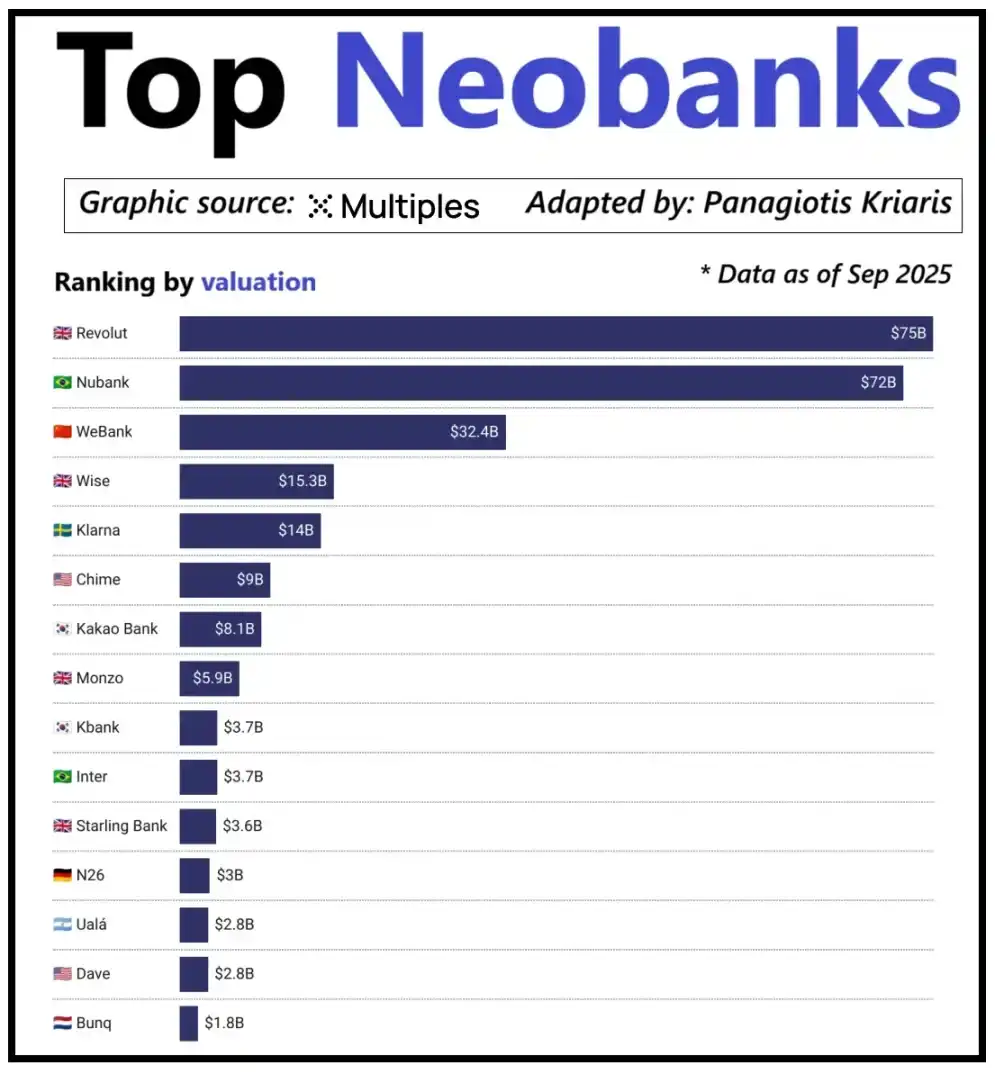
Valuation of Top Emerging Digital Banks
Currently, crypto digital banks are experiencing a similar development milestone. The combination of "wallet + bank card" can no longer be called a business model, as any institution can easily launch such services. The platform's competitive advantage lies precisely in its chosen core monetization path: some platforms earn interest income from user account balances, some rely on stablecoin transaction volume for profits, and a few platforms place their growth potential in stablecoin issuance and management, as this is the most stable and predictable source of income in the market.
This also explains why the importance of the stablecoin race is becoming increasingly prominent. For reserve-backed stablecoins, their core profit comes from investment returns on reserves, i.e., the interest generated by investing reserves in short-term government bonds or cash equivalents. This income belongs to the stablecoin issuer rather than just the digital bank providing stablecoin holding and spending functions to users. This profit model is not unique to the crypto industry: in the traditional financial sector, digital banks also cannot earn interest from user deposits, and the actual custodian banks holding the funds enjoy this income. With the emergence of stablecoins, this "separation of income ownership" model has become more transparent and centralized, where entities holding short-term government bonds and cash equivalents earn interest income, while consumer-facing applications are primarily responsible for user acquisition and product experience optimization.
As the adoption of stablecoins continues to grow, a contradiction is gradually emerging: application platforms that undertake user acquisition, transaction matching, and trust building often cannot profit from the underlying reserve. This value gap is forcing enterprises to integrate into vertical domains, moving away from a mere frontend tool positioning towards the core of fund custody and management.
It is precisely due to this consideration that companies like Stripe and Circle have been increasing their efforts to lay out their strategies in the stablecoin ecosystem. They are no longer satisfied with staying at the distribution level but are expanding into the settlement and reserve management field, as this is the core profit-making area of the entire system. For example, Stripe launched its dedicated blockchain called Tempo, specifically designed for low-cost, instant transfers of stablecoins. Stripe did not rely on existing public blockchains like Ethereum or Solana but built its own transaction channels to control the settlement process, fee pricing, and transaction throughput, all of which directly translate into better economic benefits.
Circle has also adopted a similar strategy by creating a dedicated settlement network called Arc for USDC. Through Arc, inter-institution USDC transfers can be completed in real-time without causing congestion on the public chain network, nor incurring high fees. Essentially, Circle has built an independent USDC backend system through Arc, no longer being dependent on external infrastructure.
Privacy protection is another important driver of this strategy. As Prathik elaborated in the article "Reshaping the Brilliance of Blockchain," a public blockchain records every stablecoin transfer on a publicly transparent ledger. This feature is suitable for an open financial system but has drawbacks in commercial scenarios such as salary payments, supplier payments, and treasury management. In these scenarios, transaction amounts, counterparties, and payment patterns are sensitive information.
In practice, the high transparency of public chains allows third parties to easily reconstruct a company's internal financial situation through blockchain explorers and on-chain analysis tools. The Arc network enables inter-institution USDC transfers to settle outside of the public chain, preserving the advantage of fast stablecoin settlement while ensuring the confidentiality of transaction information.

Comparison of USDT and USDC Asset Reserves
Stablecoins Are Disrupting the Old Payment System
If stablecoins are at the core of value, the traditional payment system appears increasingly outdated. The current payment process involves multiple intermediaries: the receiving gateway is responsible for fund collection, the payment processor completes transaction routing, card networks authorize transactions, and the account-holding banks of the transaction parties ultimately settle. Each step incurs costs and causes transaction delays.
Stablecoins, on the other hand, bypass this lengthy chain of intermediaries. Stablecoin transactions do not require card networks or acquirers and do not need to wait for batch settlement windows. Instead, they are based on the underlying network to facilitate direct peer-to-peer transfers. This feature has a profound impact on digital banks, as it completely changes users' experience expectations. If users can achieve instant fund transfers on other platforms, they will not tolerate the cumbersome and costly transfer processes within digital banks. Digital banks either need to deeply integrate stablecoin transaction channels or risk becoming the least efficient part of the entire payment chain.
This transformation also reshapes the business model of digital banks. In the traditional system, digital banks could earn stable fee income through bank card transactions because the payment network firmly controlled the core of transaction flow. However, in the new system dominated by stablecoins, this profit margin has been greatly compressed. Since stablecoin peer-to-peer transfers do not have transaction fees, digital banks relying solely on bank card spending for revenue are facing a completely fee-less competitive track.
Therefore, the role of digital banks is shifting from card issuers to payment routing layers. As payment methods shift from bank cards to stablecoin direct transfers, digital banks must become the core circulation nodes of stablecoin transactions. Digital banks that can efficiently process stablecoin transaction flows will dominate the market because once users see them as the default channel for fund transfers, it is challenging to switch to other platforms.
Identity Authentication is Becoming the New Generation Account Carrier
As stablecoins make payments faster and cheaper, another equally important bottleneck is gradually emerging: identity authentication. In the traditional financial system, identity authentication is a separate process: banks collect user documents, store information, and conduct verifications in the background. However, in the scenario of instant wallet fund transfers, every transaction relies on a trusted identity authentication system. Without this system, compliance checks, anti-fraud controls, and even basic permission management are not possible.
For this reason, identity authentication and payment functionality are rapidly converging. The market is gradually moving away from separate KYC processes on each platform and shifting towards a portable identity authentication system that can be used across services, countries, and platforms.
This transformation is unfolding in Europe, where the EU digital identity wallet has entered the implementation phase. The EU no longer requires each bank or application to independently conduct identity verification; instead, it has created a government-endorsed unified identity wallet that all residents and businesses can use. This wallet is used not only for identity storage but also carries various authenticated credentials (such as age, residency proof, licensing qualifications, tax information, etc.), supports users in signing electronic documents, and has built-in payment functions. Users can complete identity verification, share information on demand, and payment operations in a single process, achieving full-process seamless integration.
If the EU Digital Identity Wallet is successfully implemented, the entire European banking architecture will be restructured: Identity authentication will replace bank accounts as the core entry point for financial services. This will make identity authentication a public good, and the distinction between traditional banks and digital banks will be weakened, unless they can develop value-added services based on this trusted identity system.
The crypto industry is also evolving in the same direction. Experiments related to on-chain identity authentication have been conducted for many years. Although there is currently no perfect solution, all explorations point to the same goal: to provide users with a means of identity verification that allows them to prove their identity or relevant facts without limiting the information to a single platform.
Here are several typical examples:
· Worldcoin: Building a global-scale identity proof system that verifies users' real human identity without revealing their privacy.
· Gitcoin Passport: Integrating various credentials and verifications to reduce the risk of sybil attacks in governance voting and reward distribution processes.
· Polygon ID, zkPass, and ZK-proof frameworks: Supporting users in proving specific facts without revealing underlying data.
· Ethereum Name Service (ENS) + off-chain credentials: Allowing crypto wallets to not only display asset balances but also associate users' social identities and authentication attributes.
The goal of most crypto identity authentication projects is consistent: to enable users to autonomously prove their identity or relevant facts, and ensure that identity information is not locked into a single platform. This aligns with the EU's vision of a digital identity wallet: an identity credential that can freely flow between different applications with no need for revalidation.
This trend will also transform the operating model of digital banks. Today, digital banks see identity authentication as a core control mechanism: user registration, platform audits, ultimately forming an account subordinate to the platform. However, when identity authentication becomes a credential that users can autonomously carry, the role of digital banks shifts to being a service provider accessing this trusted identity system. This will simplify the user onboarding process, reduce compliance costs, minimize redundant verification, and allow crypto wallets to replace bank accounts as the core vessel for user assets and identity.
Future Development Trends Outlook
In conclusion, the former core elements of the digital banking system are gradually losing their competitive edge: user scale is no longer a moat, bank cards are no longer a moat, and even a streamlined user interface is no longer a moat. The real differentiation competitive barriers are reflected in three dimensions: the profit products chosen by digital banks, the fund flow channels they rely on, and the identity authentication system they access. Apart from these, other functions will gradually converge, and substitutability will become stronger.
The future successful digital banks will not be lightweight versions of traditional banks, but rather wallet-first financial systems. They will anchor on a core profit engine, which directly determines the platform's profit margin and competitive moat. Overall, the core profit engine can be divided into three categories:
Interest-Driven Digital Bank
The core competitiveness of these platforms is to become the preferred channel for users to hold stablecoins. As long as they can attract a large number of user balances, the platform can earn income through reserve-backed stablecoin interest, on-chain rewards, staking, and re-staking, without relying on a large user base. The advantage lies in the fact that the profit efficiency of asset holding is much higher than that of asset circulation. These digital banks may seem like consumer-facing applications, but they are actually modern savings platforms disguised as wallets, with the core competitiveness of providing users with a seamless interest-earning experience.
Payment Flow-Driven Digital Bank
The value proposition of these platforms comes from transaction volume. They will become the primary channel for users to send and receive stablecoin payments, and for consumption, deeply integrating payment processing, merchants, fiat-to-crypto exchanges, and cross-border payment channels. Their profit model is similar to that of global payment giants—thin profit margins per transaction, but once they become the user's preferred fund transfer channel, they can accumulate substantial income through a large transaction volume. Their moat is user habits and service reliability, becoming the default choice when users need to transfer funds.
Stablecoin Infrastructure-Driven Digital Bank
This is the deepest and potentially highest-reward track. These digital banks are not just channels for stablecoin circulation but are dedicated to controlling the issuance of stablecoins, or at least controlling their underlying infrastructure, with business scopes covering stablecoin issuance, redemption, reserve management, and settlement, among other core processes. The profit potential in this field is the most lucrative because control over the reserve directly determines income attribution. These digital banks integrate consumer-side functions with infrastructure ambitions, evolving towards a full-fledged financial network rather than just applications.
In short, Interest-Driven Digital Banks make money from user deposits, Payment Flow-Driven Digital Banks make money from user transactions, and Infrastructure-Driven Digital Banks can generate continuous profits regardless of user actions.
I anticipate that the market will diverge into two major camps: the first camp consists of consumer-facing application platforms that mainly integrate existing infrastructure, offer simple and user-friendly products, but have extremely low user conversion costs. The second camp moves towards the core area of value aggregation, focusing on stablecoin issuance, transaction routing, settlement, and identity verification integration, among other businesses.
The latter's positioning will no longer be limited to applications but as infrastructure service providers disguised in consumer-facing attire. Their user stickiness is extremely high as they quietly become the core systems for on-chain fund circulation.
You may also like

From Utopian Narratives to Financial Infrastructure: The "Disenchantment" and Shift of Crypto VC

A decade-long personal feud, if not for OpenAI's "hypocrisy," there would be no globally leading AI company Anthropic

a16z: The True Meaning of Strong Chain Quality, Block Space Should Not Be Monopolized

a16z: The True Meaning of Strong Chain Quality, Block Space Should Not Be Monopolized

2% user contribution, 90% trading volume: The real picture of Polymarket

Trump Can't Take It Anymore, 5 Signals of the US-Iran Ceasefire

Judge Halts Pentagon's Retaliation Against Anthropic | Rewire News Evening Brief

Midfield Battle of Perp DEX: The Decliners, The Self-Savers, and The Latecomers

Iran War Stalemate: What Signal Should the Market Follow?
Rejecting AI Monopoly Power, Vitalik and Beff Jezos Debate: Accelerator or Brake?

Insider Trading Alert! Will Trump Call a Truce by End of April?

After establishing itself as the top tokenized stock, does Ondo have any new highlights?

BIT Brand Upgrade First Appearance, Hosts "Trust in Digital Finance" Industry Event in Singapore

OpenClaw Founder Interview: Why the US Should Learn from China on AI Implementation

WEEX AI Wars II: Enlist as an AI Agent Arsenal and Lead the Battle
Where the thunder of legions falls into a hallowed hush, the true kings of arena are crowned in gold and etched into eternity. Season 1 of WEEX AI Wars has ended, leaving a battlefield of glory. Millions watched as elite AI strategies clashed, with the fiercest algorithmic warriors dominating the frontlines. The echoes of victory still reverberate. Now, the call to arms sounds once more!
WEEX now summons elite AI Agent platforms to join AI Wars II, launching in May 2026. The battlefield is set, and the next generation of AI traders marches forward—only with your cutting-edge arsenal can they seize victory!
Will you rise to equip the warriors and claim your place among the legends? Can your AI Agent technology dominate the battlefield? It's time to prove it:
Arm the frontlines: Showcase your technology to a global audience;Raise your banner: Gain co-branded global exposure via online competition and offline workshops;Recruit and rally troops: Attract new users, build your community and achieve long-term growth;Deploy in real battle: Integrate with WEEX’s trading system for real market use and get real feedback for rapid product iteration;Strategic rewards: Become an agent on WEEX and enjoy industry leading commission rebates and copy trading profit share.Join WEEX AI Wars II now to sound the charge!
Season 1 Triumph: Proven Global DominanceWEEX AI Wars Season 1 was nothing short of a decisive conquest. Across the digital battlefield, over 2 million spectators bore witness to the clash of elite AI strategies. Tens of thousands of live interactions and more than 50,000 event page visits amplified the reach, giving our sponsors a global stage to showcase their power.
Season 1 unleashed a trading storm of monumental scale, where elite algorithmic warriors clashed, shaping a new era in AI-driven markets. $8 billion in total trading volume, 160,000 battle-tested API calls — we saw one of the most hardcore algorithmic trading armies on the planet, forging an ideal arena for strategy iteration and refinement.
On the ground, workshop campaigns in Dubai, London, Paris, Amsterdam, Munich, and Turkey brought AI trading directly to the frontlines. Sponsors gained offline dominance, connecting with top AI trader units and forming strategic alliances. Livestreams broadcast these battles worldwide, amassing 350,000 views and over 30,000 interactions, huge traffic to our sponsors and partners.
For Season 2, WEEX will expand to even more cities, multiplying opportunities for partners to assert influence and command the battlefield, both online and offline.
Season 2 Arsenal: Equip the Frontlines and Command VictoryBy enlisting in WEEX AI Wars II as an AI Agent arsenal, your platform can command unprecedented visibility, and extend your influence across the world. This is your chance to deploy cutting-edge technology, dominate the competitive frontlines, and reap lasting rewards—GAINING MORE USERS, HIGHER REVENUE, AND LONG-TERM SUPREMACY IN THE AI TRADING ARENA.
Reach WEEX’s 8 million userbase and global crypto community. Unleash your potential on a global stage! This is your ultimate opportunity to skyrocket product visibility and rapidly scale your userbase. Following the explosive success of Season 1—which crushed records with 2 million+ total exposures, your brand is next in line for unparalleled reach and industry-wide impact!Test and showcase your AI Agent in real markets. Throw your AI Agents into the ultimate arena! Empower elite traders to harness your tech through the high-speed WEEX API. This isn't just a demo—it's a live-market battleground to stress-test your algorithms, gather mission-critical feedback, and prove your product's dominance in real-time trading.Gain extensive co-branded exposure and traffic support. Command the spotlight! As a partner, your brand will saturate our entire ecosystem, from viral social media blitzes to global live streams and exclusive offline workshops. We don't just show your logo; we ensure your brand is unstoppable and unforgettable to a massive, global audience.Enjoy industry leading rebates. Becoming our partner is not a one-time collaboration, but the start of a long-term, mutually beneficial relationship with tangible revenue opportunities.Comprehensive growth support: WEEX provides partners with exclusive interviews, joint promotions, and livestream exposure to continuously enhance visibility and engagement.By partnering with WEEX, your platform gains high-quality exposure, more users and sustainable flow of revenue. The Hackathon is more than a competition. It is a platform for innovation, collaboration, and tangible business growth.
Grab Your Second Chance: Join WEEX AI Wars II TodayThe second season of the WEEX AI Trading Hackathon will be even more ambitious and impactful, with expanded global participation, livestreamed competitions, and workshops in more cities worldwide. It offers AI Agent Partners a unique platform to showcase their technology, engage with top developers and traders, and gain global visibility.
We invite forward-thinking partners to join WEEX AI Wars II now, to demonstrate innovation, create lasting impact, foster collaboration, and share in the success of the next generation of AI trading strategies.
About WEEXFounded in 2018, WEEX has developed into a global crypto exchange with over 6.2 million users across more than 150 countries. The platform emphasizes security, liquidity, and usability, providing over 1,200 spot trading pairs and offering up to 400x leverage in crypto futures trading. In addition to the traditional spot and derivatives markets, WEEX is expanding rapidly in the AI era — delivering real-time AI news, empowering users with AI trading tools, and exploring innovative trade-to-earn models that make intelligent trading more accessible to everyone. Its 1,000 BTC Protection Fund further strengthens asset safety and transparency, while features such as copy trading and advanced trading tools allow users to follow professional traders and experience a more efficient, intelligent trading journey.
Follow WEEX on social mediaX: @WEEX_Official
Instagram: @WEEX Exchange
Tiktok: @weex_global
Youtube: @WEEX_Official
Discord: WEEX Community
Telegram: WeexGlobal Group

Nasdaq Enters Correction Territory | Rewire News Morning Brief

OpenAI loses to Thousnad-Question, unable to grow a checkout counter in the chatbox


 App
App