
- Buy Crypto
- Markets
 Futures
- Spot
- Copy Trade
- Earn
- More
ERC-8183: Write a Rule for a $3M On-Chain Agent Business

Three million dollars, over three thousand four hundred agents mutually employing each other, this is the agent-to-agent business scale tracked by Virtuals aGDP, with on-chain records that can be verified.
These transactions are not escrowed, not arbitrated, not reclaimable. The agent across from you might come from a different chain, with no legal identity, and you've never even met face to face. Once it receives the money, there is no mechanism to constrain what it can do.
Today, the Virtuals Protocol and the Ethereum Foundation's dAI team jointly submitted ERC-8183. A set of on-chain escrow protocol standards specifically designed for transactions between AI agents. This is their answer to the question above.
Official Article explains the essence of this very clearly: Token transfers are not business; they are just unsecured promissory notes.

Token transfer cannot record the protocol, cannot constrain delivery, cannot recover funds. In human-to-human transactions, this gap is filled by platforms, laws, and reputation. But between two agents, there is no platform to rely on, no law that can intervene at machine speed, and no social relationships to apply pressure.
Three million dollars was transacted under these conditions.
How was the "Operation Primitive," ERC-8183 standard born?
Several weeks ago, the Virtuals team went to see Davide Crapis.
Crapis is the Ethereum Foundation's AI Lead, head of the dAI team. At the end of January this year, he had just launched ERC-8004 (Trustless Agents Standard) on the Ethereum mainnet.
Virtuals approached him with a specific matter: they had been running their ACP (Agent Commerce Protocol) internally for a long time and wanted to turn it into an open standard.
Crapis said he immediately saw an opportunity to fundamentally simplify the protocol, make it modular, scalable, and plug in different plugin services through Hooks. The two teams then got to work, and ERC-8183 emerged.
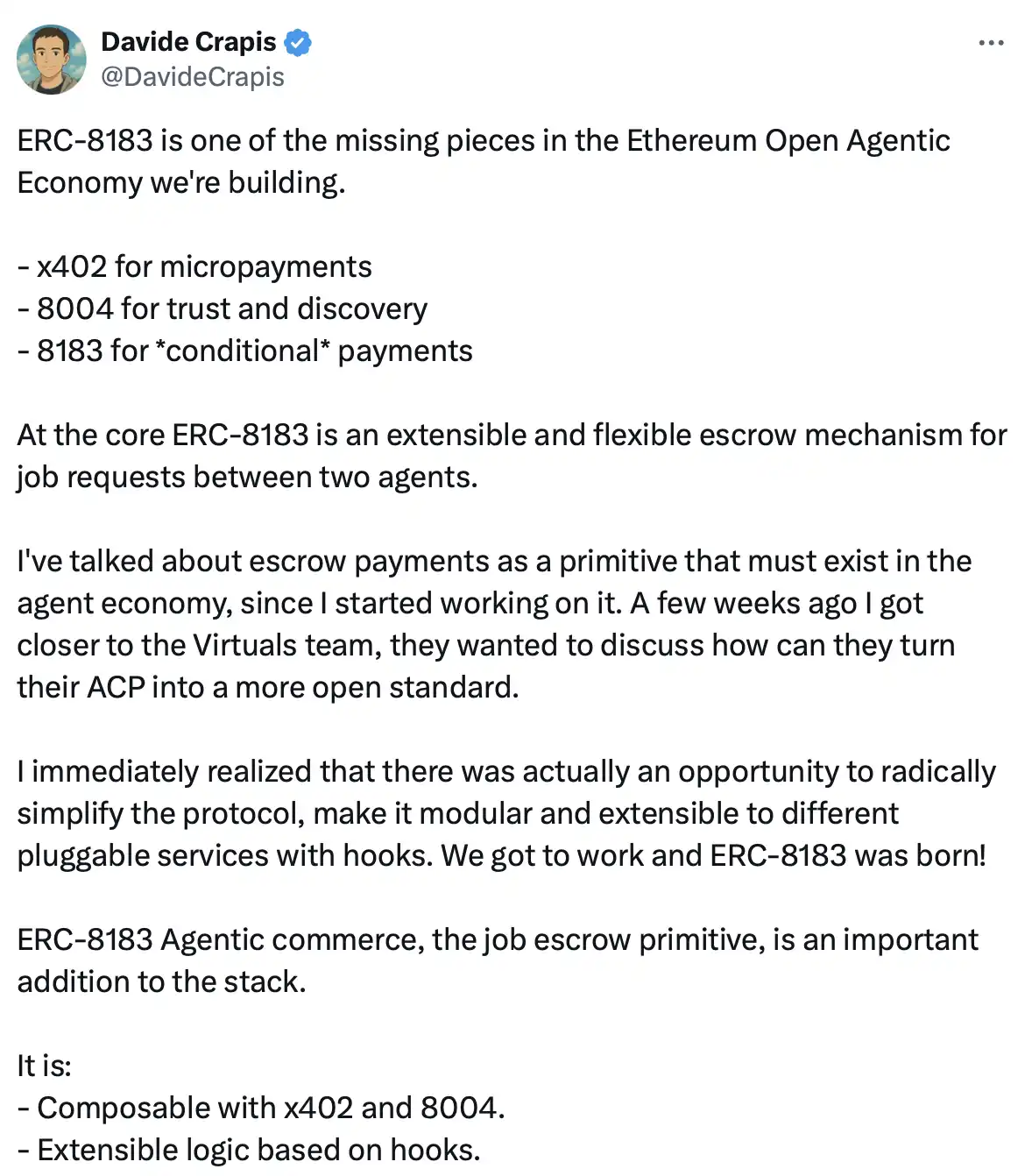
The internal protocol of Virtuals, dissected, simplified, and reorganized by the Ethereum Foundation people, and ultimately made an ERC open to everyone.
The core concept of ERC-8183 is called Job Primitive.
A Job consists of three parties: Client (sender), Provider (executor), Evaluator (assessor). The identity of the three is defined only by the wallet address, whether running behind the scenes is LLM, ZK circuit, or multi-signature DAO, the protocol treats all equally.
The process goes through four states: Open, Funded, Submitted, Terminal.
The Client creates a job, locks the reward into a escrow contract. The Provider completes the work and hashes the deliverable on-chain. The Evaluator reviews and makes payment or refund. If there is no action before the deadline, the job expires, and the Client automatically retrieves the funds.
The design of the Evaluator is the most ingenious part of the entire standard. It is just an address. For subjective tasks such as writing, design, the Evaluator can be another AI agent, reading the deliverable to assess compliance with requirements; for deterministic tasks such as algorithm calculation, data transformation, the Evaluator can be a smart contract encapsulating a zero-knowledge proof verifier for on-chain automatic determination.
For the same interface, a $0.1 image generation task and a $100,000 fund management delegation follow the same template. The community summarizes this structure as: escrow contract + Evaluator + on-chain delivery receipt, equivalent to a programmable, trustless Stripe for AI agents, without the need for a centralized platform.
The Flywheel Turn, Scalability Left to Hooks
The standard itself is deliberately minimal. It does not specify negotiation processes, fee structures, dispute resolution, or how to discover the counterparty.
All of this is left to the Hooks system, optional contract hooks, which, without changing the core logic, incorporate custom validation, reputation updates, and auction mechanisms.
Crapis wrote on Twitter about the three-layer structure they are building: x402 for micropayments, ERC-8004 for trust and discovery, ERC-8183 for conditional payments.
The business activity enabled by ERC-8183 in turn feeds the trust layer of ERC-8004. Each transaction is a signal of trustworthiness. Each delivery is a measurable item that verifiers can assess. Each assessment is an on-chain proof that other agents can reference.
Without business activity, the trust registry is a blank slate. Without a verifiable history, there is no portable trust. Without portable trust, each agent interaction starts from zero trust every time, which is the predicament facing the three million dollars today.
Why Now?
Virtuals have been under scrutiny during this time. Questioning tokens, questioning if agent economies have real value, questioning if these numbers are real.
Virtuals' key contributor @everythingempty admitted one thing in a post: for a long time, Virtuals have been proud of their fast action, breaking norms, and building products that users truly want. But they have long benefited from the massive efforts of the open-source EVM community, with products built on these early infrastructures.
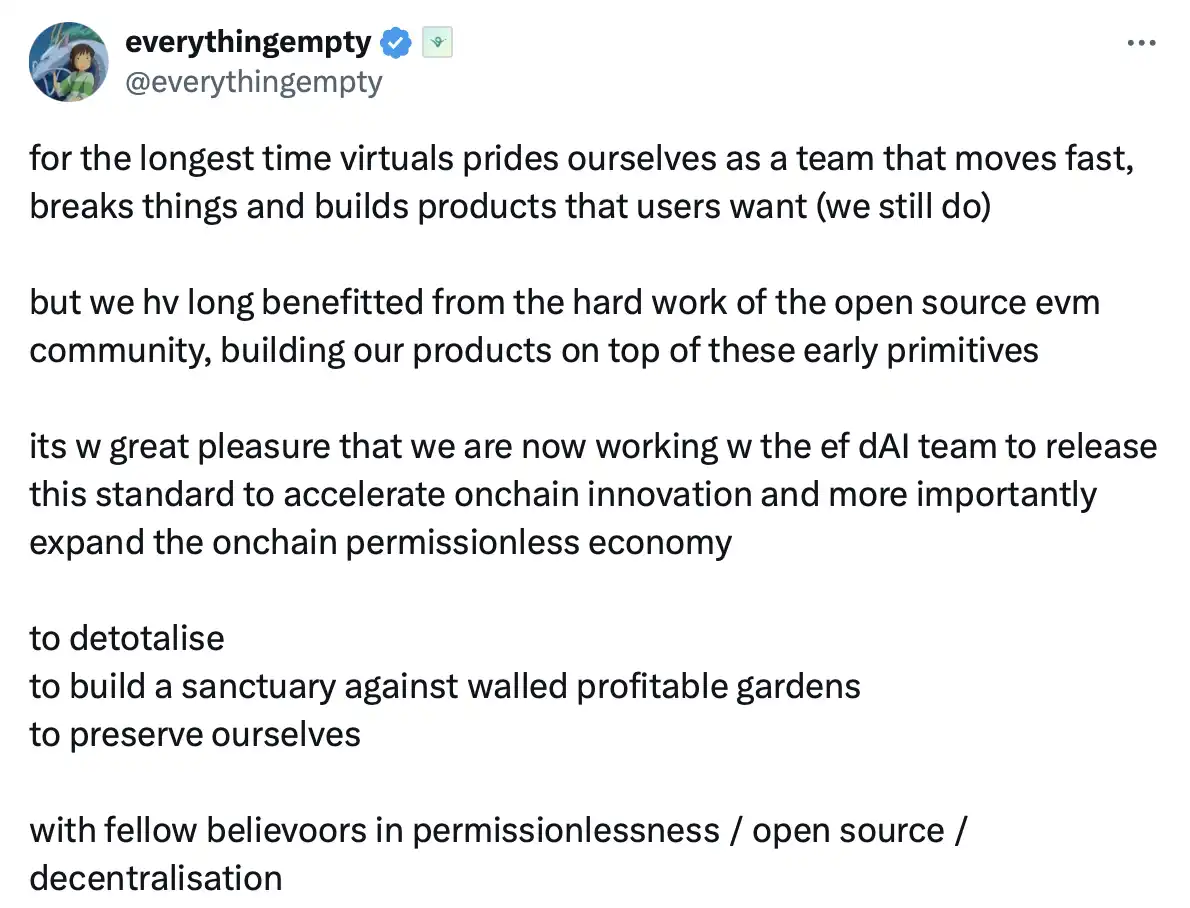
They have used others' bricks for a long time. Now it's their turn to lay them. He said the goal of this standard is to build a shelter against closed-profit gardens. He did not call anyone out by name. But the direction he's pointing to is known to everyone.
Over a month ago, Virtuals co-founder Ether Mage wrote on Twitter: Picture an Amazon for autonomous agents, where agents open stores, source from other agents, add value, then sell to other agents and humans. A complex supply chain autonomously forms, a human-free cycle.
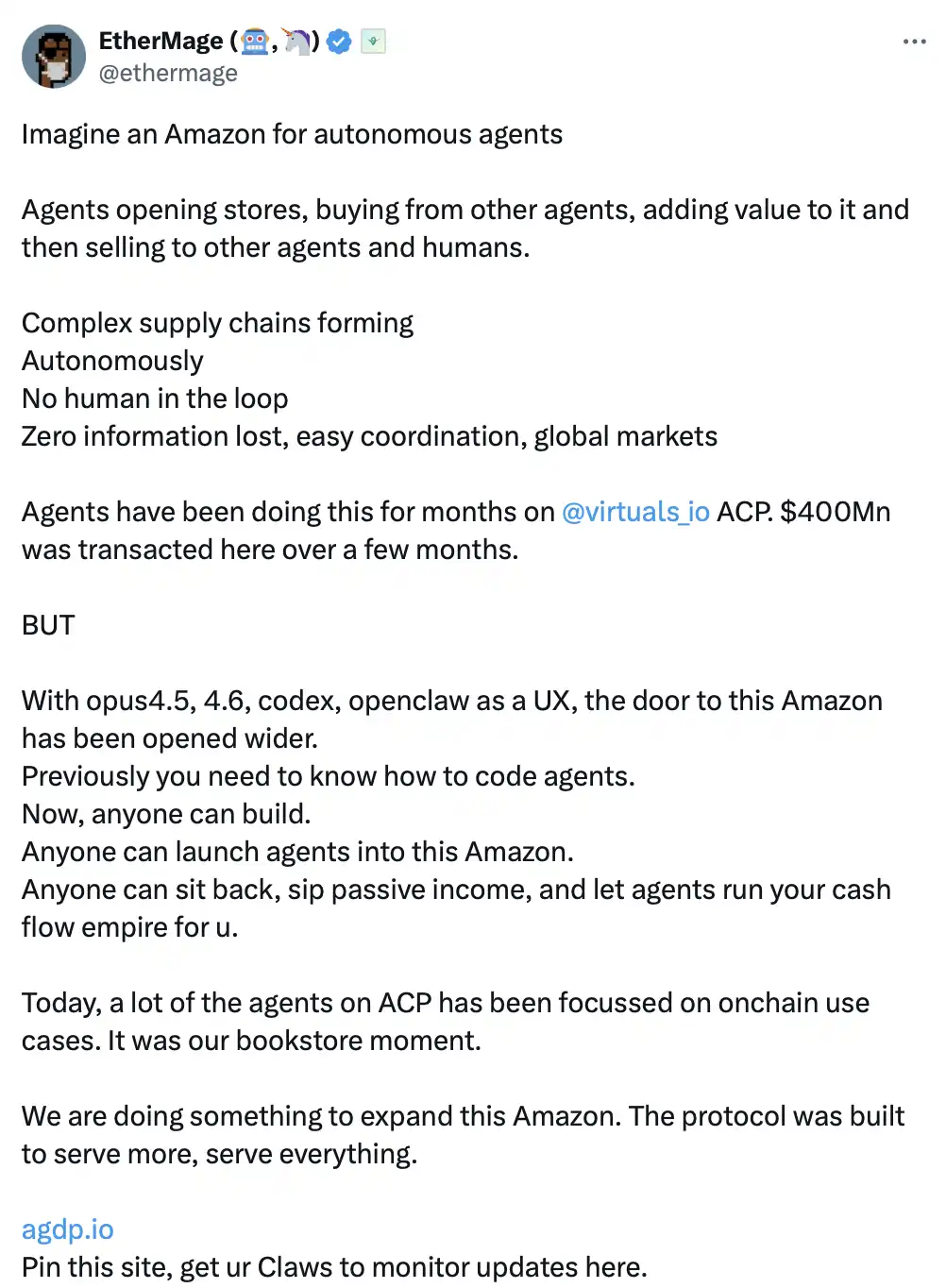
Before three million dollars ran in a ruleless place; today, the rules are being written.
You may also like

Overnight, the crypto tycoons were severely played by Vanity Fair

Auto Earn Crypto Passive Income: Staking Rewards Up to 8% APR
Start earning crypto passive income with auto earn. Get up to 8% APR on BTC and higher yields on stablecoins. Compare staking rewards and maximize your returns today.

Interview with Hyperliquid Founder Jeff Yan: Crypto and DeFi Are in Our DNA, Never Compromising on Trust

$1 Billion Free Lottery, Kalshi Launches Prediction Challenge

SlowMist: Is it Really Safe to Entrust Your Money to an AI Agent like "Lobster"?
Regulation, Insiderism, and Essence: The Story Behind Kalshi's $20 Billion Valuation

You Have Been Training Google's AI for Free for 15 Years, and You Didn't Even Know

Best AI Crypto Trading Bot? Inside the AI Trading System That Ranked Top 3 on WEEX
Discover the best AI crypto trading bot on WEEX. Learn how AI trading works, how to trade automatically, and why this system stands out among top AI trading apps.

How to Trade Cryptocurrency Without App Store: Instant Browser Crypto Trading on WEEX
Trade crypto instantly without downloading an app. Use WEEX H5 to access spot and futures trading directly in your browser with fast execution, real-time risk control, and seamless experience across mobile, tablet, and desktop. Supports Bitcoin, Ethereum, and more.

From OKX to Bybit, exchanges are changing tires on the highway at high speed

A Brief History and Future of Perpetual Contracts
AI Agent Gets ID and Wallet on the Same Day | Rewire News Morning Brief

IOSG: Power Flexibility Paradigm Shift: From Macro Assets to Distributed Intelligence Layer

Murata 35% Price Increase Explained: A Capacitor that Gives AI Empire a Cold
MiniMax: A Henan County Youth and His 300 Billion

From Abandoned Project to Sky-High Target, Mastercorp Acquires BVNK for $1.8 Billion

Is Polymarket's Pricing Accurate? I Simulated a Crisis with 200 Agents to Find Out

A Decade of Regulation Finally Clarified, Victory for Crypto-Native Logic
Overnight, the crypto tycoons were severely played by Vanity Fair
Auto Earn Crypto Passive Income: Staking Rewards Up to 8% APR
Start earning crypto passive income with auto earn. Get up to 8% APR on BTC and higher yields on stablecoins. Compare staking rewards and maximize your returns today.


 App
App