
 Buy Crypto
- Markets
 Futures
- Spot
- Copy Trade
- Earn
- More
Ethereum's Identity Crisis: Cryptocurrency or Bitcoin's Shadow?

Original Article Title: The ETH Debate: Is it Cryptomoney?
Original Article Author: @AvgJoesCrypto, Messari
Translation: Luffy, Foresight News
Among all mainstream cryptocurrency assets, Ethereum has sparked the most intense debate. While Bitcoin has been widely recognized as the leading cryptocurrency, Ethereum's position has always been in question. To some, Ethereum is seen as the only credible non-sovereign monetary-like asset apart from Bitcoin; while others believe Ethereum is fundamentally a business that has seen declining revenues, tightening profit margins, and faces fierce competition from many other public chains offering faster transactions and lower costs.
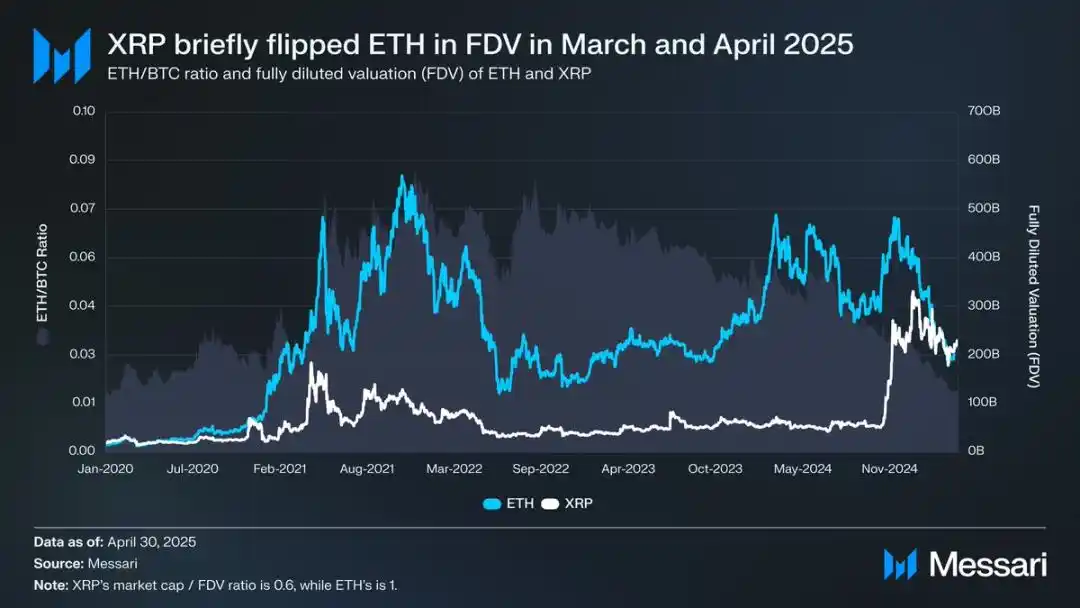
This debate seemed to reach its peak in the first half of this year. In March, Ripple (XRP) briefly surpassed Ethereum in fully diluted valuation (notably, all Ethereum tokens are in circulation, while only about 60% of Ripple's total supply is circulating).
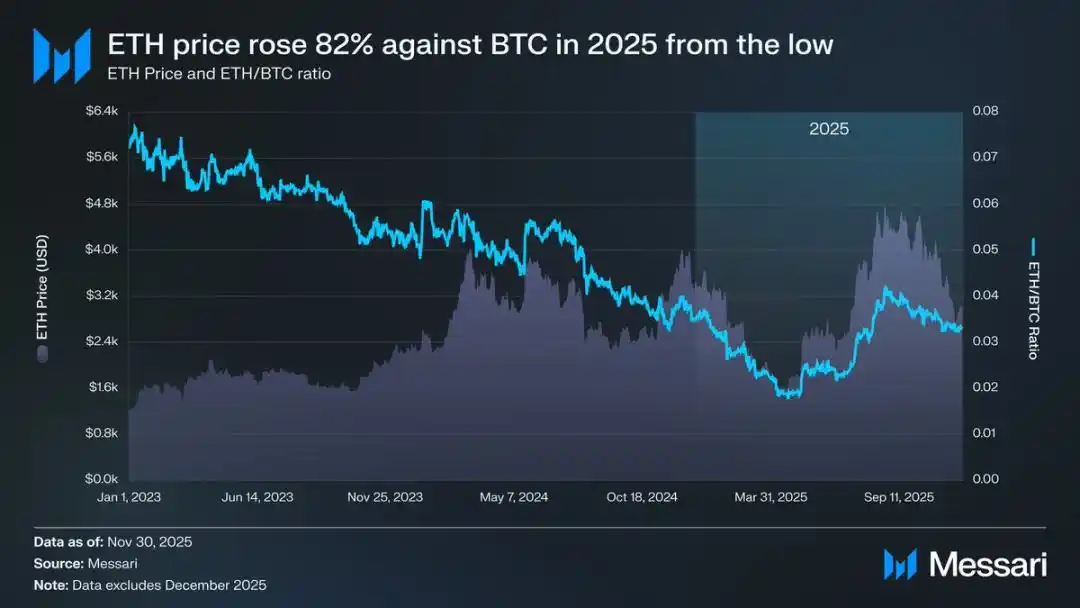
On March 16th, Ethereum's fully diluted valuation was $227.65 billion, while Ripple's equivalent valuation reached $239.23 billion. This result was almost unimaginable a year ago. Subsequently, on April 8th, 2025, Ethereum's exchange rate to Bitcoin (ETH/BTC) fell below 0.02, hitting a record low since February 2020. In other words, Ethereum has completely retraced all its gains relative to Bitcoin from the previous bull run. At that time, market sentiment towards Ethereum hit rock bottom.
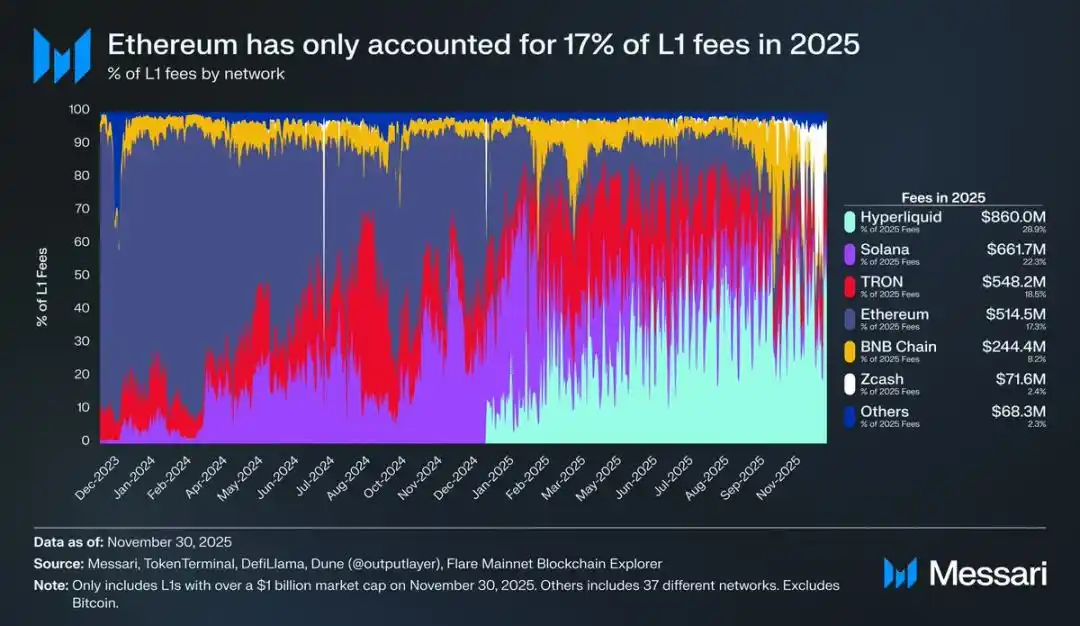
To make matters worse, the price decline was just the tip of the iceberg. As competitors' ecosystems flourished, Ethereum's share of the on-chain fee market continued to shrink. In 2024, Solana made a comeback; in 2025, Hyperliquid emerged. Together, the two pushed Ethereum's fee market share down to 17%, ranking it fourth among public chains—a cliff-like drop from its top spot a year ago. While fees may not tell the whole story, they are a clear signal of economic activity flow. Today, Ethereum is facing the most challenging competitive landscape in its development history.
However, historical experience has shown that significant reversals in the cryptocurrency market often begin at the most pessimistic moment of market sentiment. When Ethereum is pronounced by the outside world as a "failed asset," most of its apparent decline has already been absorbed by market prices.
In May 2025, signs of market overbearishness towards Ethereum began to emerge. It was during this period that Ethereum experienced a strong rebound in both its exchange rate against Bitcoin and its price in USD. The Ethereum-to-Bitcoin exchange rate climbed from a low of 0.017 in April to 0.042 in August, representing a 139% increase. During the same period, Ethereum's USD price surged from $1646 to $4793, marking a 191% increase. This upward trend peaked on August 24th when the price of Ethereum reached $4946, setting a new all-time high. After this reevaluation of value, Ethereum's overall trajectory clearly returned to an upward trend. The Ethereum Foundation's leadership transition and the emergence of a group of treasury companies focused on Ethereum injected confidence into the market.
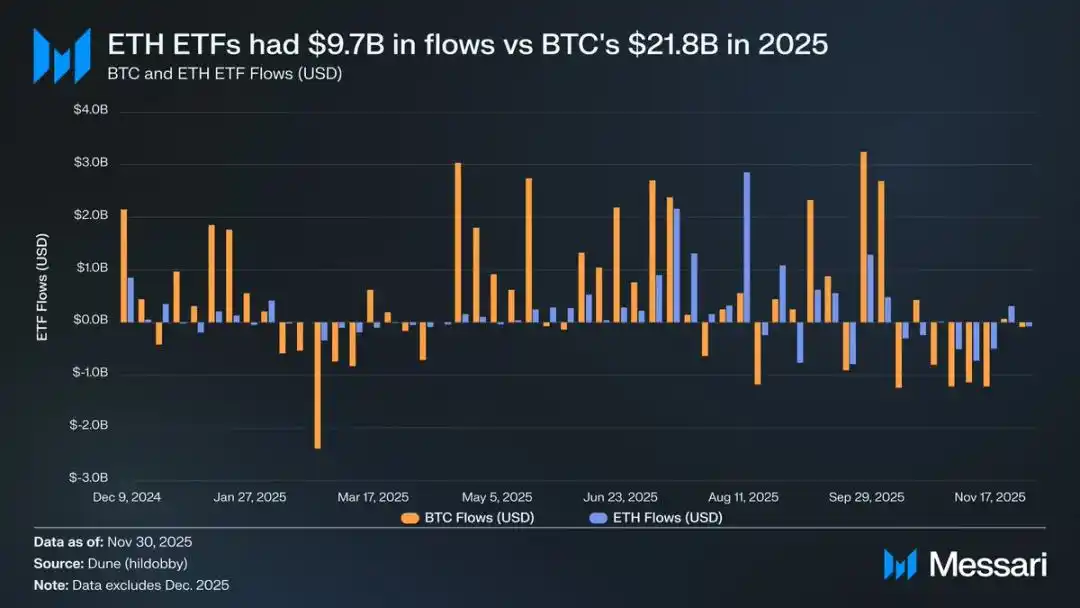
Prior to this round of growth, the diverging fortunes of Ethereum and Bitcoin were vividly reflected in the exchange-traded fund (ETF) markets for both. In July 2024, an Ethereum spot ETF was launched, but its fund inflows were very weak. In the first six months post-listing, its net inflow was only $2.41 billion, showcasing a stark contrast to the record-breaking performance of the Bitcoin ETF.
However, with Ethereum's strong recovery, concerns about its ETF fund inflows dissipated. Looking at the entire year, the net inflow of the Ethereum spot ETF reached $9.72 billion, while the Bitcoin ETF reached $21.78 billion. Considering that Bitcoin's market cap is nearly five times that of Ethereum, the disparity in the scale of ETF fund inflows is only 2.2 times, much lower than market expectations. In other words, when adjusted for market cap size, the market demand for Ethereum ETFs actually exceeds that of Bitcoin. This result completely reversed the narrative that "institutions lack genuine interest in Ethereum." Moreover, during specific time periods, the inflow of funds into the Ethereum ETF even surpassed Bitcoin directly. From May 26th to August 25th, the net inflow into the Ethereum ETF was $10.2 billion, exceeding the $9.79 billion for the Bitcoin ETF during the same period, marking the first clear tilt of institutional demand towards Ethereum.
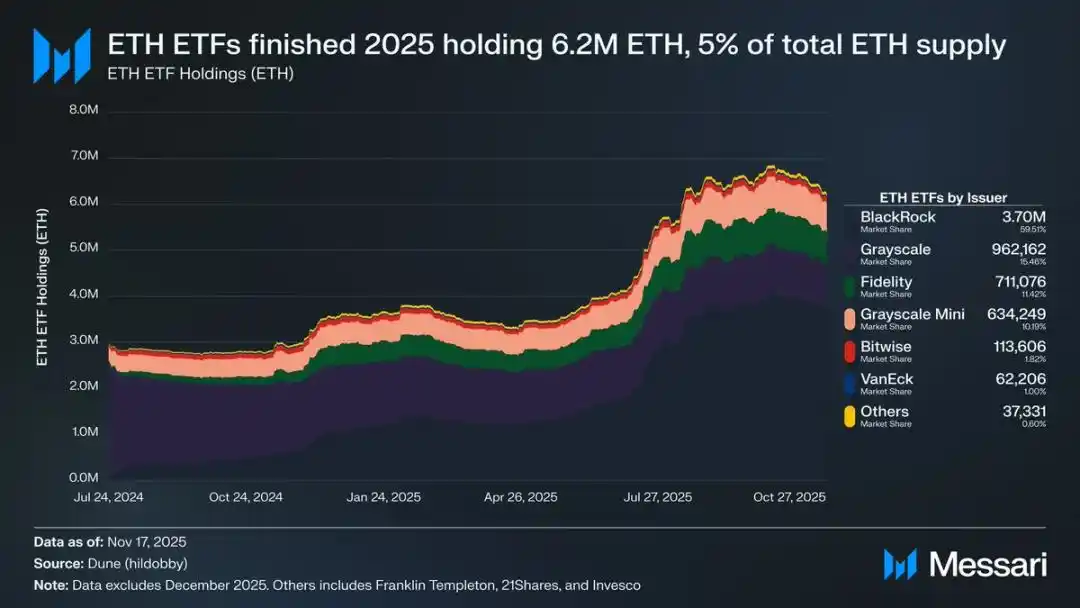
Looking at the performance of ETF issuers, BlackRock continued to lead the market. By the end of 2025, BlackRock's Ethereum ETF holdings reached 3.7 million ETH, representing 60% of the Ethereum spot ETF market share. Compared to the year-end 2024 holding of 1.1 million ETH, this marked a 241% increase, with an annual growth rate far exceeding other issuers. Overall, the Ethereum spot ETF's holdings at the end of 2025 were 6.2 million ETH, accounting for approximately 5% of its total token supply.
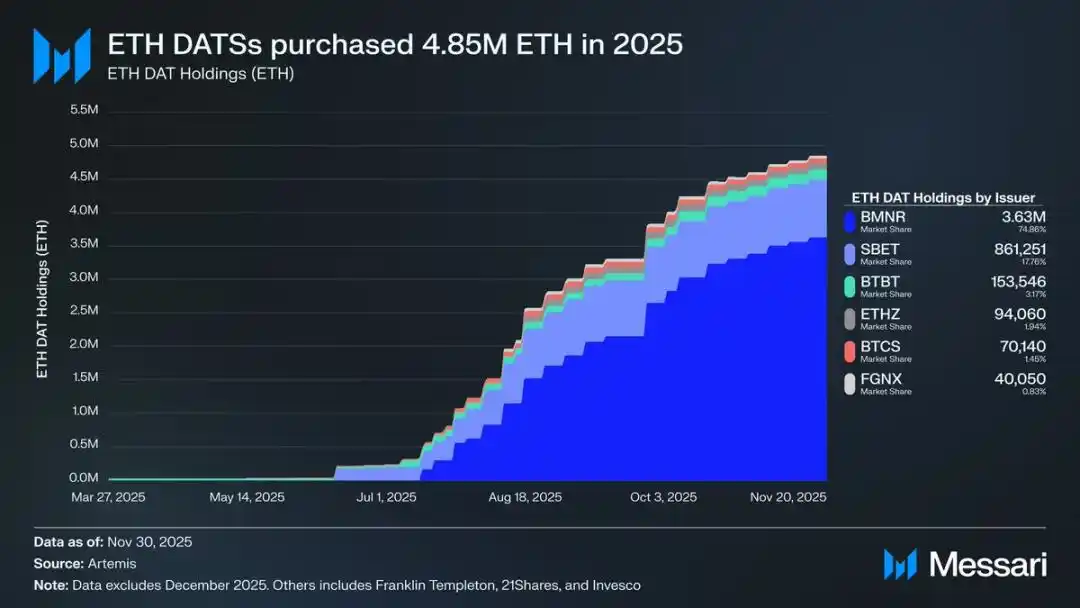
Behind Ethereum's strong rebound, the key driver has been the rise of Ethereum treasury companies. These reserve vaults have created unprecedented stable and sustained demand for Ethereum, providing support that narrative-driven or speculative funds cannot match. If Ethereum's price action marks a clear inflection point, then the continued accumulation by treasury companies represents a profound, structural shift that brought about this turning point.
By 2025, Ethereum treasury companies had accumulated 4.8 million Ethereum, representing 4% of its total supply, significantly impacting Ethereum's price. Among them, the most prominent performer is Bitmine led by Tom Lee (stock code BMNR). This company, originally focused on Bitcoin mining, began converting its reserve funds and capital to Ethereum in July 2025. From July to November, Bitmine acquired a total of 3.63 million Ethereum, holding 75% of the market share in the Ethereum treasury company market.
Despite Ethereum's strong rebound, the upward momentum eventually cooled off. As of November 30, Ethereum's price had retraced from its August high to $2,991, even lower than the previous bull market's peak of $4,878. While Ethereum's situation has significantly improved from its April low, this round of rebound has not completely dispelled the structural concerns that initially triggered market pessimism. On the contrary, the controversy surrounding Ethereum's positioning is once again in the public eye with even more intensity.
On one hand, Ethereum is exhibiting many features similar to Bitcoin, which are key to Bitcoin's ascent as a monetary asset. Today, Ethereum ETF inflows are no longer weak, and the Ethereum treasury company has become a source of its sustained demand. Perhaps most importantly, an increasing number of market participants are starting to differentiate Ethereum from other altcoins, incorporating it into the same monetary framework as Bitcoin.
On the other hand, the core issues that dragged Ethereum down in the first half of this year have yet to be resolved. Ethereum's core fundamentals have not fully recovered: its share of the public chain transaction fee market continues to be squeezed by strong competitors like Solana and Hyperliquid; the transaction activity on the Ethereum base layer is still far below the peak levels of the previous bull market; despite a significant price rebound, Bitcoin has easily surpassed its all-time high, while Ethereum is still lingering below its all-time high. Even in Ethereum's strongest months, there are still many holders who see this rally as an opportunity to cash out rather than a recognition of its long-term value.
The core issue of this controversy is not whether Ethereum has value, but how the asset ETH can accumulate value from the development of the Ethereum network.
In the previous bull market, the market widely believed that ETH's value would directly benefit from the success of the Ethereum network. This is the core logic of the "Sound Money Thesis": the utility of the Ethereum network will drive a significant demand for token burning, thereby establishing a clear and mechanized value support for Ethereum assets.
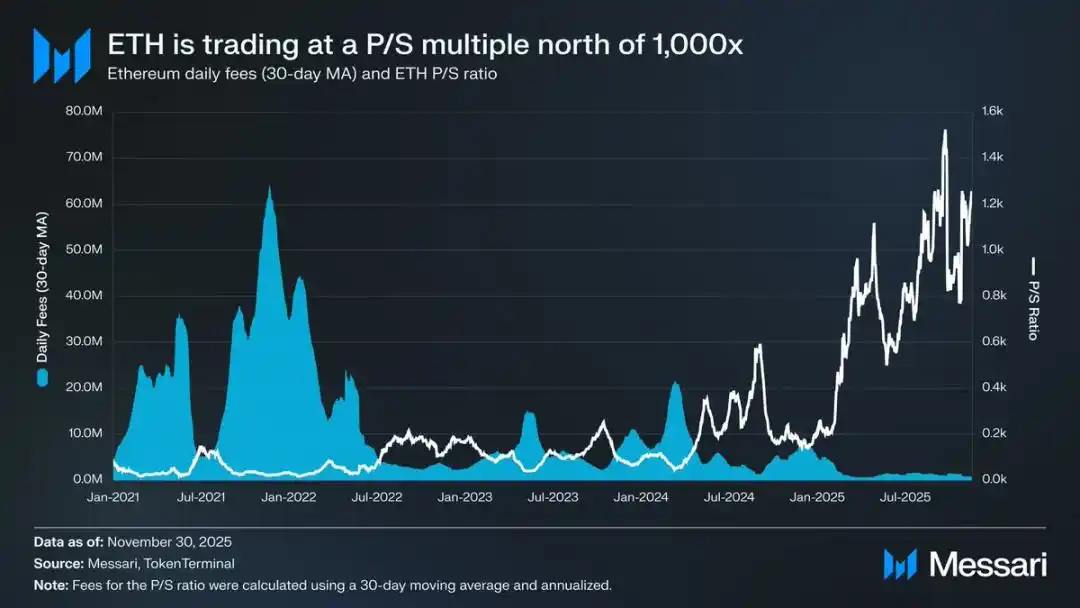
Today, we can almost certainly say that this logic will no longer hold. Ethereum's fee revenue has plummeted significantly and shows no signs of recovery; meanwhile, the two core areas driving Ethereum network growth — Real-World Assets (RWAs) and the institutional market — settle in USD as their core settlement currency, not in Ethereum.
The future value of Ethereum will depend on how it can indirectly benefit from the development of the Ethereum network. However, this indirect value accumulation carries great uncertainty. Its premise is that as the systemic importance of the Ethereum network continues to rise, more and more users and capital are willing to see Ethereum as a cryptocurrency and store of value tool.
Unlike direct, mechanized value accumulation, this indirect path has no certainty whatsoever. It relies entirely on market social preferences and collective consensus. Of course, this is not a flaw in itself; but it means that Ethereum's value growth will no longer have a necessary causal relationship with Ethereum network economic activity.
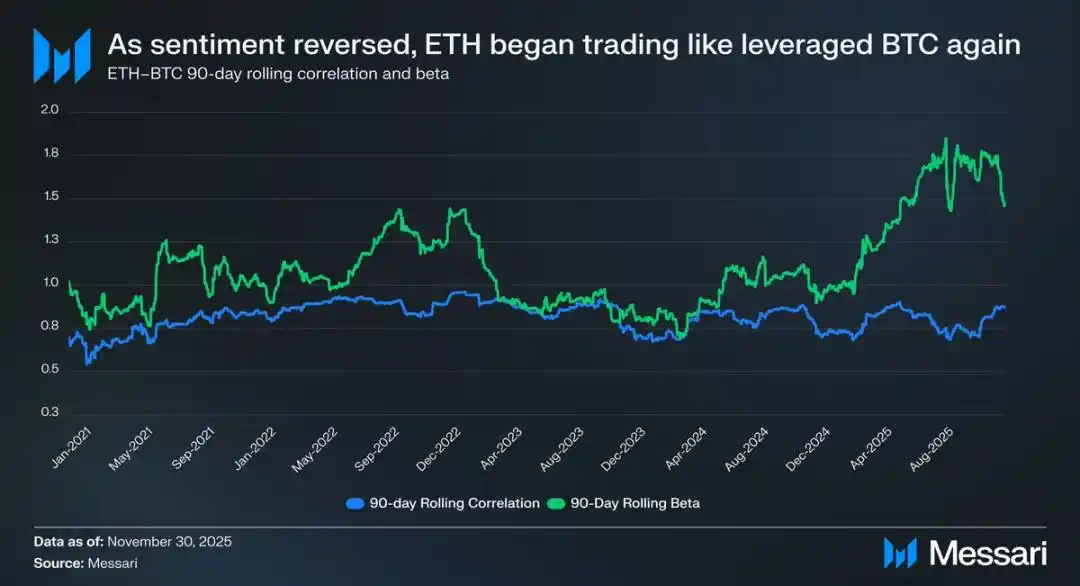
All of this will bring Ethereum's controversy back to its most core contradictory point: Ethereum may indeed be gradually accumulating a monetary premium, but this premium always lags behind Bitcoin. The market once again sees Ethereum as a "leverage expression" of Bitcoin's currency attributes rather than an independent monetary asset. Throughout the year 2025, Ethereum's 90-day rolling correlation with Bitcoin remained between 0.7 and 0.9, with the rolling beta coefficient skyrocketing to multi-year highs, briefly exceeding 1.8. This means that Ethereum's price volatility far exceeds Bitcoin's, but it is also always attached to Bitcoin's trend.
This is a subtle yet crucial distinction. The currency attributes that Ethereum possesses today are still recognized by the market as rooted in Bitcoin's currency narrative. As long as the market believes in Bitcoin's non-sovereign store of value attributes, some fringe market participants will be willing to extend this trust to Ethereum. Therefore, if Bitcoin's trend remains strong in 2026, Ethereum will also recapture more lost ground.
Currently, the Ethereum treasury company is still in its early stages of development, and its acquisition of Ethereum funds mainly comes from common stock issuance. However, if the cryptocurrency market experiences a new bull market, such institutions may explore more diversified financing strategies, such as borrowing from the strategy of expanding Bitcoin holdings, issuing convertible bonds and preferred stock.
For example, a Ethereum Treasury company like BitMine can finance itself by issuing low-interest convertible bonds and high-yield preferred shares, using the raised funds to directly accumulate Ethereum, while staking this Ethereum to earn ongoing rewards. Under reasonable assumptions, the staking rewards can partially offset the bond interest and preferred share dividend payments. This model allows the treasury to continue accumulating Ethereum using financial leverage when market conditions are favorable. Assuming a full-fledged bull market for Bitcoin in 2026, this "second growth curve" of the Ethereum Treasury company will further strengthen Ethereum's high beta attribute relative to Bitcoin.
Ultimately, the current market pricing of Ethereum's monetary premium is still based on Bitcoin's trajectory. Ethereum has not yet become a standalone currency asset with independent macroeconomic fundamental support; it is merely a secondary beneficiary of Bitcoin's currency consensus, and this beneficiary group is gradually expanding. The recent strong rebound of Ethereum reflects that some market participants are willing to see it as akin to Bitcoin rather than just an ordinary public chain token. However, even during a period of relative strength, market confidence in Ethereum remains closely linked to Bitcoin's narrative of continued strength.
In summary, while Ethereum's narrative of monetization has moved beyond its fractured state, it is far from settled. In the current market structure, combined with Ethereum's high beta attribute relative to Bitcoin, as long as Bitcoin's currency narrative continues to play out, Ethereum's price is poised for significant gains. The structural demand from Ethereum Treasury companies and corporate funds will provide tangible upward momentum. However, ultimately, in the foreseeable future, Ethereum's monetization process will still be tied to Bitcoin. Unless Ethereum can achieve a low correlation and low beta coefficient with Bitcoin over an extended period, a goal it has never achieved, Ethereum's premium space will always remain overshadowed by Bitcoin's halo.
You may also like

2% user contribution, 90% trading volume: The real picture of Polymarket

Trump Can't Take It Anymore, 5 Signals of the US-Iran Ceasefire

Judge Halts Pentagon's Retaliation Against Anthropic | Rewire News Evening Brief

Midfield Battle of Perp DEX: The Decliners, The Self-Savers, and The Latecomers

Iran War Stalemate: What Signal Should the Market Follow?

Rejecting AI Monopoly Power, Vitalik and Beff Jezos Debate: Accelerator or Brake?

Insider Trading Alert! Will Trump Call a Truce by End of April?

After establishing itself as the top tokenized stock, does Ondo have any new highlights?

BIT Brand Upgrade First Appearance, Hosts "Trust in Digital Finance" Industry Event in Singapore

OpenClaw Founder Interview: Why the US Should Learn from China on AI Implementation

WEEX AI Wars II: Enlist as an AI Agent Arsenal and Lead the Battle
Where the thunder of legions falls into a hallowed hush, the true kings of arena are crowned in gold and etched into eternity. Season 1 of WEEX AI Wars has ended, leaving a battlefield of glory. Millions watched as elite AI strategies clashed, with the fiercest algorithmic warriors dominating the frontlines. The echoes of victory still reverberate. Now, the call to arms sounds once more!
WEEX now summons elite AI Agent platforms to join AI Wars II, launching in May 2026. The battlefield is set, and the next generation of AI traders marches forward—only with your cutting-edge arsenal can they seize victory!
Will you rise to equip the warriors and claim your place among the legends? Can your AI Agent technology dominate the battlefield? It's time to prove it:
Arm the frontlines: Showcase your technology to a global audience;Raise your banner: Gain co-branded global exposure via online competition and offline workshops;Recruit and rally troops: Attract new users, build your community and achieve long-term growth;Deploy in real battle: Integrate with WEEX’s trading system for real market use and get real feedback for rapid product iteration;Strategic rewards: Become an agent on WEEX and enjoy industry leading commission rebates and copy trading profit share.Join WEEX AI Wars II now to sound the charge!
Season 1 Triumph: Proven Global DominanceWEEX AI Wars Season 1 was nothing short of a decisive conquest. Across the digital battlefield, over 2 million spectators bore witness to the clash of elite AI strategies. Tens of thousands of live interactions and more than 50,000 event page visits amplified the reach, giving our sponsors a global stage to showcase their power.
Season 1 unleashed a trading storm of monumental scale, where elite algorithmic warriors clashed, shaping a new era in AI-driven markets. $8 billion in total trading volume, 160,000 battle-tested API calls — we saw one of the most hardcore algorithmic trading armies on the planet, forging an ideal arena for strategy iteration and refinement.
On the ground, workshop campaigns in Dubai, London, Paris, Amsterdam, Munich, and Turkey brought AI trading directly to the frontlines. Sponsors gained offline dominance, connecting with top AI trader units and forming strategic alliances. Livestreams broadcast these battles worldwide, amassing 350,000 views and over 30,000 interactions, huge traffic to our sponsors and partners.
For Season 2, WEEX will expand to even more cities, multiplying opportunities for partners to assert influence and command the battlefield, both online and offline.
Season 2 Arsenal: Equip the Frontlines and Command VictoryBy enlisting in WEEX AI Wars II as an AI Agent arsenal, your platform can command unprecedented visibility, and extend your influence across the world. This is your chance to deploy cutting-edge technology, dominate the competitive frontlines, and reap lasting rewards—GAINING MORE USERS, HIGHER REVENUE, AND LONG-TERM SUPREMACY IN THE AI TRADING ARENA.
Reach WEEX’s 8 million userbase and global crypto community. Unleash your potential on a global stage! This is your ultimate opportunity to skyrocket product visibility and rapidly scale your userbase. Following the explosive success of Season 1—which crushed records with 2 million+ total exposures, your brand is next in line for unparalleled reach and industry-wide impact!Test and showcase your AI Agent in real markets. Throw your AI Agents into the ultimate arena! Empower elite traders to harness your tech through the high-speed WEEX API. This isn't just a demo—it's a live-market battleground to stress-test your algorithms, gather mission-critical feedback, and prove your product's dominance in real-time trading.Gain extensive co-branded exposure and traffic support. Command the spotlight! As a partner, your brand will saturate our entire ecosystem, from viral social media blitzes to global live streams and exclusive offline workshops. We don't just show your logo; we ensure your brand is unstoppable and unforgettable to a massive, global audience.Enjoy industry leading rebates. Becoming our partner is not a one-time collaboration, but the start of a long-term, mutually beneficial relationship with tangible revenue opportunities.Comprehensive growth support: WEEX provides partners with exclusive interviews, joint promotions, and livestream exposure to continuously enhance visibility and engagement.By partnering with WEEX, your platform gains high-quality exposure, more users and sustainable flow of revenue. The Hackathon is more than a competition. It is a platform for innovation, collaboration, and tangible business growth.
Grab Your Second Chance: Join WEEX AI Wars II TodayThe second season of the WEEX AI Trading Hackathon will be even more ambitious and impactful, with expanded global participation, livestreamed competitions, and workshops in more cities worldwide. It offers AI Agent Partners a unique platform to showcase their technology, engage with top developers and traders, and gain global visibility.
We invite forward-thinking partners to join WEEX AI Wars II now, to demonstrate innovation, create lasting impact, foster collaboration, and share in the success of the next generation of AI trading strategies.
About WEEXFounded in 2018, WEEX has developed into a global crypto exchange with over 6.2 million users across more than 150 countries. The platform emphasizes security, liquidity, and usability, providing over 1,200 spot trading pairs and offering up to 400x leverage in crypto futures trading. In addition to the traditional spot and derivatives markets, WEEX is expanding rapidly in the AI era — delivering real-time AI news, empowering users with AI trading tools, and exploring innovative trade-to-earn models that make intelligent trading more accessible to everyone. Its 1,000 BTC Protection Fund further strengthens asset safety and transparency, while features such as copy trading and advanced trading tools allow users to follow professional traders and experience a more efficient, intelligent trading journey.
Follow WEEX on social mediaX: @WEEX_Official
Instagram: @WEEX Exchange
Tiktok: @weex_global
Youtube: @WEEX_Official
Discord: WEEX Community
Telegram: WeexGlobal Group

Nasdaq Enters Correction Territory | Rewire News Morning Brief

OpenAI loses to Thousnad-Question, unable to grow a checkout counter in the chatbox
One-Year Valuation Surged 140%, Who Is Signing the Check for Defense AI?

Bittensor vs. Virtuals: Two Distinct AI Flywheel Mechanisms

Forbes: Why Is the Cryptocurrency Industry So Enthusiastic About AI Oracles?

Ethereum Foundation publishes: Restructuring the division of labor between L1 and L2, jointly building the ultimate Ethereum ecosystem


 App
App