
 Buy Crypto
- Markets
 Futures
- Spot
- Copy Trade
- Earn
- More
From Yen Hike to Mine Shutdown, Why Is Bitcoin Still Falling

Starting off the week after the interest rate cut, the market trend is not looking good.
Bitcoin fell back to around $85,600, Ethereum lost the $3,000 mark; crypto stocks were under pressure as well, with Strategy and Circle both experiencing nearly a 7% intraday decline, Coinbase dropping over 5%, and mining companies CLSK, HUT, WULF seeing declines of over 10%.
From the Bank of Japan's interest rate hike expectations to the uncertainty surrounding the Fed's future rate cut path, and the systematic de-risking by long-term holders, miners, and market makers, the reasons for this round of decline are more macro-oriented.
Yen Hike, the Underestimated First "Domino Effect"
Japan's interest rate hike is the biggest factor in this decline, which may be the last major event in the financial industry this year.
Historical data shows that whenever Japan raised interest rates, Bitcoin holders did not fare well.
After the last three Bank of Japan interest rate hikes, Bitcoin fell by 20%–30% in the following 4–6 weeks. As analyst Quinten detailed, Bitcoin dropped by around 27% after the March 2024 yen hike, 30% after the July hike, and another 30% after the January 2025 hike.
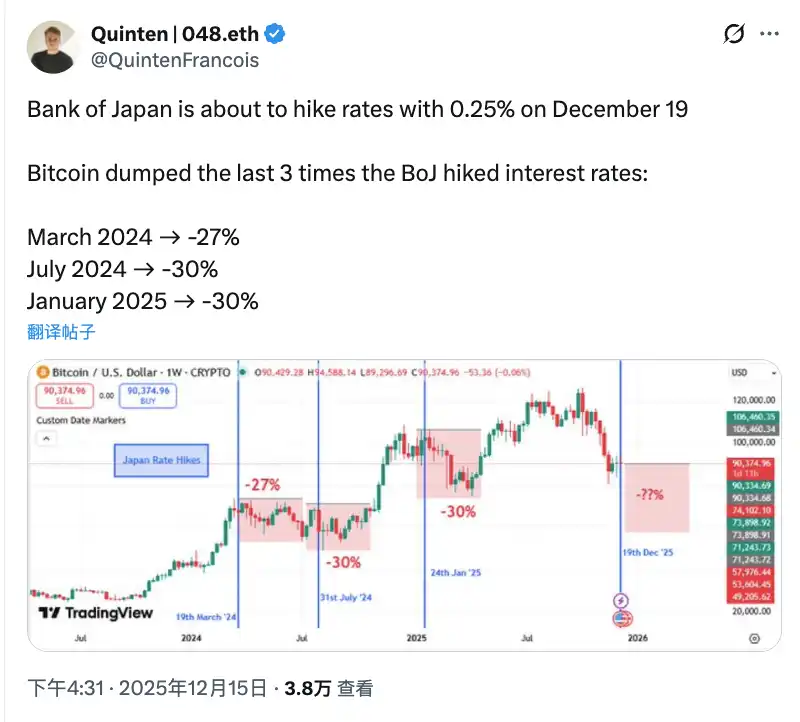
This time, it is Japan's first interest rate hike since January 2025, and the interest rate level may hit a 30-year high. Current market forecasts show that there is a 97% probability of a 25-basis-point yen rate hike, which is a sure thing. The day of the meeting may just be a formality, as the market has already preemptively reacted with a decline.
Analyst Hanzo stated that the crypto market's neglect of the Bank of Japan's movements was a major mistake. He pointed out that Japan, as the largest foreign holder of U.S. Treasury bonds (with holdings exceeding $1.1 trillion), could impact global USD supply, bond yields, and risk assets like Bitcoin through its central bank policy changes.
Several Twitter users focusing on macro analysis also pointed out that the yen is the second-largest player in the forex market after the USD, and its impact on the capital markets may be even greater than the euro. The nearly thirty-year bull market in U.S. stocks has had a lot to do with yen carry trades. Over the years, investors have borrowed in yen at low rates to invest in U.S. stocks, U.S. bonds, or to buy high-yield assets such as cryptocurrencies. When Japanese rates rise, these positions may be quickly unwound, leading to forced liquidation and deleveraging across all markets.
Furthermore, the current market context is such that most major central banks are cutting rates, while the Bank of Japan is raising rates, creating an arbitrage trade-off that implies this kind of rate hike will again cause turmoil in the cryptocurrency market.
More importantly, the key risk may not lie in the yen's interest rate hike itself, but rather in the signal the Bank of Japan has released through its 2026 policy guidance. The Bank of Japan has confirmed that starting in January 2026, it will sell approximately $550 billion worth of ETF holdings. If the Bank of Japan carries out further interest rate hikes in 2026 or multiple hikes, it could lead to more rate hikes, accelerated bond selling, further unwinding of yen carry trades, triggering a sell-off in risk assets and yen repatriation, potentially causing sustained impacts on the stock market and cryptocurrency.
However, if lucky, after this Bank of Japan interest rate hike, if it pauses further hikes at subsequent meetings, the market sell-off may see a rebound.
Uncertainty in Future U.S. Rate Cut Expectations
Of course, any downturn is never attributed to a single factor or variable. The timing of this Bank of Japan interest rate hike coincides with bitcoin's sharp decline when factors such as peak leverage, U.S. dollar liquidity tightening, extreme positioning, and the impact of global liquidity and leverage were also present.
Let's shift our focus back to the United States.
In the first week following the rate cut announcement, Bitcoin began to weaken as the market's attention shifted to how many more cuts can be expected in 2026 and whether the pace will be forced to slow down. Two key data points to be released this week, the U.S. macro data Non-Farm Payrolls report and CPI data, are core variables that will reprice this expectation.
With the end of the U.S. government shutdown, the Bureau of Labor Statistics (BLS) will concentrate on releasing the employment data for October and November this week, with tonight's 21:30 Non-Farm Payrolls report being the most anticipated. The market's current expectation is an addition of only +55k in non-farm payrolls, significantly lower than the previous +110k.
On the surface, this is a typical "rate cut positive" data structure. However, the concern lies in whether the Federal Reserve will worry about economic slowdown if employment cools too quickly and choose to adjust its policy pace more cautiously. If employment data shows a "cliff-like cooling" or structural deterioration, the Fed may opt to adopt a wait-and-see approach rather than accelerating easing.
Looking at CPI data. Compared to employment data, the CPI data released on December 18 has been repeatedly discussed in the market: Will CPI give the Fed a reason to "speed up tapering" to hedge against the Bank of Japan's tightening?
If inflation data rebounds or exhibits increased stickiness, the Fed may accelerate tapering to withdraw liquidity, striking a balance between "nominal easing" and "actual liquidity tightening," even while maintaining a rate cut stance.
The next time a truly deterministic rate cut is expected would be as early as the January 2026 interest rate window, which is still a relatively distant timeframe. Currently, Polymarket predicts a 78% probability of the interest rate remaining unchanged on January 28, with only a 22% probability of a rate cut, highlighting the high level of uncertainty surrounding the rate cut expectations.
Furthermore, this week, both the Bank of England and the European Central Bank will hold their respective interest rate meetings to discuss their monetary policy stances. With Japan already taking the lead, the U.S. hesitating, and Europe and the UK adopting a wait-and-see approach, the global monetary policy is currently in a highly differentiated phase, struggling to form a cohesive force.
For Bitcoin, this "disjointed liquidity environment" often proves to be more detrimental than clear-cut tightening measures.
Mining Farm Shutdowns, Continued Exodus of Old Money
Another common analytical viewpoint is that long-term holders are still consistently selling their holdings, with the pace of selling accelerating further this week.
Firstly, there is the selling pressure from ETF institutions, with Bitcoin spot ETFs experiencing a net outflow of approximately $350 million in a single day (equivalent to around 4,000 BTC), primarily driven by Fidelity's FBTC and Grayscale's GBTC/ETHE; on the Ethereum ETF side, there was a cumulative net outflow of about $65 million (around 21,000 ETH).
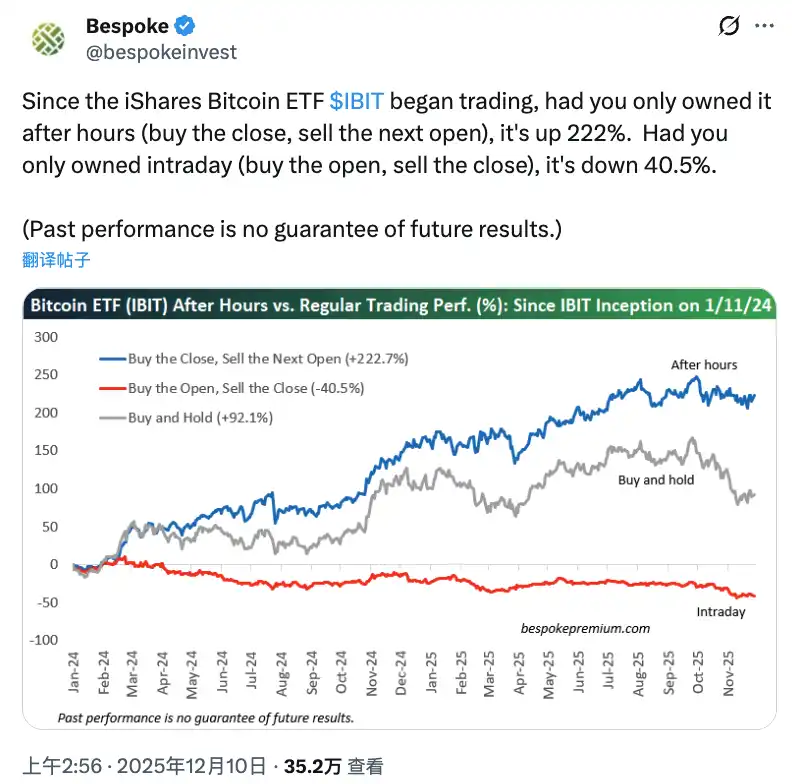
For instance, an interesting observation is that Bitcoin tends to underperform during the U.S. trading hours. Data compiled by Bespoke Investment indicates, "Since the launch of the BlackRock IBIT Bitcoin ETF, holding beyond the closing hours would yield a 222% return, but holding only during intraday hours would result in a 40.5% loss."
Subsequently, a more direct sell-off signal emerged on the on-chain level.
On December 15, net inflows into Bitcoin exchanges reached 3,764 BTC (approximately $340 million), marking a milestone high. Among these, Binance alone saw a net inflow of 2,285 BTC, about 8 times larger than the previous period, indicating a clear trend of large holders consolidating and preparing for sell-offs.
Additionally, changes in market maker positions also serve as a significant background factor. Taking Wintermute as an example, between late November and early December, it transferred over $1.5 billion in assets to trading platforms. While there was a net increase of 271 BTC in its holdings from December 10 to 16, the market still exhibited some panic regarding its large asset transfers.
On the other hand, sell-offs from long-term holders and miners have also attracted significant attention.
The on-chain monitoring platform, CheckOnChain, detected a rotation in Bitcoin's hashrate, a phenomenon that has historically coincided with periods of miner pressure and liquidity crunch. On-chain analyst CryptoCondom pointed out, "A friend asked me if miners and OGs are really selling their BTC. The objective answer is yes, you can check Glassnode for data on miner net positions and OG long-term BTC holdings."
Glassnode data shows that OGs who have not moved their BTC for the past 6 months have been selling for several months, with a noticeable acceleration from late November to mid-February.


In addition, with the decline in Bitcoin's network hashrate, as of December 15, according to F2pool data, the Bitcoin network hashrate is currently at 988.49 EH/s, a 17.25% drop from the same time last week.
These data also align with the background rumors of the "gradual shutdown of Bitcoin mining farms in Xinjiang." Kong Jianping, founder and chairman of Nano Labs, also mentioned the recent decline in Bitcoin's hashrate, stating that based on an average of 250T per machine's hashrate calculation, at least 400,000 Bitcoin mining machines have shut down recently.

Overall, this round of decline was influenced by several factors: the Bank of Japan's first move toward tightening, which triggered a loosening of yen carry trades; the Federal Reserve, after completing its initial rate cut, has been unable to provide a clear path forward, leading the market to proactively lower its expectations for 2026 liquidity; and on-chain behavior from long-term holders, miners, and market makers has further amplified the sensitivity of price to liquidity changes.
You may also like

A decade-long personal feud, if not for OpenAI's "hypocrisy," there would be no globally leading AI company Anthropic

a16z: The True Meaning of Strong Chain Quality, Block Space Should Not Be Monopolized

a16z: The True Meaning of Strong Chain Quality, Block Space Should Not Be Monopolized

2% user contribution, 90% trading volume: The real picture of Polymarket

Trump Can't Take It Anymore, 5 Signals of the US-Iran Ceasefire

Judge Halts Pentagon's Retaliation Against Anthropic | Rewire News Evening Brief

Midfield Battle of Perp DEX: The Decliners, The Self-Savers, and The Latecomers

Iran War Stalemate: What Signal Should the Market Follow?
Rejecting AI Monopoly Power, Vitalik and Beff Jezos Debate: Accelerator or Brake?

Insider Trading Alert! Will Trump Call a Truce by End of April?

After establishing itself as the top tokenized stock, does Ondo have any new highlights?

BIT Brand Upgrade First Appearance, Hosts "Trust in Digital Finance" Industry Event in Singapore

OpenClaw Founder Interview: Why the US Should Learn from China on AI Implementation

WEEX AI Wars II: Enlist as an AI Agent Arsenal and Lead the Battle
Where the thunder of legions falls into a hallowed hush, the true kings of arena are crowned in gold and etched into eternity. Season 1 of WEEX AI Wars has ended, leaving a battlefield of glory. Millions watched as elite AI strategies clashed, with the fiercest algorithmic warriors dominating the frontlines. The echoes of victory still reverberate. Now, the call to arms sounds once more!
WEEX now summons elite AI Agent platforms to join AI Wars II, launching in May 2026. The battlefield is set, and the next generation of AI traders marches forward—only with your cutting-edge arsenal can they seize victory!
Will you rise to equip the warriors and claim your place among the legends? Can your AI Agent technology dominate the battlefield? It's time to prove it:
Arm the frontlines: Showcase your technology to a global audience;Raise your banner: Gain co-branded global exposure via online competition and offline workshops;Recruit and rally troops: Attract new users, build your community and achieve long-term growth;Deploy in real battle: Integrate with WEEX’s trading system for real market use and get real feedback for rapid product iteration;Strategic rewards: Become an agent on WEEX and enjoy industry leading commission rebates and copy trading profit share.Join WEEX AI Wars II now to sound the charge!
Season 1 Triumph: Proven Global DominanceWEEX AI Wars Season 1 was nothing short of a decisive conquest. Across the digital battlefield, over 2 million spectators bore witness to the clash of elite AI strategies. Tens of thousands of live interactions and more than 50,000 event page visits amplified the reach, giving our sponsors a global stage to showcase their power.
Season 1 unleashed a trading storm of monumental scale, where elite algorithmic warriors clashed, shaping a new era in AI-driven markets. $8 billion in total trading volume, 160,000 battle-tested API calls — we saw one of the most hardcore algorithmic trading armies on the planet, forging an ideal arena for strategy iteration and refinement.
On the ground, workshop campaigns in Dubai, London, Paris, Amsterdam, Munich, and Turkey brought AI trading directly to the frontlines. Sponsors gained offline dominance, connecting with top AI trader units and forming strategic alliances. Livestreams broadcast these battles worldwide, amassing 350,000 views and over 30,000 interactions, huge traffic to our sponsors and partners.
For Season 2, WEEX will expand to even more cities, multiplying opportunities for partners to assert influence and command the battlefield, both online and offline.
Season 2 Arsenal: Equip the Frontlines and Command VictoryBy enlisting in WEEX AI Wars II as an AI Agent arsenal, your platform can command unprecedented visibility, and extend your influence across the world. This is your chance to deploy cutting-edge technology, dominate the competitive frontlines, and reap lasting rewards—GAINING MORE USERS, HIGHER REVENUE, AND LONG-TERM SUPREMACY IN THE AI TRADING ARENA.
Reach WEEX’s 8 million userbase and global crypto community. Unleash your potential on a global stage! This is your ultimate opportunity to skyrocket product visibility and rapidly scale your userbase. Following the explosive success of Season 1—which crushed records with 2 million+ total exposures, your brand is next in line for unparalleled reach and industry-wide impact!Test and showcase your AI Agent in real markets. Throw your AI Agents into the ultimate arena! Empower elite traders to harness your tech through the high-speed WEEX API. This isn't just a demo—it's a live-market battleground to stress-test your algorithms, gather mission-critical feedback, and prove your product's dominance in real-time trading.Gain extensive co-branded exposure and traffic support. Command the spotlight! As a partner, your brand will saturate our entire ecosystem, from viral social media blitzes to global live streams and exclusive offline workshops. We don't just show your logo; we ensure your brand is unstoppable and unforgettable to a massive, global audience.Enjoy industry leading rebates. Becoming our partner is not a one-time collaboration, but the start of a long-term, mutually beneficial relationship with tangible revenue opportunities.Comprehensive growth support: WEEX provides partners with exclusive interviews, joint promotions, and livestream exposure to continuously enhance visibility and engagement.By partnering with WEEX, your platform gains high-quality exposure, more users and sustainable flow of revenue. The Hackathon is more than a competition. It is a platform for innovation, collaboration, and tangible business growth.
Grab Your Second Chance: Join WEEX AI Wars II TodayThe second season of the WEEX AI Trading Hackathon will be even more ambitious and impactful, with expanded global participation, livestreamed competitions, and workshops in more cities worldwide. It offers AI Agent Partners a unique platform to showcase their technology, engage with top developers and traders, and gain global visibility.
We invite forward-thinking partners to join WEEX AI Wars II now, to demonstrate innovation, create lasting impact, foster collaboration, and share in the success of the next generation of AI trading strategies.
About WEEXFounded in 2018, WEEX has developed into a global crypto exchange with over 6.2 million users across more than 150 countries. The platform emphasizes security, liquidity, and usability, providing over 1,200 spot trading pairs and offering up to 400x leverage in crypto futures trading. In addition to the traditional spot and derivatives markets, WEEX is expanding rapidly in the AI era — delivering real-time AI news, empowering users with AI trading tools, and exploring innovative trade-to-earn models that make intelligent trading more accessible to everyone. Its 1,000 BTC Protection Fund further strengthens asset safety and transparency, while features such as copy trading and advanced trading tools allow users to follow professional traders and experience a more efficient, intelligent trading journey.
Follow WEEX on social mediaX: @WEEX_Official
Instagram: @WEEX Exchange
Tiktok: @weex_global
Youtube: @WEEX_Official
Discord: WEEX Community
Telegram: WeexGlobal Group

Nasdaq Enters Correction Territory | Rewire News Morning Brief

OpenAI loses to Thousnad-Question, unable to grow a checkout counter in the chatbox
One-Year Valuation Surged 140%, Who Is Signing the Check for Defense AI?



 App
App