
 Buy Crypto
- Markets
 Futures
- Spot
- Copy Trade
- Earn
- More
Hyperbeat, to launch a "bank" on Hyperliquid

Original Title: "Hyperbeat: The Person Behind the 'Bank' on Hyperliquid"
Original Author: Sanqing, Foresight News
On April 8, the Hyperliquid native protocol Hyperbeat launched Liquid Banking, deploying a self-managed "bank" on HyperEVM, integrating stablecoin deposits, VISA card spending, perpetual contract trading, and multi-currency fiat transactions into a single on-chain smart wallet.
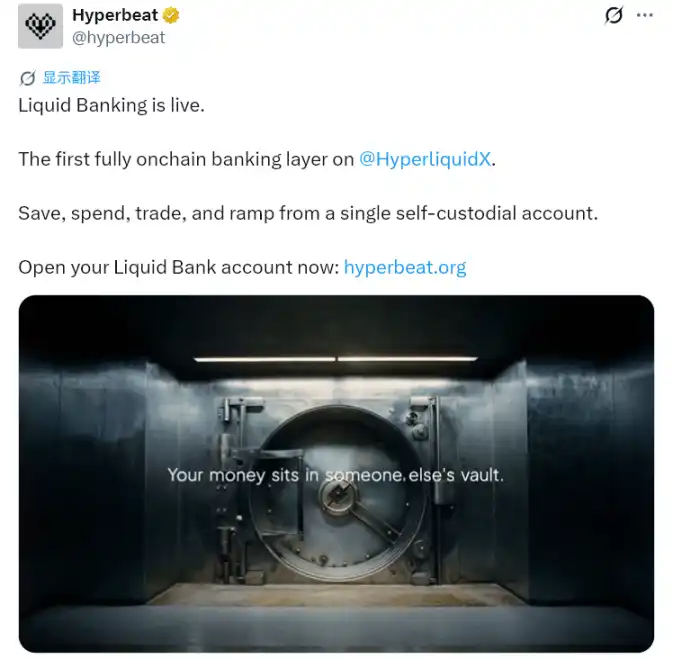
Image Source: Hyperbeat Tweet
The Hyperbeat team transitioned from the Hyperliquid testnet's initial validators, starting with only 5 members and self-raising around $200,000 to kick off. The two co-founders, Kilian Boshoff (@Fundi_Crypto) and 800.HL (@degennQuant), have kept a low profile, with the former having a background from Stellenbosch University in South Africa, and the company registered in the Cayman Islands.
In August 2025, they completed a $5.2 million seed round, led by ether.fi Ventures and Electric Capital, with participation from Coinbase Ventures, Maelstrom, Anchorage Digital, among others, valuing the company at around $40 million.
Morpho Powers the Engine, Creating a 'Bank' in Ten Months
The core selling point of Liquid Banking is Credit Mode.
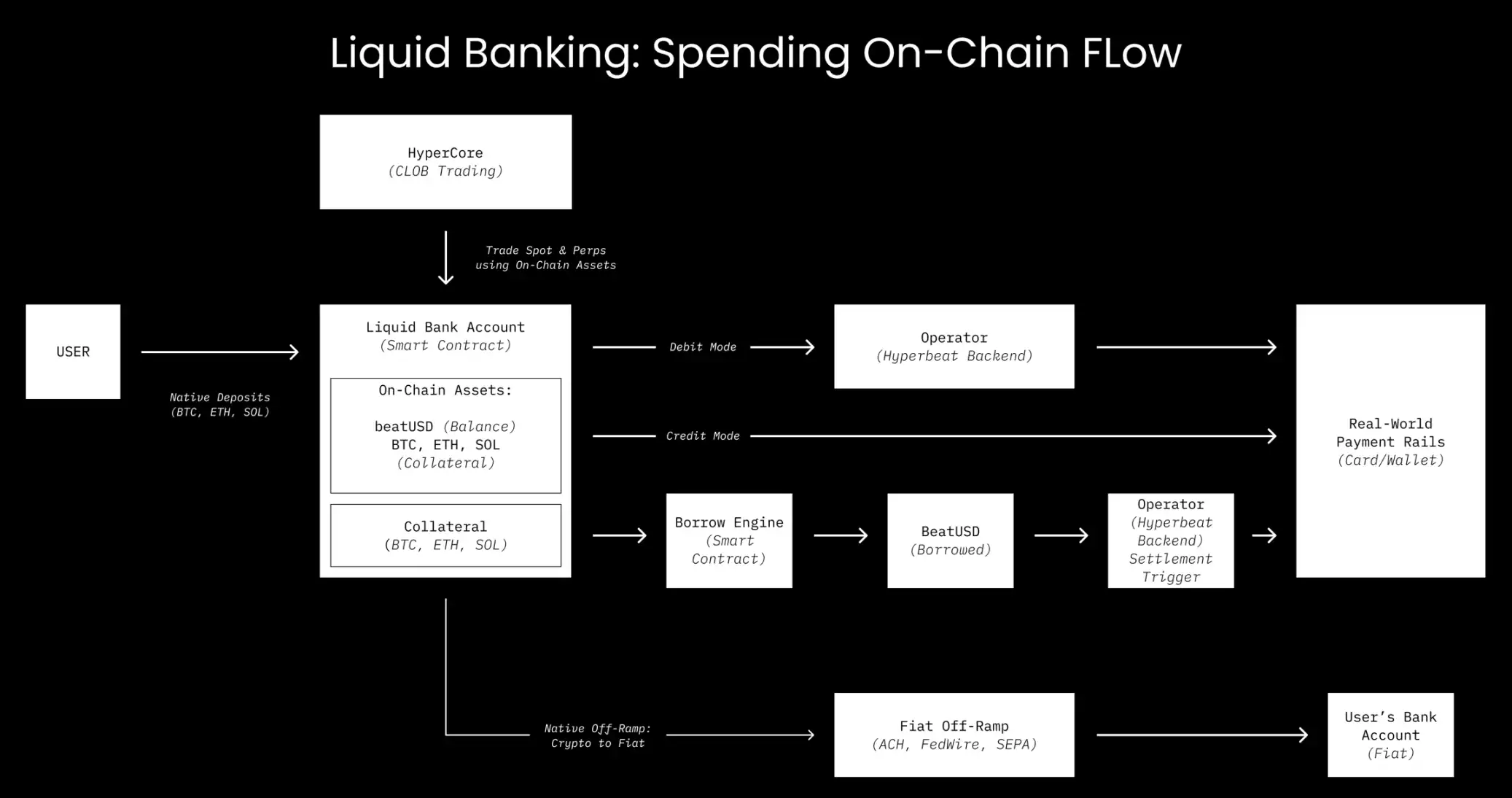
CREDIT Mode | Image Source: Hyperbeat Docs
Users deposit assets such as BTC, ETH, HYPE as collateral, and when they swipe their VISA card, the system instantly borrows stablecoins through the Morpho Blue market to complete the payment, while the collateral remains on-chain to continue earning rewards. Users never interact with a lending interface throughout the process, as the act of swiping the card itself constitutes an on-chain loan.
The underlying lending engine comes from Morpho. Hyperbeat integrates Morpho into users' smart wallets through an on-chain whitelist mechanism. Currently, Credit Mode is running on six isolated markets, with collateral including HYPE, UBTC, UETH, USOL, and even the gold token XAUT.
Hyperbeat does not touch the core lending logic, and Morpho does not touch the user interface. The former creates the "bank frontend," while the latter provides the "credit engine."
The stablecoin deposits in Liquid Banking are centered around the native stablecoin beatUSD issued in collaboration with Paxos Labs. Paxos provides the stablecoin infrastructure (based on USDG0), with reserve earnings flowing directly back into Hyperbeat's reward program and ultimately distributed to users, rather than remaining with the issuer.
The USD+ Treasury on the deposit side automatically allocates user funds to Morpho and protocols like Hypuur, Hyperlend, Felix, offering an annual percentage yield of 3%-8%.
The earnings come from real lending interest from Credit Mode consumers. The more the consumption, the higher the deposit yield. However, whether this cycle can be sustained depends on the actual consumption volume.
Non-selling coin consumption, but card swiping accrues interest
The fiat deposits and withdrawals in Liquid Banking are provided by Noah, supporting USD (ACH, FedWire) and Euro (SEPA) deposits, with each account linked to a unique IBAN.
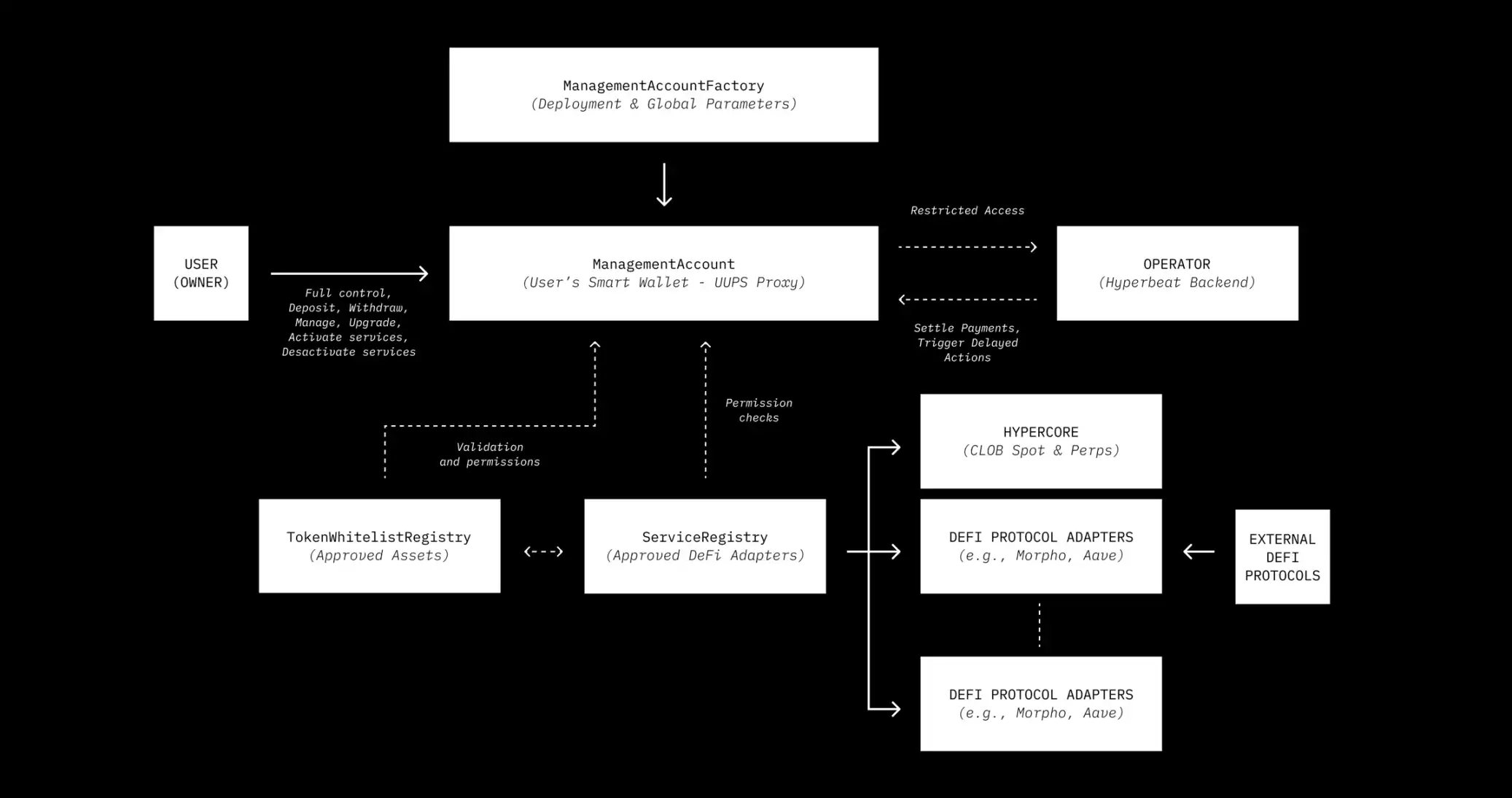
Liquid Banking Architecture | Source: Hyperbeat Docs
In March 2026, direct deposits and withdrawals for the Vietnamese Dong and Malaysian Ringgit will be further enabled, with withdrawals also covering currencies like Pound Sterling, Dirham, Baht, among a dozen others.
The VISA card is issued by Third National, with the underlying infrastructure provided by Rain, a Visa Principal Member. By early January 2026, its funding valuation had reached $1.95 billion, with an annualized processing volume exceeding $30 billion, covering over a hundred countries.
The card is classified as Visa Signature, with benefits such as airport lounge access. Foreign exchange transactions incur a 1% FX fee (based on Visa's official rate), no annual fee, no swipe fees; ATM withdrawals cost $1 + 0.65%; default monthly spending limit of $100,000.
The Credit Mode's lending interest rate fluctuates with the Morpho market utilization rate, but there is no interest-free period; interest on each "HODL & Borrow" transaction starts accruing from the moment of the transaction.
The Hyperbeat official "no hidden fees" refers to the transparency of the yield strategy, not the card fee pricing. The Credit Mode lending interest rate is dynamically determined by the Morpho market, without an interest-free period, meaning that the real-time cost of "HODL & Borrow" convenience exists and is not low.
Self-Custody Comes with a One-Day Cooling-Off Period
Unlike all centralized crypto cards, user assets always stay in their self-controlled ManagementAccount smart wallet. The Hyperbeat backend only has a limited Operator role, which can only settle within the user-set limits and cannot transfer assets to unauthorized addresses.
However, self-custody must address one issue: what if users front-run withdrawals after swiping their card? Hyperbeat has introduced an on-chain time-lock mechanism.
Settlement token withdrawals require a cooling-off period and confirmation process, collateral withdrawals require Operator approval to prevent defaults, and mode switches also have delays. The contract has been audited by Zellic and Nethermind, and key management is provided by Turnkey.
These frictions are not bugs but features. It acknowledges the speed difference between on-chain settlement and offline consumption, filling the gap with contract rules instead of "trust us." However, users must monitor their health factor themselves, as there is no customer service to help undo operational errors.
You may also like
Bitcoin Hits $73,000 Triggering $427M Short Liquidation | Carl Moon: $200,000 is the Target
April 9, 2026 (UTC+0), 22:17. Bitcoin (BTC) executed a high-velocity surge within minutes, heavy-hitting the $73,000 psychological barrier and touching a local high near $74,000. While the price has since retraced to consolidate above $72,000, this "instant ambush" successfully completed a $427M liquidation of short positions.

a16z partner: perpetual contracts are rewriting the global trading rules
Bitcoin ETF Inflows Just Turned Positive After 5 Months of Outflows: What Does That Mean for BTC Price Now?
The Hidden Risks Behind Bitcoin ETF Inflows in 2026: What Traders Should Know. The question now isn't whether inflows are happening. It's what they're telling you about the next phase and whether your portfolio is positioned for it.
Decoding 2026's Bitcoin ETF Data: How to Trade Alongside Institutional Smart Money in 2026
After months of sustained outflows, rolling 30-day net ETF inflows just crossed 30,000 BTC. That's not noise. Historically, when institutional capital rotates back in at this scale, it marks a regime shift — not just a bounce.

Auto Earn Bonus 2026: WEEX vs Binance vs Bybit vs OKX vs Kraken (Only 1 Pays Extra)
Auto Earn 2026: Binance? Bybit? No extra bonus. Only WEEX gives +0.5% + 300% APR referral. Limited-time. See exactly how much more you can earn.

Auto Earn 2026: WEEX Offers 0.5% Extra + 300% APR Bonus — More Than Binance & Bybit?
Most exchanges offer Auto Earn, but only WEEX adds an extra 0.5% bonus on balance growth + 300% APR referral rewards in 2026. Here’s how WEEX compares to Binance, Bybit, OKX, and Kraken — and why you might earn more with a simple toggle.

Seven Green Candles Meet Three White Soldiers | Rewire News Morning Brief

Gold Revisits $4800, Where Is the Top This Year?

Anthropic's Earth's Most Powerful AI So Strong It Made Wall Street Hold Emergency Meeting, But JPMorgan Was Missing Its "Antidote"

Why did Covenant AI flee from Bittensor?

March Exchange Rankings: Market Shrinks Overall, Spot Trading Volume Sees Rare Over 20% Decline

After the node dropped by 70%, Solana is anxious this time

Morning News | Binance officially launches prediction market; Circle introduces stablecoin settlement solution; Bitmine listed on the NYSE main board
WEEX OTC Now Supports EUR Deposits via SEPA Bank Transfer
To provide a smoother, more accessible fiat on-ramp, WEEX OTC has added SEPA Bank Transfer.
Crypto Market Macro Research: US-Iran Ceasefire, Time to Reassess Risk Assets

Is Bitcoin Forming a Bottom in 2026? How the Tariff Shock and Ceasefire Could Push BTC Toward $75K
Bitcoin may be forming its 2026 bottom near $65K. See how tariff shocks, ETF inflows, and the Iran ceasefire could shape BTC’s next breakout toward $75K.

Stablecoins Hit $315 Billion in 2026: Why This Is the Biggest Trend in Crypto Right Now
Bitcoin may be forming its 2026 bottom near $65K. See how tariff shocks, ETF inflows, and geopolitical signals could shape BTC’s next breakout toward $75K.
Tiger Research: A Comprehensive Analysis of the Most Profitable Businesses and Their Business Models in Crypto
Bitcoin Hits $73,000 Triggering $427M Short Liquidation | Carl Moon: $200,000 is the Target
April 9, 2026 (UTC+0), 22:17. Bitcoin (BTC) executed a high-velocity surge within minutes, heavy-hitting the $73,000 psychological barrier and touching a local high near $74,000. While the price has since retraced to consolidate above $72,000, this "instant ambush" successfully completed a $427M liquidation of short positions.
a16z partner: perpetual contracts are rewriting the global trading rules
Bitcoin ETF Inflows Just Turned Positive After 5 Months of Outflows: What Does That Mean for BTC Price Now?
The Hidden Risks Behind Bitcoin ETF Inflows in 2026: What Traders Should Know. The question now isn't whether inflows are happening. It's what they're telling you about the next phase and whether your portfolio is positioned for it.
Decoding 2026's Bitcoin ETF Data: How to Trade Alongside Institutional Smart Money in 2026
After months of sustained outflows, rolling 30-day net ETF inflows just crossed 30,000 BTC. That's not noise. Historically, when institutional capital rotates back in at this scale, it marks a regime shift — not just a bounce.
Auto Earn Bonus 2026: WEEX vs Binance vs Bybit vs OKX vs Kraken (Only 1 Pays Extra)
Auto Earn 2026: Binance? Bybit? No extra bonus. Only WEEX gives +0.5% + 300% APR referral. Limited-time. See exactly how much more you can earn.
Auto Earn 2026: WEEX Offers 0.5% Extra + 300% APR Bonus — More Than Binance & Bybit?
Most exchanges offer Auto Earn, but only WEEX adds an extra 0.5% bonus on balance growth + 300% APR referral rewards in 2026. Here’s how WEEX compares to Binance, Bybit, OKX, and Kraken — and why you might earn more with a simple toggle.


 App
App