
 Buy Crypto
- Markets
 Futures
- Spot
- Copy Trade
- Earn
- More
Life Insights in a Transaction

Original Article Title: Life lessons from trading
Original Article Author: thiccy, cofounder of scimitar capital
Translation: SpecialistXBT, BlockBeats
Editor's Note: Trading is a mirror, reflecting the relationship between people and reality. This article, on the surface, is about how to survive in the market, but in reality, it explores a more universal life theme: how to recognize your strengths, how to calibrate your understanding of the world, how to make decisions in uncertainty, and how to maintain humanity in a zero-sum game. The author says, "In a sense, everyone is a trader," as we all bet on the future with incomplete information, the only difference being the form of the chips.

1) Traders make money by speculating on fund flows.
2) There are many ways to win in the speculation game:
Some people can quickly read new information
Some people can quickly make speculations
Some people can accurately process new information
Some people can quickly identify patterns
Some people can see patterns that others cannot
Some people can accurately interpret others' predictions
Some people have a network of insiders who can gossip about fund flows
Some people can chase funds that others cannot, do not want to, or do not know how to chase
3) Each skill is called an "edge," and you can think of each skill as a attribute value in the game.
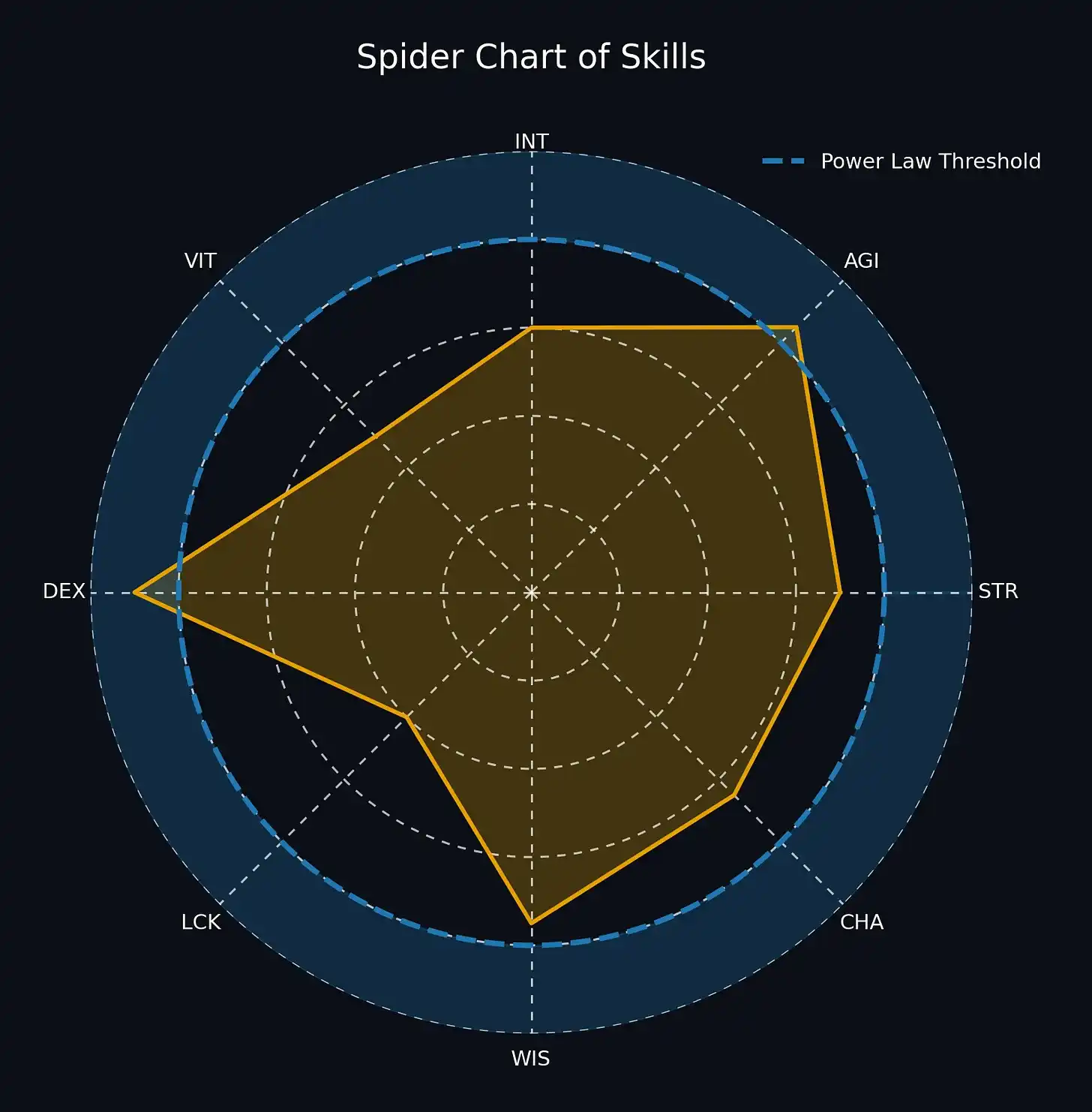
4) This game is winner-takes-all. If you want to continue making money, you need to fill in the attribute circles and cross the power law threshold.
5) Team hunting is easier. Overlaying everyone's best skills can cross more thresholds. A great trading team is a positive-sum game. The whole is greater than the sum of its parts.
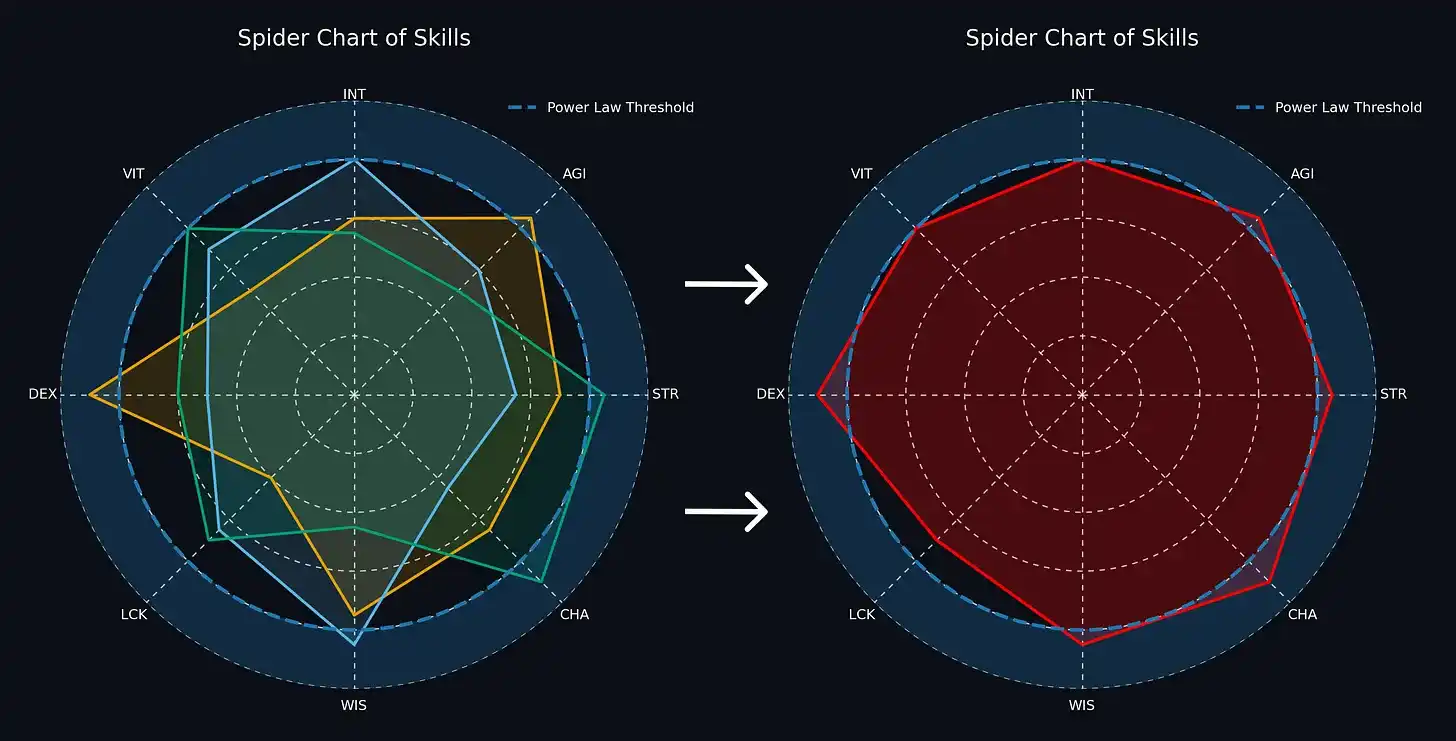
6) Trust is built through constantly escalating trust tests. Calibrating the scale of trust tests is crucial. Too large will lead you to be scammed, too small will hinder the compounding growth of the relationship. Generosity is very useful. Most people in trading will feel lonely, so making this process fun is a valuable skill.
7) If you want to win, you must be willing to sacrifice everything. In reality, most people are not that eager for success, and that's okay.
8) Only play games that you can learn to consistently win. Honestly calibrate your abilities and your true level of ability in the world. Achieving a world-class level in any game requires intense focus, courage, and often rare talents shaped from childhood. Most importantly, find a game that suits your specific strengths. Playing a game that doesn't suit you is the most common tragedy in this industry. Trading has swallowed up and spit out millions of people, wasting their prime years and scattering their stories to the wind.
9) The guessing game always becomes increasingly difficult over time as it is an adaptive Darwinian system. People learn, knowledge spreads, advantages decay, winners grow, and losers perish.
10) Survivorship bias is everywhere. Always ask yourself why someone smarter, better connected, or faster than you didn't seize this opportunity before you.
11) Most market participants are just flipping coins at each other. Occasionally, someone will flip twenty heads in a row, looking like a genius, and then trigger a wave of blind followers.
12) Your best trades will be swift and fierce.
13) Trading exposes your deepest insecurities to yourself and the world. It is a rapid reckoning of reality and your place within it. In a sense, everyone is a trader. We make calculated decisions with incomplete information, manage drawdowns to avoid bankruptcy, and convert our natural advantages into returns. Almost everything boils down to aligning your understanding of yourself with your understanding of the world. Many people underestimate their most potent unique traits and take on too little risk when building a life around those traits.
14) Envy is the most potent emotion of the internet age. Handled well, it can quickly copy effective things from the best people. Handled poorly, it generates scarcity-driven anxiety and fatigue.
15) With the passage of trading time, you'll realize the eventual need to build an identity founded on something stable. Identities built on talent or a "niche perspective" are quickly challenged. Identities based on a problem-solving thought process are more sustainable, even if they sacrifice novelty and excitement.
16) Only paranoiacs survive. Panic before others. Always have an exit plan. Avoid deep drawdowns. Stay humble, leaving room for the unknown unknowns. Recognize when you're selling tail risk. Maintain liquidity. Respect counterparty risk. Respect path dependence.
17) People often build a man-made paradise around the goals they chase and a man-made hell around the anxieties they evade. This framework can inspire a temporary outburst of motivation, but it is not a sustainable way of life. The sense of scarcity and anxiety can distort decision-making, making you susceptible to ideological capture.
18) Trading is a zero-sum game within a larger positive-sum game. While each trade has a winner and a corresponding loser, the market as a whole allocates resources in space and time, aiding in the development of civilization. The emergent goals of a complex system are often only clear in hindsight. If you are too cynical about the futility of what you are doing, you will be spiritually annihilated and depleted.
19) It is challenging to see the big picture clearly. You are an individual ant trying to understand the collective behavior of the ant colony. Price and price action are a low-dimensional projection of a vast machine. The market fluctuates for various reasons, but we simplify views, compressing them into a single concise narrative.
20) Money can change a lot of things, but not everything. When you understand what truly changes and what remains constant, you will experience the pain of growth.
21) Profiting in trading means your view of the world is closer to reality than the average market participant. However, seeing through the essence in one market does not mean you can do the same in another. The ability to transfer across markets is a higher-order skill: discovering and capitalizing on advantages, insight into adverse selection, and knowing where the power-law critical points lie.
22) Those who make a living from trading often age rapidly. The mental stress cost is high. Make a conscious effort to take care of yourself. Without health, money loses its meaning.
23) Winning streaks often mask bad habits that will eventually backfire over time. Losing streaks will make you question the entire process. Do not get too excited at the peak or disheartened at the trough.
24) The world is in a constant state of decay. Reality is ever-changing, and everyone's models will become outdated and misaligned. That's why there's always room for young, success-hungry, and obsessed individuals to make money. People are like their life's moving average. Short windows are the first to capture new trends, even if what they capture is partly noise.
25) The market trains you to see self-reinforcing and self-correcting loops where you look.
26) Most of the excess opportunities in the modern market ultimately stem from people trying to fill the void of existential meaning.
27) I am grateful to be able to play this game with friends and reap rewards from it. Life is indeed beautiful.
You may also like

The 17-Year Mystery Will Be Solved, Who is Satoshi Nakamoto?

5 Minutes to Make AI Your Second Brain

Uniswap is trapped in an innovation dilemma

What is the key to competition in crypto banking?

The flow of stablecoins and the spillover effects in the foreign exchange market

After two years, Hong Kong's first batch of stablecoin licenses finally issued: HSBC, Standard Chartered make the cut
The person who helped TAO rise by 90% has now single-handedly crashed the price again today

3-Minute Guide to Participating in the SpaceX IPO on Bitget

Top 5 Cryptos to Buy in 2026 Q1: A ChatGPT Deep Dive Analysis
Explore the top 5 cryptos to buy in Q1 2026 including BTC, ETH, SOL, TAO, and ONDO. See price outlooks, key narratives, and institutional catalysts shaping the next market move.

How to Earn $15,000 with Idle USDT Before Altcoin Season 2026
Wondering if altcoin season is coming in 2026? Get the latest market update, and learn how to turn your idle stablecoins waiting for entry into extra rewards up to 15,000 USDT.
Can You Win Joker Returns Without Large Trading Volume? 5 Mistakes New Players Make In WEEX Joker Returns Season 2
Can small traders win WEEX Joker Returns 2026 without huge volume? Yes—if you avoid these 5 costly mistakes. Learn how to maximize card draws, use Jokers wisely, and turn small deposits into 15,000 USDT rewards.

Altcoin Season 2026: 4 Stages to Profit (Before the Crowd FOMO In)
Altcoin Season 2026 is starting — discover the 4 key stages of capital rotation (from ETH to PEPE) and how to position before the peak. Learn which tokens will lead each phase and avoid missing the rally.

Will Alt season come in 2026? 5 Tips to Spot the Next 100x Crypto Opportunities
Will altcoin season arrive in 2026? Discover 5 rotation stages, early signals smart traders watch, and the key crypto sectors where the next 100x altcoin opportunities may emerge.

The bear market has arrived, and cryptocurrency ETF issuers are also getting involved

The richest man had a quarrel with his former boss

BTC Firm Above 70K! Saylor’s "Institutional Logic" vs. Moon’s "Retail Faith": Who is Really Harvesting the Market?
Bitcoin is holding firm above the $70,000 support level following a massive short squeeze that liquidated $427 million. As the "Four-Year Cycle" narrative shifts, the market is split: Michael Saylor’s cold, institutional "indiscriminate stacking" vs. Carl Moon’s high-energy retail "hopium." This article decodes these two polar-opposite strategies for the 2026 bull run and reveals how WEEX’s institutional-grade liquidity and AI trading tools empower every type of investor to convert market volatility into profit.

The Girl Who Created the SBTI Test: A Story of a Doomed Cyber Love, an E-Widow Ratfolk



 App
App