
 Buy Crypto
- Markets
 Futures
- Spot
- Copy Trade
- Earn
- More
Musk's Million-Dollar Artistic Creation Reward, Long-Form Content Revival, and Everything App's Ambition

Entering 2026, X (Twitter) has been quite active. While we can't see if anxiety is written on Musk's face, we can see Musk's anxiety written in his tweets.
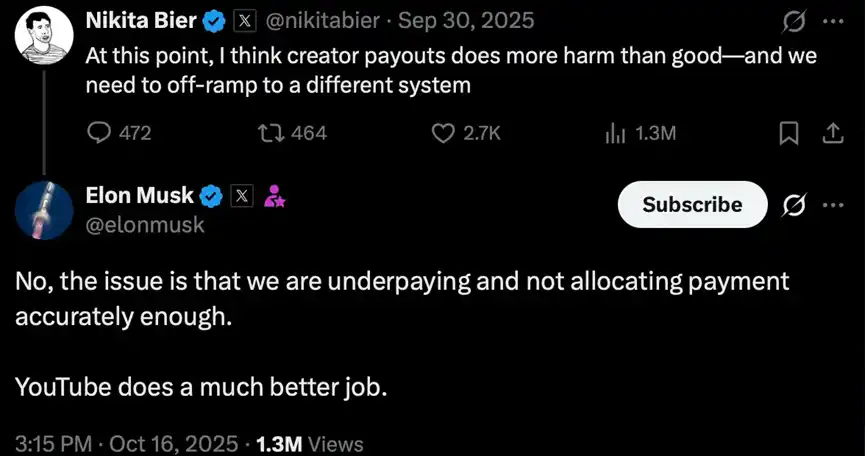
Musk said, "We still pay creators too little money, and the distribution is not done well enough, YouTube does much better in this regard."
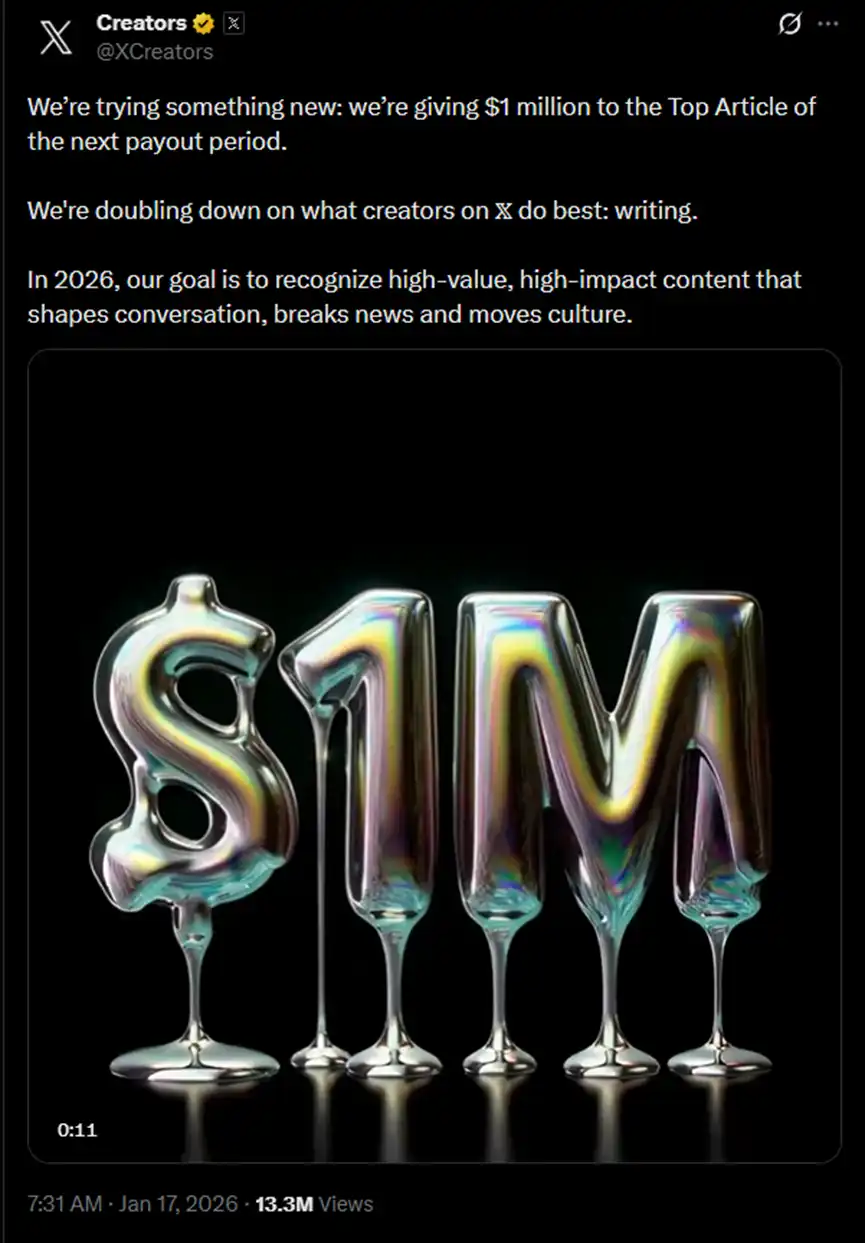
Moreover, last weekend, X officially launched a "Million Dollar Article Reward Event," sparking a wave of "long article fever" on the platform.
Currently, the most impactful article is "How to Fix Your Life in 1 Day" by DAN KOE. This article has received over 1.5 billion reads and has been retweeted by Musk.

Since Musk's acquisition of X several years ago, why has he started vigorously promoting X's creator ecosystem this year? In today's fragmented global user reading habits, why choose long articles as the key content type to promote? Can the revival of long-form content really support Musk's Everything App ambitions?
Musk's Anxiety
Every family has its own challenges, and even geniuses face anxiety. The relentless pressure from competitors and X's financial performance have also made Musk restless.
X is facing fierce competition in user growth and engagement, especially since Meta's Threads were launched in 2023, showing rapid growth and surpassing or closely approaching X in several metrics.
According to data analytics firm Similarweb's latest data released in early January 2026, Threads' global mobile Daily Active Users (DAU) have exceeded X, averaging 143.2 million, while X stands at 126.2 million. Looking at the growth trends, X's global DAU has seen an 11.9% year-on-year decrease, while Threads achieved an astonishing 37.8% growth. Even in X's home market, the United States, although X still leads Threads with 21.2 million DAU compared to Threads' 19.5 million, the gap is rapidly narrowing, with the latter seeing a 41.8% annual growth rate, while X has declined by 18.4%.
In terms of Monthly Active Users (MAU), Threads has also performed well. As of January 2026, its MAU has reached 320 million, and it grew from 350 million to 400 million in 2025. In comparison, X's MAU, although still at around 611 million, has lost approximately 32 million users since Musk's acquisition. This ebb and flow trend undoubtedly has put tremendous pressure on Musk.
The decline in user data has directly impacted X's core revenue source — advertising. According to public data, X's global ad revenue dropped to $25 billion in 2024, almost halving from $44 billion in 2022. Although a slight rebound to $22.6 billion is projected for 2025, the overall decline is still significant, with some institutions predicting that it will only recover to $2.7 billion by 2027.
Meanwhile, competitor Threads is highly anticipated by the capital market. Analysts forecast that Threads' advertising revenue in 2026 could reach $11.3 billion, several times higher than X's estimated revenue. Although X achieved quarterly revenue growth at the end of 2025, the company remains in a loss-making position overall due to high restructuring costs.
Although Premium subscribers (X Premium) saw significant growth in 2025, their revenue contribution is far below Musk's initial target of "50% of total revenue." Therefore, X will link the growth of Premium subscriptions to creator earnings directly, not only providing higher creator revenue but also clearly calculating revenue based on the Verified Home Timeline impressions of paid users to incentivize creators to produce high-quality content that attracts paid users and thus drive more users to subscribe to the Premium service.
So much so that we eventually saw the "Million-Dollar Article Reward" event initiated by the Old Horse. Chinese users joked that in 2026, the Old Horse started the "New Concept Essay Contest" in the United States.
The Renaissance of Long-Form Content
Musk chose to use long-form articles as the breakthrough point for the X platform's creator ecosystem, not on a whim but based on deep strategic considerations of the platform's positioning.
Today, X's recommendation algorithm has a core metric — "Regret-Free User Time," which is the total time users effectively spend on a piece of content. Musk explicitly stated that this mechanism inherently favors long-form content because they can "accumulate more user seconds," thereby enhancing the content algorithm's weight and the platform's overall user engagement.
Due to its depth, context, and complete narrative, long-form content inherently extends user dwell time, contrasting sharply with the fast consumption model of short posts or videos. Recent algorithm updates have introduced "content format weighting," explicitly favoring longer-form content that requires more creative effort and has a greater impact. This is not only an incentive for creators but also a data-driven decision: high-quality long articles can effectively reduce user clicks to external links, keep users on the platform longer, and provide more high-quality training data for Elon Musk's AI project Grok AI.
Musk has repeatedly emphasized his desire to make X the "primary news source on Earth," replacing traditional media with real-time aggregation of "collective wisdom." The long-form content feature allows users to publish "complete articles or even books," enabling domain experts, eyewitnesses, and in-depth creators to directly share their full insights on the platform, rather than fragmented information. Furthermore, compared to other platforms' significant subsidies for short videos, the incentive model for long-form content is more conducive to achieving a commercial closed loop through subscriptions, thereby attracting more professional journalists and writers back to the X platform.
However, a question arises. You may ask, in today's world where global user reading habits have become fragmented, what is Elon doing with this "Renaissance"?
Undeniably, global users' digital reading habits are showing a clear trend of fragmentation, especially under the impact of short-video platforms, where younger groups like Gen Z prefer "fragmented" reading several times a day, 5-10 minutes each time. Nevertheless, data also shows that overall reading volume is actually increasing. As a countermovement, "slow, immersive reading" is on the rise, as people in digital fatigue seek depth, emotional connection, and meaningful content consumption.
What X aims for is not to become another entertainment platform like TikTok but to become more like WeChat, a "life hub" deeply integrated into every American's daily life, which Musk has always referred to as the "Everything App." To achieve this, the platform's content and service ecosystem must be significantly enriched, enhancing users' "time well spent," giving them more reasons to stay on the platform, and accomplish more tasks here.
Ambitions of the Everything App
All of Musk's efforts ultimately point to a grand goal: turning X into an "Everything App" like WeChat. However, to achieve this ambition, X still has a long way to go.
Compared to WeChat, X lags significantly in several key metrics. In terms of Monthly Active Users (MAU), WeChat has over 1.4 billion users, while X has only 557 million, less than a third of the former. Such a huge gap in user numbers makes it difficult for X to establish the robust "network effect" of WeChat—where users cannot leave because all their friends, family, and life services are on the platform. WeChat has become essential in many people's daily lives, while X is still seen by most users as a social media platform for news consumption and opinion sharing, still reminiscent of the old Twitter or the "American Weibo."
When it comes to user engagement, the gap is equally evident. The average daily usage time of WeChat users is as high as 82 minutes, while X users are only at 30-35 minutes. The reason behind this is that users can complete a large number of "productive" tasks within WeChat, such as chatting, payment, shopping, and accessing municipal services, whereas X's content consumption still relies mainly on passive browsing, which easily leads to "browse and leave" behavior.
Old Ma doesn't want X to become TikTok, so he first needs to let X break away from the entertainment-focused user experience of "browse and leave." He needs high-quality, in-depth content to enhance user engagement, attract and retain high-value users, then gradually integrate more services such as payment and e-commerce based on content, ultimately paving the way to the "Everything App."
And the grander this dream is, the deeper Musk's anxiety will be.
You may also like

From x402 to MPP: Cloudflare's crucial vote, will it go to Coinbase or Stripe?

BlackRock CEO issues annual open letter: The wave of tokenization has arrived, and we will lead this trend

When Backpack backstabs the community

When gold is no longer a safe haven, and Bitcoin continues to panic

Trump, the World's Largest Oil Trader

If the US and Iran have not reached an agreement in 5 days, what other cards does Trump have?

Tether Whale Dumps £12 Million, Backing Crypto’s ‘British Trump’
Ethereum Foundation Post: Rethinking the Division of Work Between L1 and L2 to Build the Ultimate Ethereum Ecosystem

Two Major Prediction Market Platforms Unite Rarely, What Is the Story Behind This New Fund?
Dragonfly Partners: Most agents will not engage in autonomous trading, how can crypto payments prevail?

US AI Startup Goes All In on Chinese Mega-Model | Rewire News Morning Brief

Trump Lies Again: A "Five-Day Pause" Psyop, How Wall Street, Bitcoin, and Polymarket Insiders Synced Uposciogen

When a Token Becomes Labor, People Become the Interface

Ceasefire News Leaked Ahead of Time? Large Polymarket Bets on Outcome Before Trump's Tweet
BlackRock CEO's Annual Shareholder Letter: How is Wall Street Using AI to Keep Profiting from National Pension Funds?

Sun Valley Releases 2025 Financial Report: Bitcoin Mining Revenue Reaches $670 Million, Accelerating Transformation to AI Infrastructure Platform
On March 16, 2026, in Dallas, Texas, USA, CanGu Company (New York Stock Exchange code: CANG, hereinafter referred to as "CanGu" or the "Company") today announced its unaudited financial performance for the fourth quarter and full year ended December 31, 2025. As a btc-42">bitcoin mining enterprise relying on a globally operated layout and dedicated to building an integrated energy and AI computing power platform, CanGu is actively advancing its business transformation and infrastructure development.
• Financial Performance:
Total revenue for the full year 2025 was $688.1 million, with $179.5 million in the fourth quarter.
Bitcoin mining business revenue for the full year was $675.5 million, with $172.4 million in the fourth quarter.
Full-year adjusted EBITDA was $24.5 million, while the fourth quarter was -$156.3 million.
• Mining Operations and Costs:
A total of 6,594.6 bitcoins were mined throughout the year, averaging 18.07 bitcoins per day; of which 1,718.3 bitcoins were mined in the fourth quarter, averaging 18.68 bitcoins per day.
The average mining cost for the full year (excluding miner depreciation) was $79,707 per bitcoin, and for the fourth quarter, it was $84,552;
The all-in sustaining costs were $97,272 and $106,251 per bitcoin, respectively.
As of the end of December 2025, the company has cumulatively produced 7,528.4 bitcoins since entering the bitcoin mining business.
• Strategic Progress:
The company has completed the termination of the American Depositary Receipt (ADR) program and transitioned to a direct listing on the NYSE to enhance information transparency and align with its strategic direction, with a long-term goal of expanding its investor base.
CEO Paul Yu stated: "2025 marked the company's first full year as a bitcoin mining enterprise, characterized by rapid execution and structural reshaping. We completed a comprehensive adjustment of our asset system and established a globally distributed mining network. Additionally, the company introduced a new management team, further strengthening our capabilities and competitive advantage in the digital asset and energy infrastructure space. The completion of the NYSE direct listing and USD pricing also signifies our transformation into a global AI infrastructure company."
"As we enter 2026, the company will continue to optimize its balance sheet structure and enhance operational efficiency and cost resilience through adjustments to the miner portfolio. At the same time, we are advancing our strategic transformation into an AI infrastructure provider. Leveraging EcoHash, we will utilize our capabilities in scalable computing power and energy networks to provide cost-effective AI inference solutions. The relevant site transformations and product development are progressing simultaneously, and the company is well-positioned to sustain its execution in the new phase."
The company's Chief Financial Officer, Michael Zhang, stated: "By 2025, the company is expected to achieve significant revenue growth through its scaled mining operations. Despite recording a net loss of $452.8 million from ongoing operations, mainly due to one-time transformation costs and market-driven fair value adjustments, the company, from a financial perspective, will reduce its leverage, optimize its Bitcoin reserve strategy and liquidity management, introduce new capital to strengthen its financial position, and seize investment opportunities in high-potential areas such as AI infrastructure while navigating market volatility."
The total revenue for the fourth quarter was $1.795 billion. Of this, the Bitcoin mining business contributed $1.724 billion in revenue, generating 1,718.3 Bitcoins during the quarter. Revenue from the international automobile trading business was $4.8 million.
The total operating costs and expenses for the fourth quarter amounted to $4.56 billion, primarily attributed to expenses related to the Bitcoin mining business, as well as impairment of mining machines and fair value losses on Bitcoin collateral receivables.
This includes:
· Cost of Revenue (excluding depreciation): $1.553 billion
· Cost of Revenue (depreciation): $38.1 million
· Operating Expenses: $9.9 million (including related-party expenses of $1.1 million)
· Mining Machine Impairment Loss: $81.4 million
· Fair Value Loss on Bitcoin Collateral Receivables: $171.4 million
The operating loss for the fourth quarter was $276.6 million, a significant increase from a loss of $0.7 million in the same period of 2024, primarily due to the downward trend in Bitcoin prices.
The net loss from ongoing operations was $285 million, compared to a net profit of $2.4 million in the same period last year.
The adjusted EBITDA was -$156.3 million, compared to $2.4 million in the same period last year.
The total revenue for the full year was $6.881 billion. Of this, the revenue from the Bitcoin mining business was $6.755 billion, with a total output of 6,594.6 Bitcoins for the year. Revenue from the international automobile trading business was $9.8 million.
The total annual operating costs and expenses amount to $1.1 billion.
Specifically, they include:
· Revenue Cost (excluding depreciation): $543.3 million
· Revenue Cost (depreciation): $116.6 million
· Operating Expenses: $28.9 million (including related-party expenses of $1.1 million)
· Miner Impairment Loss: $338.3 million
· Bitcoin Collateral Receivable Fair Value Change Loss: $96.5 million
The full-year operating loss is $437.1 million. The continuing operations net loss is $452.8 million, while in 2024, there was a net profit of $4.8 million.
The 2025 non-GAAP adjusted net profit is $24.5 million (compared to $5.7 million in 2024). This measure does not include share-based compensation expenses; refer to "Use of Non-GAAP Financial Measures" for details.
As of December 31, 2025, the company's key assets and liabilities are as follows:
· Cash and Cash Equivalents: $41.2 million
· Bitcoin Collateral Receivable (Non-current, related party): $663.0 million
· Miner Net Value: $248.7 million
· Long-Term Debt (related party): $557.6 million
In February 2026, the company sold 4,451 bitcoins and repaid a portion of related-party long-term debt to reduce financial leverage and optimize the asset-liability structure.
As per the stock repurchase plan disclosed on March 13, 2025, as of December 31, 2025, the company had repurchased a total of 890,155 shares of Class A common stock for approximately $1.2 million.

The US AI Startup Is Loving China's Open Source Model



 App
App