
 Buy Crypto
- Markets
 Futures
- Spot
- Copy Trade
- Earn
- More
Q3 Earnings Report: While the Coin Price Cooled Off, Coinbase's Money-Making Machine Heated Up

On October 31, 2025, Coinbase released its Q3 financial report, right on time to inject a much-needed boost of confidence into the liquidity-starved crypto industry.
Total revenue was $18.7 billion, a 55% year-over-year increase and a 25% increase from the previous quarter. Net profit was $433 million, compared to just $75.5 million in the same period last year. Earnings per share were $1.50, surpassing analysts' expectations by 45%. Wall Street analysts applauded collectively, with J.P. Morgan upgrading its rating to Overweight last week, setting a target price of $404.
Just when many were expecting poor liquidity and lower-than-expected trading volume in the crypto space in the third quarter, Coinbase delivered a stellar performance, with consumer trading volume surging to $590 billion, a 37% increase from the previous quarter. Retail trading revenue reached $844 million.
In addition, Coinbase has been doubling down on Bitcoin. Through weekly dollar-cost averaging, it accumulated an additional $299 million worth of Bitcoin this quarter. As of now, its total Bitcoin holdings have reached 14,548 BTC.
CEO Brian Armstrong stated during the company's earnings call, "‘Everything Is Tradable’ is the core of the next phase we are building." Furthermore, Coinbase is integrating prediction markets, tokenized stocks, and other products into its platform.
Behind the idea of ‘Everything Is Tradable,’ Coinbase is no longer the custodian of cryptocurrency; it is transforming into a "crypto Apple ecosystem" that connects humanity and capital.
With this 14,548 BTC accumulation, what ambitions is Coinbase pursuing?
Wall Street's "Turnaround Thumbs Up": Base×USDC From Side Project to Cash Cow
Looking back from 2023 to the present, the stock price of the pioneer crypto exchange, Coinbase, has been like a roller coaster, climbing from a low of $30 to above $300 today, not by luck, but by walking on two legs: Base and USDC.
These two were originally considered "side projects," but now they have become cash cows, with Wall Street's turnaround praise coming fast and direct.
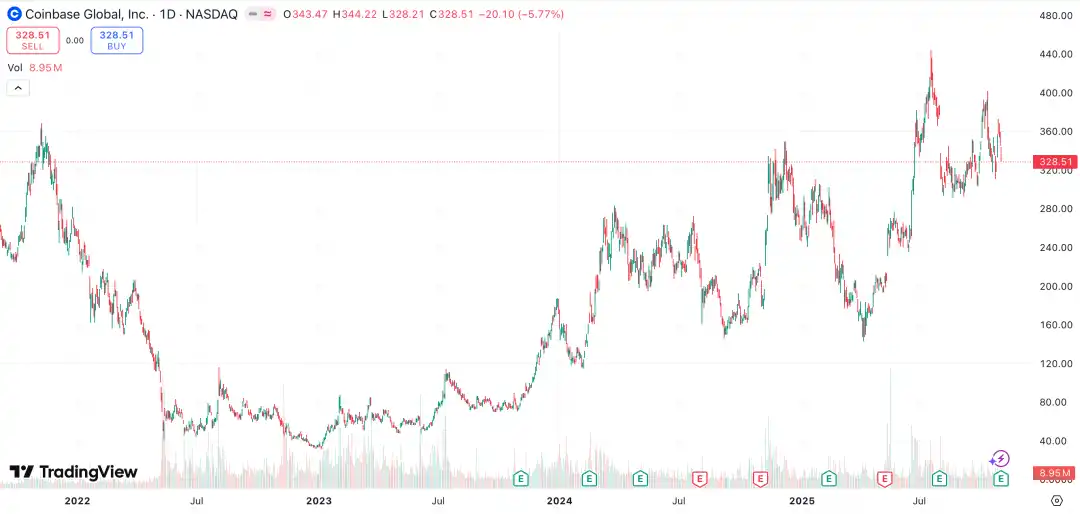
COIN Price Chart|Source: Tradingview
First, let's talk about J.P. Morgan's upgrade to "Overweight."
On October 24, analyst Kenneth Worthington plainly stated in a report, "Coinbase's valuation is undervalued, with the potential opportunity value of the Base token ranging from $120 billion to $340 billion."
Base is an Ethereum Layer 2 network incubated by Coinbase that, when launched in 2023, was just a "low-fee playground," but has since become a star.
How does this money come about? As an Optimistic Rollup, Base requires each transaction to be sequenced by a single sequencer for on-chain bundling. While the fees are low (average of $0.01 per transaction), the scale is staggering—daily transaction volume has exceeded 5 million transactions multiple times, doubling that of the mainnet. The Sequencer model has made fee revenue a strong cash flow source.
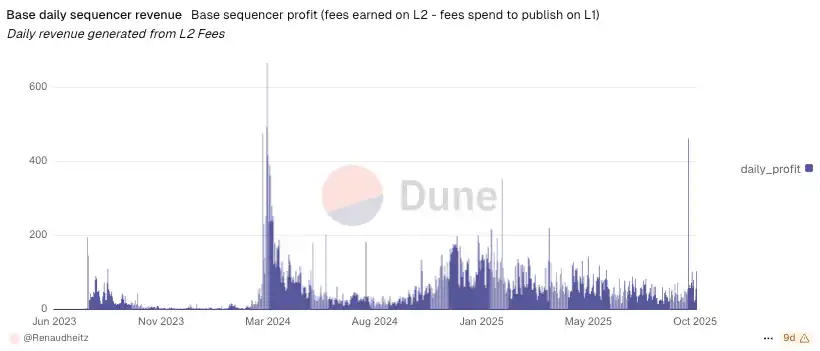
Base Sequencer Revenue | Image Source: Dune
Coinbase transfers all these fees to its own custody account, citing "security and auditing" reasons, but the community has criticized this as "centralized vampirism." The management responded at the earnings call that they will explore ecosystem revenue sharing in the future, such as returning some fees to developers or users, creating a positive feedback loop.
More anticipated is the potential native token of Base.
J.P. Morgan predicts that if Base issues a native token, its market cap could reach several billion dollars.
What can the token do? Stimulate usage elasticity, allow holders to participate in governance, stake to earn fee rewards, and even be used for gas fee discounts. With millions of daily active users and significant fee revenue elasticity, if the token is implemented, Base's transformation from a "cost center" to a "profit engine" is just around the corner.
Now, looking at USDC, this stablecoin is a joint venture between Coinbase and Circle.
The Q3 earnings report shows that the USDC market cap has reached an all-time high of $74 billion, with an average USDC balance on the Coinbase platform of $15 billion, a 9% increase MoM. The average USDC balance off the platform is $53 billion, a 12% increase MoM. Stablecoin revenue is $355 million, a 7% increase MoM.
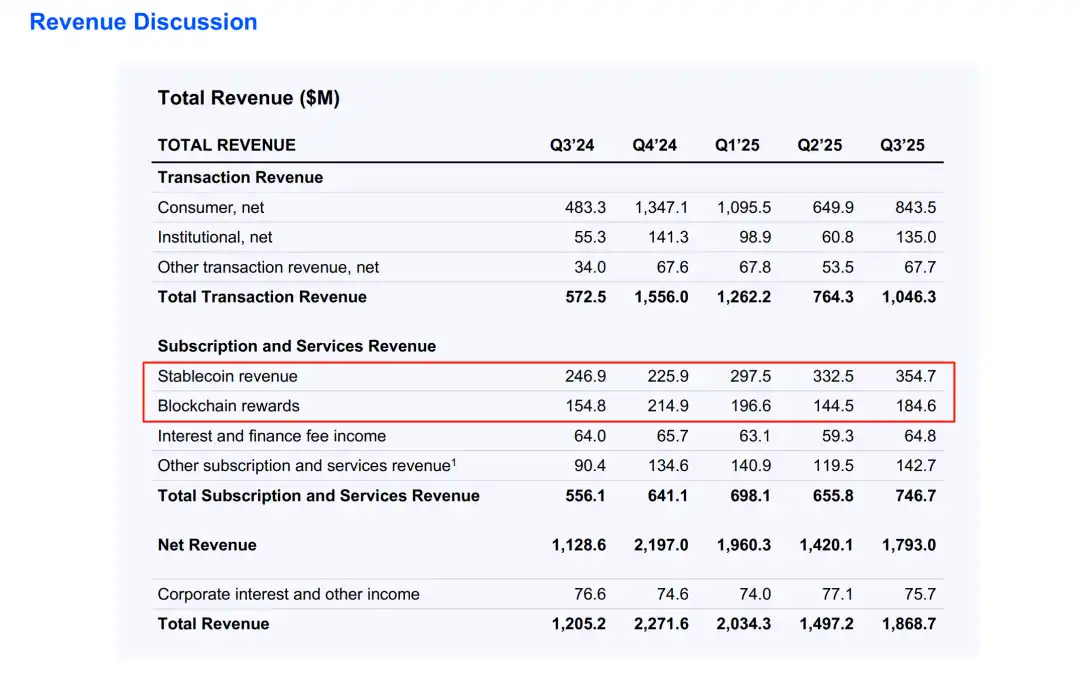
Stablecoin Revenue and Blockchain Revenue | Image Source: Coinbase
Its revenue comes from a variety of sources: interest spread (USDC reserve invested in US Treasury bonds, earning a 4-5% yield), custody fees (Coinbase Prime offers institutional custody with a 0.1-0.2% cut), settlement fees (cross-border transfer fees), and merchant fees (integration into e-commerce platforms like Shopify, charging a 1% fee).
Why is USDC so profitable?
Due to its penetration in merchant and cross-border settlements. Management revealed that USDC has achieved a 15% penetration rate in cross-border payments, especially in emerging markets such as Latin America and Southeast Asia, where users utilize it to avoid foreign exchange fluctuations. For example, after Remitly and Wise integrated USDC, transfer costs decreased by 30%, with Coinbase getting a slice of the pie.
More crucially, USDC is transitioning from being a "store of value" to a "payment medium." Sell-side analysts mentioned that Coinbase may expand distribution, such as issuing an L2-exclusive variant of USDC or deep integration with DeFi protocols. Timeline? Management said, "It will be revealed in the first half of next year."
The synergy between Base and USDC is a game-changer. Base uses USDC as the native gas fee, reducing transaction costs to as low as $0.001, attracting the DeFi and NFT ecosystems. The essence applauded by Wall Street is seeing Coinbase shift from "volatility reliance" to "stable rent collection."
In the past, transaction revenue accounted for 80%, halving during bear markets; now, subscription services represent 40%, displaying strong countercyclicality.
Of course, risks still exist.
Regulation is a double-edged sword—the SEC's scrutiny of stablecoins is increasing, and Base's centralized sequencer could also attract attacks from "decentralization purists."
However, judging from the financial report, the management is confident: "We are not gambling in the market; we are building infrastructure." Coinbase has navigated the path from a side gig to a cash cow steadily and ambitiously.
Empire Continues to Expand
Coinbase's expansion is akin to the Roman Empire, advancing step by step, from an exchange to custody, and now to the primary market. In the Q3 financial report, the most eye-catching acquisition was the October 21 acquisition of the Echo blockchain financing platform for $375 million.
From issuance, listing, trading, and custody, Coinbase has anchored its ecosystem with six pillars, propelling itself toward being the "crypto Apple," where developers come and don't want to leave, institutions enter and can't escape, and users rely on it.
Let's first talk about the technical infrastructure, the cornerstone of Coinbase's empire.
Base Chain is not just another Layer 2 but Coinbase's "iOS," compatible with the Ethereum ecosystem but under its own core control.
Leading protocols like Aave and Uniswap have already onboarded, but the value of Base lies in its "App Store" attribute. Through the acquisition of Spindl (an on-chain advertising attribution tool), Coinbase can track user sources, behavior conversion, similar to the App Store's recommendation mechanism, controlling traffic distribution. Do developers want to acquire users? They must use Spindl, and Coinbase decides who makes it to the top of the recommendation list based on this.
The acquisition of Iron Fish fills the privacy gap. Under high regulatory pressure, Base integrated zero-knowledge proofs, balancing compliance with user privacy, emulating Apple's privacy protection strategy. More importantly, Base has a direct connection to Coinbase's 100 million users, with developers reaching massive traffic as soon as they go online, giving it a competitive edge that Arbitrum or Polygon find hard to match.
The capital formation system is the second pillar, with Echo's acquisition being the highlight.
Echo is an on-chain capital inheritance platform founded by renowned crypto trader Cobie and has the Sonar public fundraising tool under its umbrella. Echo has helped raise over $200 million for more than 300 projects, such as the XPL token sale for Plasma.
Why did Coinbase take an interest in it?
Because primary issuance is the "upstream source" of Crypto. The traditional VC model is closed, making it difficult for retail investors to participate; Echo allows projects to raise funds directly from the community, covering both private and public sales comprehensively. The acquisition price is $3.75 billion (cash + stock), a small amount compared to Coinbase's $70 billion market value, but of immense strategic value as it fills Coinbase's "capital formation" gap.
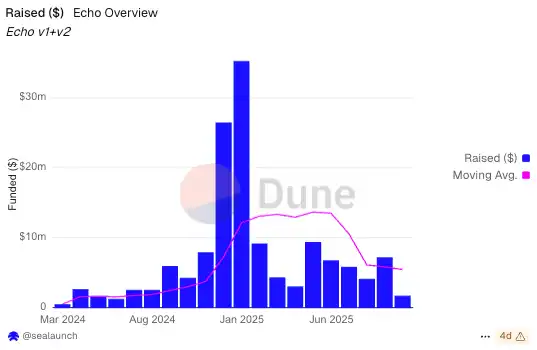
Echo Fundraising Volume Trend Chart | Source: Dune
The integration roadmap is already taking shape. Echo will be embedded in the Coinbase ecosystem, using Coinbase's compliance framework for issuance approvals (KYC/AML), leveraging Base's transparent ledger for disclosures, connecting to the Coinbase Exchange for secondary market making, and seamlessly integrating custody into Prime. The initial issuance categories will focus on crypto tokens, with a target volume of $1 billion by Q1 next year.
For institutions, Coinbase is rolling out a settlement toolkit, offering real-time settlement and data APIs; for developers, Sonar will upgrade to support privacy-enhanced fundraising (utilizing zero-knowledge proofs to avoid sensitive disclosures). The on-chain crowdfunding platform founded by KOL Cobie has already raised $51 million, completing 131 transactions. The first project, Ethena's USDe stablecoin, has seen rapid growth, demonstrating its potential.
Echo's Sonar tool enables founders to self-custody token sales, reviving the ICO model from 2017. However, the landscape has changed significantly since then with the GENIUS Act providing legal support and a clear regulatory framework. Coinbase has officially stated that starting from crypto token sales, it will expand to tokenized securities and real-world assets (RWA).
This ambition is far-reaching, involving not just Crypto, but the financialization of everything, from stocks and real estate to art on-chain issuance.
Filling in the puzzle is Liquifi's acquisition, providing token full lifecycle management — issuance, distribution, locking, and liquidity. Echo manages "who can be funded," Liquifi manages "how to operate," forming a closed loop.
The institutional market is the third pillar. Deribit's acquisition is a milestone in crypto history, acquiring the world's largest derivatives exchange for $2.9 billion, with institutional clients accounting for 70% and daily volumes in the tens of billions. While Coinbase was previously retail-focused and weak in derivatives, it has now filled the gap, significantly increasing options depth and futures liquidity.
This mirrors Goldman Sachs' investment banking + retail dual-wheel model. Institutions are not just for trading but also become Base/USDC seed users. Management revealed that after Deribit integration, the cross-selling rate reached 40%, with institutions expanding from derivatives into custody and clearing.
Retail entry is the fourth pillar. Coinbase's credit card is not just a payment tool but the ecosystem's "final link."
In partnership with AmEx, with a high-end positioning, users' average monthly spending is $3,000, above the average. They receive 2-4% Bitcoin cashback pegged to platform assets, holding more and at a higher proportion.
Deeper is the data, where spending habits are used for targeted marketing, recommending NFTs or DeFi. This model creates a closed-loop effect where users receive cashback from card spending, invest the cashback amount in Base, receive even higher cashback, further stimulating more spending. With regulatory backing, this bridges fiat and crypto, lowering the threshold.
Content ecosystem is the fifth pillar. On October 20, Coinbase spent $25 million to buy NFTs, relaunching the UpOnly podcast — a bull market divine show hosted by Cobie/Ledger. This is no coincidence, as they are both part of the Cobie network.
This is a cultural foothold, where UpOnly spreads ideas and products, enhancing community influence. Coinbase does not control advertising/creation, purely community tribute, sparking discussions. Combined with Echo, it forms a "content + capital" dual-wheel, with the podcast showcasing projects, and Echo following up on funding. Future expansion into an Apple TV+ style service, content becoming a sticky engine.
Regulatory moat is the sixth pillar. Coinbase's domestic listing falls under SEC jurisdiction, with licenses in multiple states. Following the GENIUS Act, its stock price rose by 30%, highlighting the compliance advantage of USDC. Traditional institutions are favoring this, with the JPMorgan partnership enabling Chase points to be converted to Crypto. This barrier is high — Binance/OKX offshore are under pressure, and newcomers find it difficult to penetrate. Similar to App Store reviews, strict in the short term, ensuring quality in the long term.
These pillars are not isolated but form a closed loop. Developers leverage Echo/Liquifi for funding, deploy on Base, acquire customers through Spindl, gain exposure via UpOnly, trade on Deribit for institutions, custody with Prime, enable retail credit card spending, and optimize data loops.
Coinbase is not just acquiring companies; it is weaving a web—spanning from issuance to trading, from technology to culture, building a crypto "Apple Empire".
Setting the Stage for the Next Era
If Base and USDC are the cash cows of the present, the x402 Foundation is Coinbase's bold bet on the future.
Imagine a 30-year-old dusty HTTP code suddenly awakening to become the bridge connecting humanity and the machine economy.
This is not a work of science fiction but a real-life drama that unfolded on September 23rd. Coinbase, in collaboration with Cloudflare, established the x402 Foundation. Meanwhile, Google's AP2 protocol advances hand in hand, transforming the HTTP 402 "Payment Required" status code into a native machine payment process.
The story begins with a clear onboarding path. In Coinbase's ecosystem, Base acts as an efficient toll booth operator, facilitating low-fee settlements at just $0.001 per transaction. USDC plays the role of a frictionless universal currency, eliminating exchange rate barriers. Custody, as the guardian of institutional-grade security, handles all custody.
At the protocol's core is the revival of HTTP 402, a long-dormant code now reborn as the "highway" for AI payments. Picture an AI agent crawling Cloudflare's CDN data, encountering a 402 response mid-route. Instead of halting, it automatically initiates a USDC payment, swiftly confirms it, and continues forward to access content—all without human intervention.
The lineup of collaborators shines brightly, with initial partners including Google (introducing AP2), Adyen, Paypal, Mastercard, Etsy, and ServiceNow, among other developer platforms.
The pilot phase has commenced, with Cloudflare's Agents SDK being the first to integrate x402. It is currently undergoing private testing in "pay per crawl" mode, where AI crawlers voraciously access a vast number of pages, settling fees on a daily basis.
Google's AP2 extends x402, supporting hybrid payments with credit cards and stablecoins, with the first batch of B2B procurement pilots landing on the Cloud Marketplace involving Intuit and Salesforce.
Coinbase plays the role of a Crypto "bridge architect" here: x402 settles through Base, and AP2's Mandates (digital contracts) act as smart sentinels, ensuring that every step of authorization and auditing is watertight.
Why does AI need this "payment script"? Because AI agents are about to "learn to spend money for you."
Currently, AIs like ChatGPT are still in the era of human-initiated checkout and payment. However, in the future, they will engage in autonomous shopping or subscription services, requiring a reliable payment framework.
AP2's Intent/Cart Mandates act as a plot twist against fraud, allowing users to pre-sign budgets, agents to generate carts, and the entire chain of events to be traceable.
x402 then injects Crypto with instant settlement's "climax," using stablecoins to bypass bank delays. Gartner predicts that the AI payment market will skyrocket to trillions of dollars by 2030, with Crypto accounting for 10%.
For Coinbase, the result of this story is Base benefiting from low-fee dividends.
Epilogue
Ten years ago, Coinbase started out by matching human trades, once even fundraising in China, experiencing ups and downs.
Ten years later, it appears more like it laid the groundwork underground, with Base managing settlements, low fees, and efficiency; USDC managing clearing, ensuring stability; Echo managing issuance, positioning upstream; and x402 connecting to the "money-spending machine" remotely.
This Q3 financial report is a milestone, with total revenue of $18.7 billion and net profit of $4.33 billion. However, behind these figures lies an imperial blueprint—from volatility dependence to stable rent income; from exchanges to full-stack hubs.
The future of crypto is not about gambling on prices; it's about building infrastructure. Coinbase's ambition, much like Rome's road network, connects everything. In the next decade, when AI agents are ubiquitous, Coinbase may already be the "digital Fed."
But do not forget, every empire's expansion faces frontiers—regulation, competition, black swans. Investors, hold onto your chips; the show has just begun.
-END-




You may also like

The flow of stablecoins and the spillover effects in the foreign exchange market

After two years, Hong Kong's first batch of stablecoin licenses finally issued: HSBC, Standard Chartered make the cut
The person who helped TAO rise by 90% has now single-handedly crashed the price again today

3-Minute Guide to Participating in the SpaceX IPO on Bitget

Top 5 Cryptos to Buy in 2026 Q1: A ChatGPT Deep Dive Analysis
Explore the top 5 cryptos to buy in Q1 2026 including BTC, ETH, SOL, TAO, and ONDO. See price outlooks, key narratives, and institutional catalysts shaping the next market move.

How to Earn $15,000 with Idle USDT Before Altcoin Season 2026
Wondering if altcoin season is coming in 2026? Get the latest market update, and learn how to turn your idle stablecoins waiting for entry into extra rewards up to 15,000 USDT.
Can You Win Joker Returns Without Large Trading Volume? 5 Mistakes New Players Make In WEEX Joker Returns Season 2
Can small traders win WEEX Joker Returns 2026 without huge volume? Yes—if you avoid these 5 costly mistakes. Learn how to maximize card draws, use Jokers wisely, and turn small deposits into 15,000 USDT rewards.

Altcoin Season 2026: 4 Stages to Profit (Before the Crowd FOMO In)
Altcoin Season 2026 is starting — discover the 4 key stages of capital rotation (from ETH to PEPE) and how to position before the peak. Learn which tokens will lead each phase and avoid missing the rally.

Will Alt season come in 2026? 5 Tips to Spot the Next 100x Crypto Opportunities
Will altcoin season arrive in 2026? Discover 5 rotation stages, early signals smart traders watch, and the key crypto sectors where the next 100x altcoin opportunities may emerge.

The bear market has arrived, and cryptocurrency ETF issuers are also getting involved

The richest man had a quarrel with his former boss

BTC Firm Above 70K! Saylor’s "Institutional Logic" vs. Moon’s "Retail Faith": Who is Really Harvesting the Market?
Bitcoin is holding firm above the $70,000 support level following a massive short squeeze that liquidated $427 million. As the "Four-Year Cycle" narrative shifts, the market is split: Michael Saylor’s cold, institutional "indiscriminate stacking" vs. Carl Moon’s high-energy retail "hopium." This article decodes these two polar-opposite strategies for the 2026 bull run and reveals how WEEX’s institutional-grade liquidity and AI trading tools empower every type of investor to convert market volatility into profit.

The Girl Who Created the SBTI Test: A Story of a Doomed Cyber Love, an E-Widow Ratfolk

B.AI Officially Launched: Building AI Agent Financial Bedrock Platform, Driving AGI Era Business Underlying Logic

B.AI Officially Launched: Breaking Down A2A Collaboration Barriers to Unlock the Smart Body Economy's Full Potential
We helped Xu Mingxing write a book called "<OK Life>".

Rare APY of 400%, is TradeXYZ handing out money to oil bulls?
a16z: Perpetual Contracts are Rewriting Global Trading Rules
The flow of stablecoins and the spillover effects in the foreign exchange market
After two years, Hong Kong's first batch of stablecoin licenses finally issued: HSBC, Standard Chartered make the cut
The person who helped TAO rise by 90% has now single-handedly crashed the price again today
3-Minute Guide to Participating in the SpaceX IPO on Bitget
Top 5 Cryptos to Buy in 2026 Q1: A ChatGPT Deep Dive Analysis
Explore the top 5 cryptos to buy in Q1 2026 including BTC, ETH, SOL, TAO, and ONDO. See price outlooks, key narratives, and institutional catalysts shaping the next market move.
How to Earn $15,000 with Idle USDT Before Altcoin Season 2026
Wondering if altcoin season is coming in 2026? Get the latest market update, and learn how to turn your idle stablecoins waiting for entry into extra rewards up to 15,000 USDT.


 App
App