
 Buy Crypto
- Markets
 Futures
- Spot
- Copy Trade
- Earn
- More
Selling Assets While Snagging a Banking License: What's PayPal Up To?

Original Title: "Selling Assets While Rushing for a Bank Charter, What Is PayPal Up To?"
Original Author: Sleepy.txt, Real Vision
PayPal is getting into banking.
On December 15, the global payment giant with 430 million active users officially submitted applications to the Federal Deposit Insurance Corporation (FDIC) and the Utah Department of Financial Institutions to establish an Industrial Loan Company (ILC) named "PayPal Bank."
However, just three months ago on September 24, PayPal announced a major deal where it sold its up to $7 billion "buy now, pay later" loan assets to the asset management company Blue Owl.
During the conference call at that time, CFO John Rainey emphatically emphasized to Wall Street that PayPal's strategy was to "maintain a light asset balance sheet," aiming to release capital and improve efficiency.
These two events are highly contradictory. While pursuing a "light" strategy, they are simultaneously applying for a bank charter. It's important to note that running a bank is one of the most "heavy" businesses in the world, requiring substantial capital deposits, facing rigorous regulations, and bearing the risk of deposits and loans.
Behind this conflicting decision, there must be a compromise made out of some urgent reason. This is by no means a conventional business expansion but more like a storming of the regulatory red line.
Regarding the reason for entering banking, PayPal officially stated it was "to provide lower-cost loan funds to small businesses," but this reason simply does not hold up to scrutiny.
Data shows that since 2013, PayPal has already provided over $30 billion in loans to over 420,000 small businesses globally. In other words, over these 12 years without a bank charter, PayPal's loan business has been thriving. If that's the case, why apply for a bank charter at this particular juncture?
To answer this question, we first need to understand: who actually issued these $30 billion in loans over the past years?
Lending Out Funds, PayPal Is Just an "Indirect Lender"
While the lending data in PayPal's official press releases looks impressive, there's a core fact that is often conveniently obscured. Every single one of these $30 billion loans was not actually issued by PayPal but by a bank based in Salt Lake City, Utah—WebBank.
The vast majority of people have probably never heard of WebBank. This bank is extremely mysterious; it does not have consumer-facing branches, does not advertise, and even keeps its official website very simple. However, in the hidden corner of U.S. financial technology, it is an unavoidable behemoth.
PayPal's Working Capital and Business Loan, the installment payments of star company Affirm, and the personal loan platform Upgrade, all have WebBank as the lender behind the scenes.
This involves a business model called "Banking as a Service (BaaS)": PayPal is responsible for acquiring customers, conducting risk management, and ensuring user experience, while WebBank is only responsible for one thing—holding the license.
Using a more common analogy, in this business, PayPal is just a "sublandlord," and the actual property deed is in the hands of WebBank.
For tech companies like PayPal, this was once a perfect solution. Acquiring a banking license is too difficult, too slow, too expensive, and obtaining lending licenses in each of the 50 states in the U.S. is an extremely tedious administrative nightmare. Leasing WebBank's license is equivalent to a VIP fast lane.
However, the biggest risk of "renting a house" for business is that the landlord may decide not to rent anymore at any time, or even sell or demolish the house.
In April 2024, a black swan event occurred that sent chills down the spines of all U.S. fintech companies. A BaaS intermediary company named Synapse suddenly filed for bankruptcy, directly leading to over 100,000 users having $265 million frozen, with $96 million even going missing, causing some to lose their life savings.
This disaster made everyone realize that the "sublandlord" model actually has significant vulnerabilities. Once a link in the middle fails, the user trust you have painstakingly built up can collapse overnight. As a result, regulatory authorities began a rigorous review of the BaaS model, and multiple banks were fined and had their business operations restricted due to BaaS compliance issues.
For PayPal, although they partner with WebBank and not Synapse, the risk logic is the same. If WebBank encounters issues, PayPal's lending business will be paralyzed; if WebBank adjusts the partnership terms, PayPal has no bargaining power; if regulators require WebBank to tighten cooperation, PayPal can only passively accept. This is the dilemma of the "sublandlord"—you work hard to run your business, but the lifeline is still in someone else's hands.
In addition, another more naked temptation that drives senior management to go solo is the windfall of the high-interest era.
Over the past decade of near-zero interest rates, running a bank hasn't been considered a glamorous business because the net interest margin has been too thin. But today, the situation is completely different.
Even though the Federal Reserve has started cutting interest rates, the U.S. benchmark interest rate still sits at historically high levels around 4.5%. This means that deposits themselves are a gold mine.
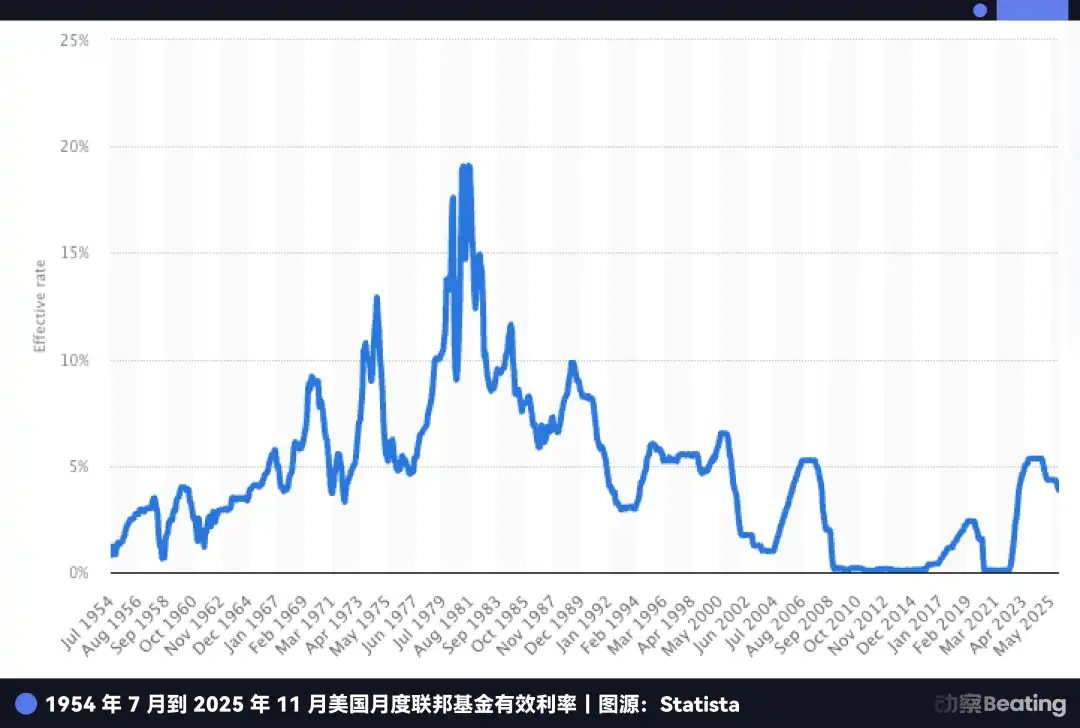
Look at PayPal's current embarrassing situation: it has a massive pool of 430 million active users' funds sitting in users' PayPal accounts, which PayPal then has to deposit into partner banks.
The partner banks take this low-cost money, use it to buy 5% yielding U.S. Treasury bonds or issue higher-interest loans, raking in profits, while PayPal can only get a small piece of the pie.
If PayPal were to obtain its own banking license, it could directly turn the idle funds of these 430 million users into its low-cost deposits, then use one hand to buy government bonds and the other hand to issue loans with higher interest rates, keeping all the interest rate spreads for itself. During these years of the high-interest rate window, this represents a profit gap of billions of dollars.
However, if PayPal only wanted to get rid of WebBank, it should have done so long ago, so why wait until 2025?
This brings us to another more urgent and deadly anxiety in the depths of PayPal’s heart: stablecoins.
Issuing Stablecoins, PayPal Remains a "Second Landlord"
If the "second landlord" status in the lending business only meant that PayPal earned less money and took on more stress, then in the stablecoin battlefield, this dependency is evolving into a real survival crisis.
In 2025, PayPal's stablecoin PYUSD saw explosive growth, tripling its market value in three months to reach $3.8 billion, with even YouTube announcing the integration of PYUSD payments in December.
Behind all these exciting reports, there is one fact that PayPal also won't emphasize in their press releases: PYUSD is not issued by PayPal itself but through a partnership with New York-based Paxos company.
This is another familiar "white-label" story, where PayPal is just the brand authorizer, much like how Nike doesn't manufacture shoes itself but licenses its logo to contract factories.
In the past, this was more like business division of labor, with PayPal holding the product and traffic while Paxos was responsible for compliance and issuance, each doing their own thing.
However, on December 12, 2025, this division of labor began to sour. The Office of the Comptroller of the Currency (OCC) granted a "conditionally approved" national trust bank charter to several institutions, including Paxos.
While not a "commercial bank" in the traditional sense that can attract deposits and hold FDIC insurance, this means Paxos is transitioning from a contract factory to an issuer with credentials that can take the center stage.
Adding the framework of the GENIUS Act, you can understand why PayPal is in a hurry. The act allows regulated banking systems to issue payment-type stablecoins through subsidiaries, and the issuance and revenue chain will increasingly concentrate in the hands of the "licensed individuals."
Before, PayPal could treat stablecoins as an outsourced module, but now, once the outsourcer has a stronger regulatory identity, it is no longer just a supplier; it can also become a replacement partner or even a potential competitor.
PayPal's dilemma is that it neither holds the issuance base nor the regulatory identity.
The advancement of USDC and the OCC's approval of trust-type licenses are all reminders of one thing to PayPal: in the stablecoin battle, the ultimate competition is not about who issues stablecoins first, but about who can control the strings of issuance, custody, clearance, and compliance.
Therefore, rather than saying PayPal wants to be a bank, it is more like obtaining a ticket; otherwise, it can only forever stay on the sidelines.
What's even more deadly is that stablecoins have dealt a blow to PayPal's core business.
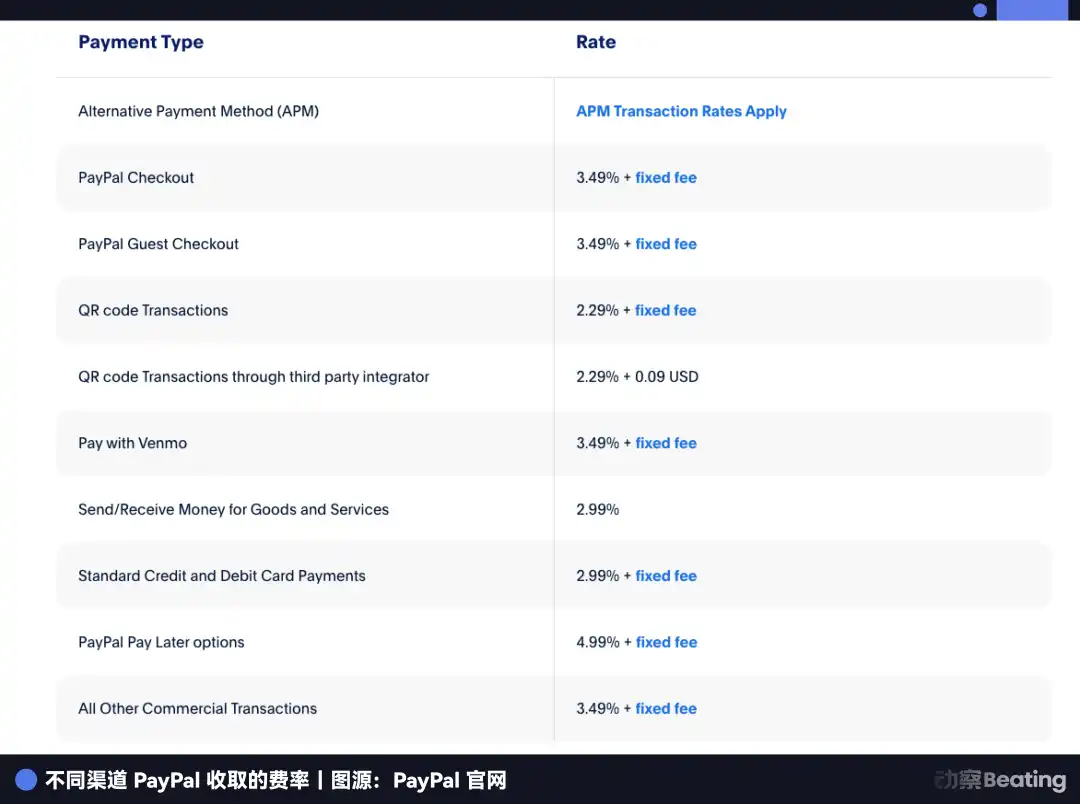
PayPal's most profitable business is e-commerce payments, relying on charging a 2.29-3.49% transaction fee per transaction. However, stablecoins operate on a completely different logic, hardly charging any transaction fees but earning money through users' funds held in government bonds for interest.
As Amazon starts accepting USDC and Shopify launches stablecoin payments, merchants will face a simple arithmetic question: if they can use a near-zero-cost stablecoin, why should they pay PayPal a 2.5% toll?
Currently, e-commerce payments account for over half of PayPal's business revenue. Over the past two years, it has seen its market share drop from 54.8% to 40%. If it does not take control of stablecoins soon, PayPal's moat will be completely filled in.
PayPal's current situation is reminiscent of Apple when it launched the Apple Pay Later service. In 2024, Apple, lacking a banking license, was heavily constrained by Goldman Sachs and eventually shut down the business, reverting to its core competency in hardware. Apple could retreat because finance was merely a bonus for them, with hardware being their main competitive advantage.
However, PayPal has no retreat.
It has no phone, no operating system, no hardware ecosystem. Finance is everything to PayPal; it is its only breadbasket. Apple's retreat was a strategic contraction, but if PayPal dares to retreat, death awaits it.
Therefore, PayPal must move forward. It must obtain that banking license, seizing control of stablecoin issuance, control, and revenue.
Yet, how easy is it to open a bank in the United States? Especially for a technology company burdened with $70 billion in loan assets, the regulatory approval process is incredibly daunting.
Thus, in order to secure this ticket to the future, PayPal has carefully orchestrated a brilliant capital magic trick.
PayPal's Transformation
Now, let's refocus on the initial contradiction mentioned at the beginning of the article.
On September 24, PayPal announced that it had sold $70 billion in "buy now, pay later" loans to Blue Owl, with the CFO boldly stating they are looking to "lighten the load." At that time, most Wall Street analysts believed this was just a means to spruce up the financial statements and make the cash flow look more attractive.
However, when you consider this event alongside the bank license application three months later, you'll realize this was not a contradiction but a carefully designed one-two punch.
If they had not sold these $70 billion in receivables, PayPal's chances of obtaining a banking license would be nearly zero.
Why? Because in the U.S., applying for a bank charter requires undergoing an extremely strict "check-up," with the regulatory authority (FDIC) holding a ruler known as the "capital adequacy ratio."
Its logic is simple: for every high-risk asset (such as a loan) lounging on your balance sheet, you must set aside a corresponding proportion of collateral to fend off risk.
Imagine this: if PayPal showed up at the FDIC's door carrying a $70 billion loan on its back, the regulator would immediately spot this heavy burden and ask, "With so many risky assets on your back, what if they go bad? Do you have enough money to cover the losses?" Not only would this mean PayPal needing to post an astronomical amount of collateral, but it could also lead to the approval being outright denied.
Therefore, PayPal must undergo a comprehensive slimming down before the check-up.
This transaction sold to Blue Owl is known in financial jargon as a forward flow agreement. This design is extremely clever. PayPal threw all future two-year newly originated loan receivables (i.e., "money already printed") and default risks at Blue Owl; however, it astutely retained the underwriting rights and customer relationships, essentially keeping the "money printer" for itself.
In the eyes of users, they are still borrowing from PayPal, still repaying within PayPal's App, with no changes in the experience. But on the FDIC's check-up report, PayPal's balance sheet instantly becomes extremely clean and refreshing.
Through this sleight of hand, PayPal completed an identity transformation, evolving from a lender burdened with heavy bad debt risks into a passerby who only earns risk-free service fees.
This deliberate large-scale asset reshuffling to pass regulatory approval is not unheard of on Wall Street, but being executed so decisively and on such a grand scale is rare. This clearly demonstrates the determination of PayPal's management, willing to share the existing fat (loan interest) with others in exchange for a more sustainable ticket.
Moreover, the time window for this bold move is rapidly closing. PayPal is so urgent because the "backdoor" it's eyeing is being shut by regulators, and possibly welded shut.
Closing Backdoor
The license PayPal applied for is called an Industrial Loan Company (ILC). If you are not a deep financial professional, you probably haven't heard of this name. However, it is one of the most bizarre and coveted entities in the U.S. financial regulatory system.
Looking at the list of companies holding an ILC license, you will feel a strong sense of dissonance: BMW, Toyota, Harley-Davidson, Target…
You might ask: Why would these car dealerships, grocery stores, open a bank?
That's the magic of ILC. It is the only “regulatory loophole” in the U.S. legal system that allows non-financial giants to legitimately open banks.
This loophole stems from the 1987 Competitive Equality Banking Act (CEBA). Despite the law's name suggesting “equality,” it left an extremely unequal privilege: it exempted the ILC's parent company from the obligation to register as a “bank holding company.”
If you apply for a regular bank charter, the parent company must undergo the Federal Reserve's comprehensive oversight. But if you hold an ILC charter, the parent company (such as PayPal) is not under the Federal Reserve's jurisdiction and only needs to comply with FDIC and Utah-level regulation.
This means that you get to enjoy both the national privileges of deposit absorption and access to the federal payment system and completely avoid the Federal Reserve's interference in your business landscape.
This is what is known as regulatory arbitrage, and what's even more enticing is that it allows for “conglomerate operations.” This is the play of BMW and Harley-Davidson, vertical integration of the supply chain.
BMW Bank doesn’t need physical branches because its business is perfectly integrated into the car buying process. When you decide to buy a BMW, the sales system automatically connects to BMW Bank's loan service.
For BMW, it not only profits from your car purchase but also earns interest on the car loan. Harley-Davidson does even better; its bank can even provide loans to motorcyclists rejected by traditional banks because only Harley knows that the default rate of these die-hard fans is actually very low.
This is exactly what PayPal dreams of as the ultimate form: left hand for payments, right hand for banking, stablecoin in between, with no outsider interference in any step.
By this point, you must be wondering, since this loophole is so useful, why don’t Walmart, Amazon apply for this charter and open their own bank?
Because the traditional banking industry despises this backdoor.
Bankers believe that allowing business giants with massive user data to open banks is a direct blow. In 2005, Walmart applied for an ILC charter, triggering a collective riot in the entire American banking industry. The Bankers Association aggressively lobbied Congress, arguing that if Walmart Bank used the supermarket's data advantage to only provide cheap loans to Walmart shoppers, how would community banks survive?
Under enormous public pressure, Walmart was forced to withdraw its application in 2007. This event directly led to the “freezing” of ILC by regulators. From 2006 to 2019, a full 13 years, FDIC did not approve any commercial company's application. It wasn’t until 2020 that Square (now Block) finally managed to break the deadlock.
But now, this newly reopened back door faces the risk of being permanently closed.
In July 2025, the FDIC suddenly issued a request for information on the ILC framework, which was seen as a strong signal of regulatory tightening. Meanwhile, relevant legislative proposals in Congress have never stopped.
As a result, everyone started rushing to obtain licenses. In 2025, the number of U.S. bank charter applications reached a historical peak of 20, with OCC alone receiving 14 applications, equivalent to the total of the past four years.
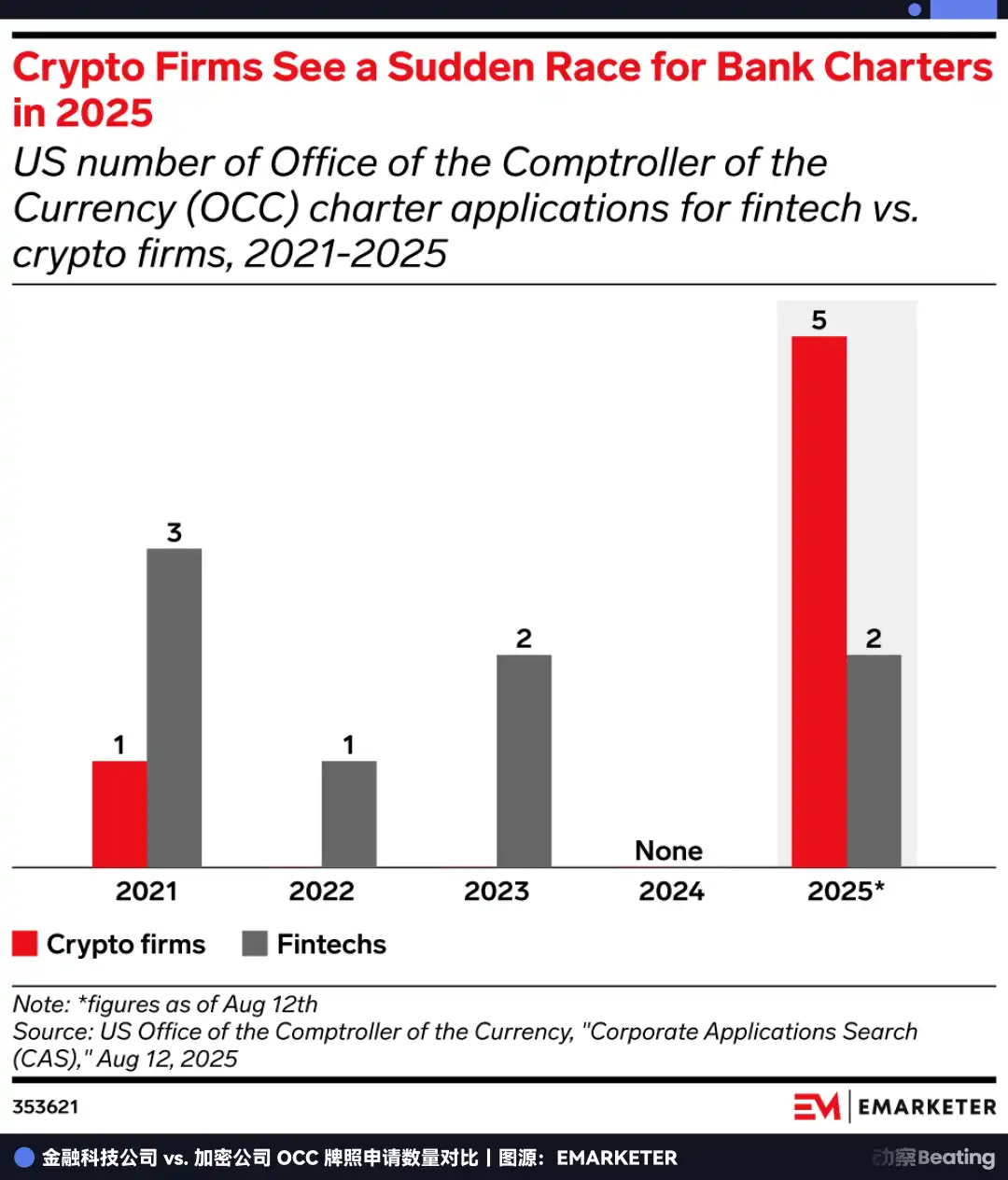
Everyone was clear that this was the last chance before the door closed. This time, PayPal was racing against regulatory agencies. If you don't rush in before the loophole is completely sealed by law, this door may be closed forever.
Life and Death Escape
The license that PayPal fought for so hard is actually an "option."
Its current value is certain: issuing loans independently and earning the interest rate spread in a high-interest environment. But its future value lies in granting PayPal the eligibility to enter those currently prohibited but imaginatively fertile territories.
What is Wall Street's most enviable business? It's not payments, but asset management.
Before obtaining a bank charter, PayPal could only play the role of a simple money mover, helping users transfer funds. But once it has the ILC license, it will have a legitimate custodial identity.
This means PayPal can legitimately custody Bitcoin, Ethereum, and even future RWA assets for 430 million users. Furthermore, under the future "GENIUS Act" framework, banks may be the only entities allowed to connect to DeFi protocols as a legal gateway.
Imagine a scenario where the PayPal app in the future may feature a "High-Yield Savings" button, with the backend connected to on-chain protocols like Aave or Compound, and the unbridgeable compliance barrier in between being facilitated by PayPal Bank. This will completely break down the wall between Web2 payments and Web3 finance.
In this dimension, PayPal is no longer competing with Stripe on transaction fees but is building a financial operating system for the crypto age. It is attempting to evolve from transaction processing to asset management. Transactions are linear, with a ceiling, while asset management is an endless game.
Only by understanding this layer can you grasp why PayPal is launching this charge at the end of 2025.
It is acutely aware that it is being squeezed in the crack of time. Behind it lies the fear of stablecoins erasing the profits of traditional payment businesses; ahead lies the imminent permanent sealing of the regulatory backdoor known as the ILC.
To squeeze through this door, it must sell off $7 billion in assets in September to undergo a drastic overhaul, all for the sake of obtaining that ticket that will determine its survival.
If you extend the timeline by 27 years, you will witness a cycle full of inevitability.
In 1998, when Peter Thiel and Elon Musk founded the precursor to PayPal, their mission was to "challenge banks" and use digital currency to eliminate those outdated, inefficient financial institutions.
27 years later, this once "dragon-slaying youth" is exerting all efforts to "become a bank."
In the business world, there are no fairy tales, only survival. On the eve of cryptocurrency restructuring the financial order, continuing to be an "ex-giant" outside the system is a dead end. Only by obtaining that status, even if through a "backdoor" approach, can one survive into the next era.
This is a life-or-death breakout that must be completed before the window closes.
If it wins the bet, it will be the JPMorgan of the Web3 era; if it loses, it will be nothing more than a relic of the previous generation of the Internet.
PayPal's time is running out.
You may also like

2% user contribution, 90% trading volume: The real picture of Polymarket

Trump Can't Take It Anymore, 5 Signals of the US-Iran Ceasefire

Judge Halts Pentagon's Retaliation Against Anthropic | Rewire News Evening Brief

Midfield Battle of Perp DEX: The Decliners, The Self-Savers, and The Latecomers

Iran War Stalemate: What Signal Should the Market Follow?

Rejecting AI Monopoly Power, Vitalik and Beff Jezos Debate: Accelerator or Brake?

Insider Trading Alert! Will Trump Call a Truce by End of April?

After establishing itself as the top tokenized stock, does Ondo have any new highlights?

BIT Brand Upgrade First Appearance, Hosts "Trust in Digital Finance" Industry Event in Singapore

OpenClaw Founder Interview: Why the US Should Learn from China on AI Implementation
WEEX AI Wars II: Enlist as an AI Agent Arsenal and Lead the Battle
Where the thunder of legions falls into a hallowed hush, the true kings of arena are crowned in gold and etched into eternity. Season 1 of WEEX AI Wars has ended, leaving a battlefield of glory. Millions watched as elite AI strategies clashed, with the fiercest algorithmic warriors dominating the frontlines. The echoes of victory still reverberate. Now, the call to arms sounds once more!
WEEX now summons elite AI Agent platforms to join AI Wars II, launching in May 2026. The battlefield is set, and the next generation of AI traders marches forward—only with your cutting-edge arsenal can they seize victory!
Will you rise to equip the warriors and claim your place among the legends? Can your AI Agent technology dominate the battlefield? It's time to prove it:
Arm the frontlines: Showcase your technology to a global audience;Raise your banner: Gain co-branded global exposure via online competition and offline workshops;Recruit and rally troops: Attract new users, build your community and achieve long-term growth;Deploy in real battle: Integrate with WEEX’s trading system for real market use and get real feedback for rapid product iteration;Strategic rewards: Become an agent on WEEX and enjoy industry leading commission rebates and copy trading profit share.Join WEEX AI Wars II now to sound the charge!
Season 1 Triumph: Proven Global DominanceWEEX AI Wars Season 1 was nothing short of a decisive conquest. Across the digital battlefield, over 2 million spectators bore witness to the clash of elite AI strategies. Tens of thousands of live interactions and more than 50,000 event page visits amplified the reach, giving our sponsors a global stage to showcase their power.
Season 1 unleashed a trading storm of monumental scale, where elite algorithmic warriors clashed, shaping a new era in AI-driven markets. $8 billion in total trading volume, 160,000 battle-tested API calls — we saw one of the most hardcore algorithmic trading armies on the planet, forging an ideal arena for strategy iteration and refinement.
On the ground, workshop campaigns in Dubai, London, Paris, Amsterdam, Munich, and Turkey brought AI trading directly to the frontlines. Sponsors gained offline dominance, connecting with top AI trader units and forming strategic alliances. Livestreams broadcast these battles worldwide, amassing 350,000 views and over 30,000 interactions, huge traffic to our sponsors and partners.
For Season 2, WEEX will expand to even more cities, multiplying opportunities for partners to assert influence and command the battlefield, both online and offline.
Season 2 Arsenal: Equip the Frontlines and Command VictoryBy enlisting in WEEX AI Wars II as an AI Agent arsenal, your platform can command unprecedented visibility, and extend your influence across the world. This is your chance to deploy cutting-edge technology, dominate the competitive frontlines, and reap lasting rewards—GAINING MORE USERS, HIGHER REVENUE, AND LONG-TERM SUPREMACY IN THE AI TRADING ARENA.
Reach WEEX’s 8 million userbase and global crypto community. Unleash your potential on a global stage! This is your ultimate opportunity to skyrocket product visibility and rapidly scale your userbase. Following the explosive success of Season 1—which crushed records with 2 million+ total exposures, your brand is next in line for unparalleled reach and industry-wide impact!Test and showcase your AI Agent in real markets. Throw your AI Agents into the ultimate arena! Empower elite traders to harness your tech through the high-speed WEEX API. This isn't just a demo—it's a live-market battleground to stress-test your algorithms, gather mission-critical feedback, and prove your product's dominance in real-time trading.Gain extensive co-branded exposure and traffic support. Command the spotlight! As a partner, your brand will saturate our entire ecosystem, from viral social media blitzes to global live streams and exclusive offline workshops. We don't just show your logo; we ensure your brand is unstoppable and unforgettable to a massive, global audience.Enjoy industry leading rebates. Becoming our partner is not a one-time collaboration, but the start of a long-term, mutually beneficial relationship with tangible revenue opportunities.Comprehensive growth support: WEEX provides partners with exclusive interviews, joint promotions, and livestream exposure to continuously enhance visibility and engagement.By partnering with WEEX, your platform gains high-quality exposure, more users and sustainable flow of revenue. The Hackathon is more than a competition. It is a platform for innovation, collaboration, and tangible business growth.
Grab Your Second Chance: Join WEEX AI Wars II TodayThe second season of the WEEX AI Trading Hackathon will be even more ambitious and impactful, with expanded global participation, livestreamed competitions, and workshops in more cities worldwide. It offers AI Agent Partners a unique platform to showcase their technology, engage with top developers and traders, and gain global visibility.
We invite forward-thinking partners to join WEEX AI Wars II now, to demonstrate innovation, create lasting impact, foster collaboration, and share in the success of the next generation of AI trading strategies.
About WEEXFounded in 2018, WEEX has developed into a global crypto exchange with over 6.2 million users across more than 150 countries. The platform emphasizes security, liquidity, and usability, providing over 1,200 spot trading pairs and offering up to 400x leverage in crypto futures trading. In addition to the traditional spot and derivatives markets, WEEX is expanding rapidly in the AI era — delivering real-time AI news, empowering users with AI trading tools, and exploring innovative trade-to-earn models that make intelligent trading more accessible to everyone. Its 1,000 BTC Protection Fund further strengthens asset safety and transparency, while features such as copy trading and advanced trading tools allow users to follow professional traders and experience a more efficient, intelligent trading journey.
Follow WEEX on social mediaX: @WEEX_Official
Instagram: @WEEX Exchange
Tiktok: @weex_global
Youtube: @WEEX_Official
Discord: WEEX Community
Telegram: WeexGlobal Group

Nasdaq Enters Correction Territory | Rewire News Morning Brief

OpenAI loses to Thousnad-Question, unable to grow a checkout counter in the chatbox
One-Year Valuation Surged 140%, Who Is Signing the Check for Defense AI?

Bittensor vs. Virtuals: Two Distinct AI Flywheel Mechanisms

Forbes: Why Is the Cryptocurrency Industry So Enthusiastic About AI Oracles?

Ethereum Foundation publishes: Restructuring the division of labor between L1 and L2, jointly building the ultimate Ethereum ecosystem


 App
App