
 Buy Crypto
- Markets
 Futures
- Spot
- Copy Trade
- Earn
- More
Smart Payments: Evolution Path of the Next-Generation Payment System

Original Title: The Hitchhiker's Guide to Agentic Payments
Original Author: @13yearoldvc
Translation: Peggy, BlockBeats
Editor's Note: We are at a new inflection point. Agentic Payments are reshaping the fundamental logic of transactions. From in-chat GPT settlements to micro-payments between agents, and to a new order of the web where machines pay for content—the landscape of the "agentic economy" is gradually taking shape.
If you care about the convergence of AI and blockchain, the practical path of next-generation payment protocols, or are pondering the automation trends of future business, this article is worth your time to read.
Below is the original article.
Introduction
This is a lengthy article, but definitely worth the read. It brings together insights from several cutting-edge builders who are shaping the future of agentic payments. We will explore the real problems they are trying to solve, the potential practical implementation of these technologies, and the true bottlenecks behind them.
You can think of it as a guided tour of the frontier. Ten pages of content covering creativity, experimentation, and experience from those building infrastructure for the machine economy. Get ready to embark.
As the coordinator of ERC-8004 and an AI advisor to the Decentralized AI (dAI) team at the Ethereum Foundation, I have worked closely with builders, researchers, and protocol teams over the past few months, focusing on stablecoins, decentralized infrastructure, and the intersection of AI. This has allowed me to closely observe the real-time evolution of these technologies. This article is not just a presentation of research findings but also a real context from intelligent economy builders.
A special thanks to the following individuals for their review and discussions (listed in alphabetical order by last name):
@louisamira (ATXP), @RkBench (Radius), @DavideCrapis (Ethereum Foundation), @nemild (Coinbase/x402), @Cameron_Dennis_ (Near Foundation), @marco_derossi (Metamask), @dongossen (Nevermined), @jayhinz (Stripe/Privy), @sreeramkannan (EigenCloud), @kevintheli (Goldsky), @MurrLincoln (Coinbase/x402), @benhoneill (Stripe/Bridge), @programmer (Coinbase/x402), @FurqanR (Thirdweb), @0xfishylosopher (Pantera Capital).
The Evolution of Smart Payments
One month ago, Stripe and OpenAI introduced a new feature that could potentially change the way online shopping works: you can now directly buy things within ChatGPT. No forms, no redirects, no checkout pages. Just one sentence: "Help me find a handmade ceramic mug," and the system will automatically process the payment through Stripe's "shared payment token."
This process looks very smooth, almost magical, but it is built on a highly centralized architecture that may limit the space for future true innovation. Payment tokens, settlement channels, and even user identities are controlled by the OpenAI and Stripe platforms. In this model, while smart agents are convenient, they cannot freely interact and can only operate within specific ecosystems. This both showcases the possibilities of the future and reminds us: without open standards and a neutral settlement layer, smart payments will be locked into platforms, making it difficult to truly unleash their potential.
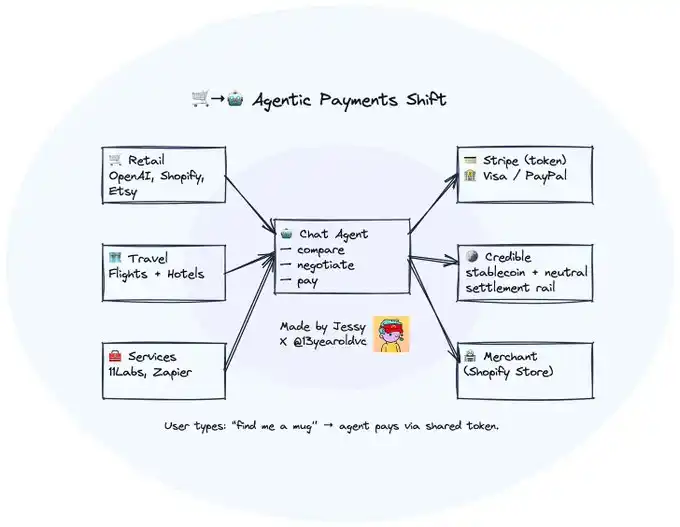
At the same time, this new payment flow also marks a larger shift: the one truly transacting is no longer the user themselves, but a "proxy." The interface we input is starting to replace us in comparison shopping, negotiation, and even payment. The commercial world is gradually being engulfed by "smart agent-driven commerce."
Currently, it seems that three things are happening simultaneously: proxies are beginning to take over transactions from humans; these transactions are likely to settle on a cryptographic network rather than the traditional financial system; this may well become a groundbreaking application scenario for the integration of blockchain and artificial intelligence.
Why stablecoins and blockchain? Because the nature of these transactions is now completely different from the pattern designed by Visa or PayPal. The smart agent economy is full of micropayments, conditionality triggers, composability, and high-frequency payments—fast, granular, and extensive.
After a discussion with Robert Bench of Radius, we found that "3V3C" is a very fitting descriptive model: high Velocity, high Volume, low Value, Conditional, Composable, and Cosmopolitan.
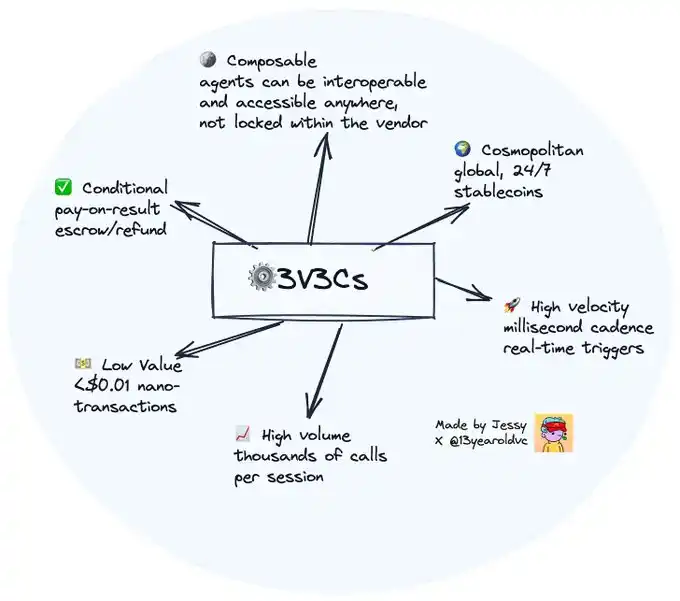
We observe three emerging behavioral patterns:
1. Human-to-Agent Payments (2C, 2B, Complex Optimization Scenarios);
2. Agent-to-Agent or Human Payments;
3. Agent-to-Network Payments.
All three behaviors challenge the fundamental assumptions of traditional payment systems.
1. Human → Agent
The chat interface is quietly becoming the new consumer entry point. Transactions that used to take place in a browser are now being completed within conversations.
You can already directly purchase Etsy products through ChatGPT's "Instant Checkout" feature, with Shopify set to follow in this process, backed by Stripe. Google, Amazon, and Perplexity are also testing similar shopping modes, allowing AI assistants to help users discover and purchase products within chat windows.
These AI front ends are turning into digital storefronts, especially in the retail e-commerce (2C) scene—product discovery, price comparison, and purchase all take place in one flow. Over time, people will rely more and more on their AI agents as personal shoppers, travel planners, or booking assistants.
Interestingly, these agents behave differently from humans: they can monitor prices in real time, automatically place orders when discounts appear, coordinate multi-party transactions (such as booking flights and hotels simultaneously), and pay for data or services on-demand, no longer relying on subscriptions (an aspect we will discuss in detail in the "Agent → Network" section).
In the short term, most of these payment processes will still be completed through traditional channels like Stripe or Visa—this is not a problem. For retail e-commerce (2C), existing infrastructure is sufficient to support the "Human → Agent" interface, at least for now.
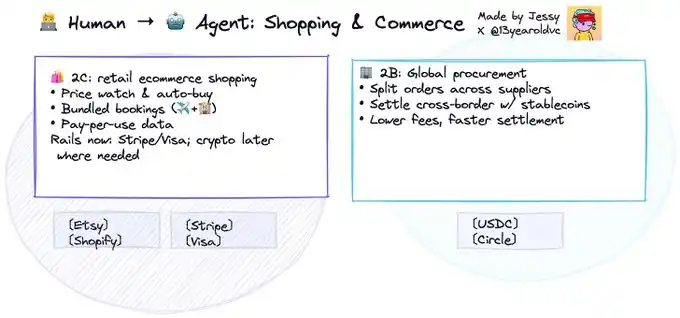
Where encrypted payments truly come into play is in global procurement (2B).
Many overseas merchants and manufacturers still face settlement delays and high costs because they struggle to access SWIFT or traditional agent banking systems. For example, in Yiwu, China, the world's largest small commodity wholesale market, most small merchants have not even heard of stablecoins. However, once the regulatory environment matures, this will become a natural use case.
Stablecoins can enable instant, low-cost, transparent cross-border value circulation—just as crypto remittances have already surpassed Western Union in some regions.
Whether on the consumer side or the enterprise side, we will see some new user behaviors that were previously impossible: complex, condition-triggered transactions that adhere to the "3V3C" model, executed automatically by agents in the background. Particularly as Large Language Models (LLMs) become more intelligent and operating costs decrease, the cost savings from these transactions will far exceed the required token fees.
For example:
A procurement agent could simultaneously monitor multiple international suppliers, automatically split orders to the cheapest manufacturer, and negotiate shipping costs within budget;
A creative agent could bundle subscriptions to multiple SaaS tools, dynamically renewing or canceling services based on usage.
This also means that agents must have "composability": one agent's output can become another agent's input, forming complex multi-step workflows (such as agent clusters or cross-model thought chains). In the past, we talked about "money Legos," and now we also need "agent Legos."
In practice, "composability" means the need for standardized APIs, message formats, and permission management. Without these, agents are isolated from each other, unable to collaborate, much like applications without APIs.
Therefore, these transactions, being too complex, high-frequency, and reliant on composition and collaboration, are not suitable for humans or traditional payment systems to coordinate — but for agents operating on programmable payment systems, they are effortless.
2. Agent → Agent
In the future, agents will need to "hire" other agents — even humans — to accomplish tasks.
Existing business models (subscription, licensing, paywalls) do not apply to interactions between autonomous software. Payments between agents are often billed based on the number of calls, token amounts, or reasoning counts, with amounts possibly as low as a few cents or even less.
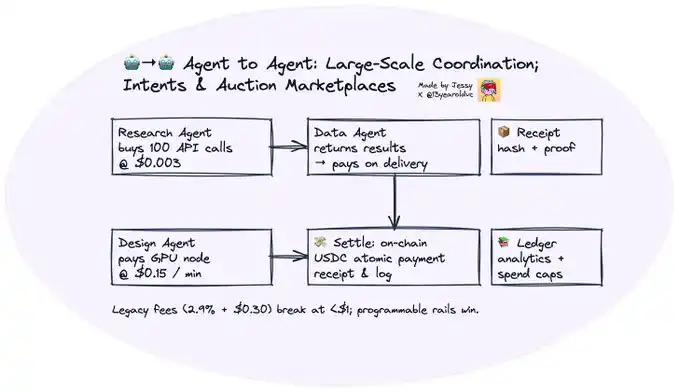
Imagine a research agent purchasing 100 API calls from a data agent; a design agent paying a computing node for GPU usage time. These are all machine-to-machine transactions, high in frequency and low in amount.
For example, an agent may need to pay another agent $0.003 to obtain 100 API calls, or pay $0.15 for GPU computation, or even just $0.0001 per inference.
Traditional payment systems cannot handle transactions at this scale — with credit cards charging a fixed fee per transaction (e.g., 2.9% + $0.30), they simply cannot function in this scenario.
However, from a user experience perspective, these transactions may not necessarily settle in a "high-frequency, low-value" manner. For example, on platforms like OpenRouter, enterprises send hundreds of millions of API calls per month, settling by recharging points with stablecoins, which is more efficient than going through the payment process for each transaction.
A more futuristic scenario is this: if each robot is equipped with an agent responsible for tasks, data, and operations (possibly also done through prepaid points). For instance, a drone may need to pay for weather data, navigation updates, or temporary use of a private delivery route.
This is why we need a new programmable payment structure. Agents should be able to: set budgets and rules; prepay fees; settle instantly upon task completion, accompanied by proof of work.
In other words, cryptocurrency payments make "atomic payments" between autonomous entities possible.
Over time, agent payment behavior will no longer be limited to AI services. They may directly "hire" global human contributors, especially in international markets where stablecoins already have real-world payment capabilities. This trend is not far off—we have already seen related experiments in our conversations with builders and could see widespread implementation within the next one to two years.
This model is very similar to the logic of remittances. Imagine a freelancer platform geared towards agents, similar to Fiverr:
A marketing agent can automatically engage dozens of micro-influencers in Southeast Asia, automatically paying them when their interaction data reaches a predefined threshold;
A data labeling agent can recruit annotators from Kenya or Bangladesh, paying real-time micro-rewards per task, no longer relying on bulk invoice settlements.
Once agents can transfer funds instantaneously and globally, labor itself begins to resemble an API call.
From a market design perspective (which is a unique advantage of cryptographic systems), when there are hundreds of thousands of autonomous entities composed of humans and agents globally, another trend will emerge: intent and bidding markets. Agents will compete around task requests.
The best-performing agents will receive rewards (such as stablecoins, reputation scores, or on-chain credit limits); poorly performing agents may lose a deposit or reputation. This is the vision we envision and aim to build in ERC-8004.
A preliminary model might include:
1. Intent Layer: A shared proxy registration system (such as ERC-8004) used to submit structured requests and verify proxy identity;
2. Auction Layer: Task allocation is completed through mechanisms like Dutch or English auctions;
3. Verification Layer: Task completion is validated by the crowd, other AI proxies, or oracles, and rewards are automatically distributed;
4. Settlement Layer: Payment is made using a stablecoin, and reputation and staking status are updated on ERC-8004.
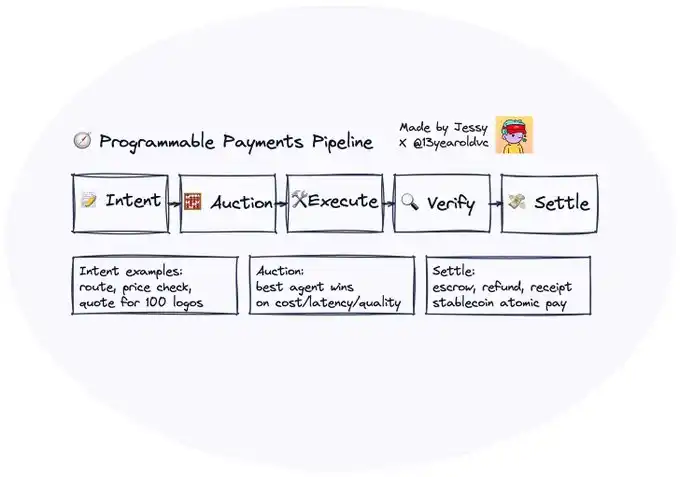
In the past, decentralization was often seen as inefficient — in part due to slow human action and high coordination costs. However, proxies are now eliminating these bottlenecks: they can continuously assess who is best suited to perform tasks, what a fair price is, and which data is trustworthy.
Blockchain plays the role of a "state coordination layer" here — an immutable shared memory system used to record results, deposits, and scores; while stablecoins serve as real-time value exchange micro-payment channels (pay-per-answer, pay-per-action).
This complex "Proxy ↔ Human" collaboration scenario is precisely the problem that blockchain and stablecoins are best suited to solve. Interoperability allows proxies to communicate with each other, and composability enables them to collaborate.
3. Proxy → Network
Another noteworthy trend is that network users are no longer just humans; more and more content is being crawled, read, and interacted with by AI proxies, and in the future, it may even be dominated by proxies. This means that websites will no longer just charge humans but will start charging machines — a concept known as "pay-per-crawl."
For example, publishers are pushing back against unrestricted content scraping. Anthropic recently paid $1.5 billion to resolve copyright lawsuits with authors — one of several cases testing whether AI companies can freely use copyrighted content. OpenAI, Microsoft, Meta, and others are also embroiled in similar controversies. The ultimate fair outcome may be that training data and content usage will adopt a "pay-per-access" model.
Meanwhile, Cloudflare (which reportedly handles about 20% of web requests through its network) has been experimenting with a new model: websites can charge proxies a nanoscale fee (even lower than micro-payments) to allow them access to data. They have recently introduced their own stablecoin — NET Dollar.
This is where cryptocurrency payments come into play once again.
Websites and APIs can expose a "paywall" interface, where a proxy can pay a few cents or even less to read, query, or consume content without the need for a subscription or advertisements. This transforms the web into a system of microservices, where value flows in real-time rather than being tied to a monthly billing cycle.
If you are interested in the early internet's "402 Payment Required" status code and related discussions by Andreesen and others, Pantera Capital's Jay Yu has written an insightful article delving into this evolution.

Imagine a 1950s mailroom where people are stuffing bills and invoices into envelopes. This inefficient process is one of the reasons we eventually adopted the "Net 30" payment term.
In reality, the "pay-per-crawl" economic model will exhibit a power-law distribution. Only a few high-traffic or high-value websites—those with data that proxies truly need—will proactively integrate this monetization logic. For most websites, the cost of metering, charging, and settling proxy traffic will far exceed the revenue. In other words, we believe that ultimately only a few large publishers will capture the majority of revenue, while long-tail sites will either remain open for access or struggle to monetize.
This is where intermediary platforms like Cloudflare might change the curve. If Cloudflare could enable websites to "enable proxy payments" through a simple toggle—and handle authentication, metering, and settlement through protocols like x402 or Web Bot Auth—the barrier to entry would be significantly lowered.
Cloudflare could automatically recognize authorized proxy requests, charge nano-level fees on behalf of websites, and distribute revenue automatically.
In this model, the open web itself would gain a native machine commerce layer: any webpage could become a billable API, and any proxy could seamlessly pay while browsing, crawling, or learning.
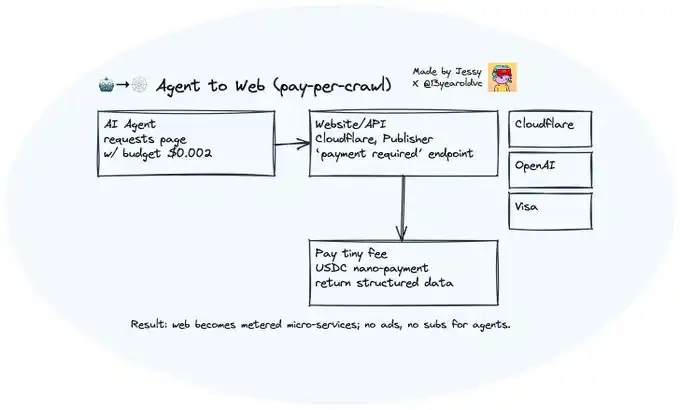
This trend is not limited to data access. Almost all online services that can be used on a per-usage basis may in the future shift to an "on-demand payment" model. In a conversation with ATXP co-founder Louis Amira, we discussed how companies could open up new revenue streams through proxy payments, citing a few examples: LegalZoom could charge $2 for an NDA; if the payment experience is smooth enough, Netflix could charge per episode, $0.5 per episode; Replit could charge based on token count, allowing unlimited "vibe-coding" at $1.23 per million tokens; PitchBook or Bloomberg could allow proxies to pull valuation models on a one-off basis, charging $0.25; hospitals could charge per record, providing anonymous cancer scan data for model training.
Louis once started taking screenshots to document the "forced upgrade" or "paywall" scenarios he encountered—these companies could have adopted a pay-per-use model to turn him into a customer.
In an ideal state, enterprise developers could quickly launch temporary API endpoints with pay-per-use instead of monthly subscriptions; writers or researchers could sell single paragraphs, charts, or datasets per query.
Conversely, agents could also access private data APIs on a request basis, query supplier data that web scrapers cannot reach, and use prepaid microrequests. This model is well-suited for long-tail APIs and enterprise datasets.
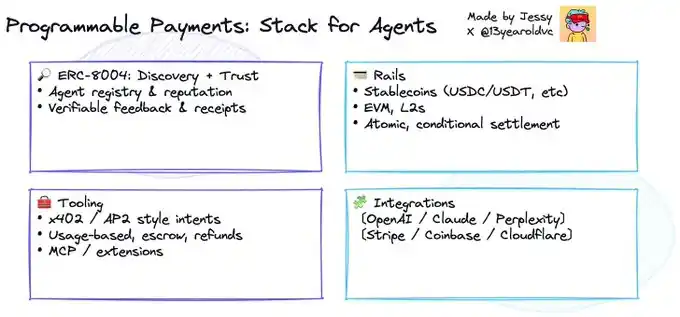
Coinbase's CDP team has already made early attempts on the Payments MCP, allowing LLM to use on-chain tools like wallets and payment functions without an API key.
The internet is no longer becoming a collection of subscription bundles but more like a "real-time billing system"—with pricing, payment, and settlement for every interaction, where value flows continuously.
We are still in the early stages, but integration is happening.
After completing a full round of research, our conclusion is: although the imaginative space for smart agent payments is significant, it is still in its early stages. One of the most significant challenges is that payments themselves are one of the most heavily regulated and complex areas on the internet. Its implementation often depends not on technical feasibility but on whether integration and interoperability with large enterprises and financial networks can be achieved. This inherently makes progress slow.
For startups, even if the underlying technology exists, meaningful experiments are almost impossible without access to banks, card schemes, or mainstream payment processors.
The future is likely to see solutions geared towards enterprise-grade, compliance-grade. Therefore, teams like Catena Labs are building the Agent Commerce Kit, focusing on agent authentication, payment interactions between humans and agents, and targeting licensed financial institutions, regulatory compliance, and enterprise-level use cases. PayPal is also likely to attempt a similar direction.
How Far Are We from True Smart Payments?
Currently, most so-called "agents" are still only semi-autonomous systems. Technically, they are more like complex workflow automation tools than intelligent entities capable of autonomous shopping or negotiation. As Kevin Li from Goldsky said: "You can't sell 'fully automated business' yet; most AI companies are still doing workflow automation."
The short-term opportunity lies in the "Semi-Autonomous Interstitial Zone": human-initiated behavior triggering API-level, pay-as-you-go settlement through a stablecoin channel. While these processes are not yet fully smart agent behavior, they are utilizing the same infrastructure—low-latency programmable wallets, call-based metering, instant settlement—all of which are core components that future true "agent ↔ agent" commerce relies on.
Meanwhile, the underlying blockchain also needs to evolve. Smart payments require stablecoin channels with high throughput, low latency, privacy protection, and other features. The next generation of payment-oriented public chains is being explored by major players, such as Stripe's new chain Tempo, Circle's native chain, and we also look forward to more teams focusing on agents and stablecoins emerging in the Ethereum L2 ecosystem (such as Thirdweb). All of this indicates that the infrastructure for programmable money is being rebuilt from scratch to support millions of transactions per second of micro and nano payments.
Furthermore, programmable wallets and server-side architecture must also be upgraded in sync. If wallets still assume mnemonic custody by humans, none of this can be achieved. What smart business needs is policy-based server-side custody—featuring programmable budgets, rate limits, spending ranges, multi-sign/TEE control, and auditable authorization mechanisms.
This is where the significance of programmable wallets lies: they provide key management and policy execution capabilities for agent invocations without the need to "hold a mnemonic phrase." As Jamie Hinz of Privy pointed out, four years ago we might have still been trying to transform Fireblocks or MetaMask into this form; yet today, the entire tech stack is being tailored for agents to execute transactions under a policy framework, rather than relying on passwords—security and automation are merging, no longer at odds. (For a deeper dive, I recommend reading Privy's article on natural language control and policy execution.)
More importantly, this trend has already begun to emerge. Even Visa and Mastercard are adjusting their networks to accommodate smart agent business, introducing the Trusted Agent and Agent Pay protocols based on Web Bot Auth—indicating that identity verification, authorization, and settlement are rapidly converging, whether in blockchain or traditional payment channels.
We may only be a few key breakthroughs away from truly realizing this vision.
Once payments become programmable, the behavior of the internet will also change. Every action can be priced, paid for, and settled in real time. Every agent, whether a model or a human, can receive instant rewards for their contributions.
As infrastructure gradually improves, two key standards are emerging: ERC-8004 providing a trust layer that allows agents to discover and collaborate without the need for centralized intermediaries; x402 enabling instant, frictionless payments between agents.
Together, they form the underlying pipeline of the intelligent agent economy.
We envision a future where Agent A finds Agent B through the ERC-8004 registry, negotiates service terms, and then instantly completes payment through smart payment protocols like x402, with settlement on the Ethereum neutral financial layer.
To enable true agent collaboration, they must have interoperability—being able to discover each other, communicate, and exchange data through shared protocols; and composability—the ability to build on top of each other.
As Lincoln Murr of Coinbase puts it: "If machine-to-machine payments are dominated by stablecoin rails, it could drive widespread stablecoin adoption across the internet. While Visa and Mastercard still dominate human-to-merchant payments, agents will be the 'Trojan horse' for advancing crypto payments."
The internet took 20 years from web pages to apps, then another 15 years from apps to platforms. Agents will compress this cycle. Commerce will no longer be something you "actively do" but will become a process that happens automatically—quietly, continuously, ubiquitously.
You may also like

The flow of stablecoins and the spillover effects in the foreign exchange market

After two years, Hong Kong's first batch of stablecoin licenses finally issued: HSBC, Standard Chartered make the cut
The person who helped TAO rise by 90% has now single-handedly crashed the price again today

3-Minute Guide to Participating in the SpaceX IPO on Bitget

Top 5 Cryptos to Buy in 2026 Q1: A ChatGPT Deep Dive Analysis
Explore the top 5 cryptos to buy in Q1 2026 including BTC, ETH, SOL, TAO, and ONDO. See price outlooks, key narratives, and institutional catalysts shaping the next market move.

How to Earn $15,000 with Idle USDT Before Altcoin Season 2026
Wondering if altcoin season is coming in 2026? Get the latest market update, and learn how to turn your idle stablecoins waiting for entry into extra rewards up to 15,000 USDT.
Can You Win Joker Returns Without Large Trading Volume? 5 Mistakes New Players Make In WEEX Joker Returns Season 2
Can small traders win WEEX Joker Returns 2026 without huge volume? Yes—if you avoid these 5 costly mistakes. Learn how to maximize card draws, use Jokers wisely, and turn small deposits into 15,000 USDT rewards.

Altcoin Season 2026: 4 Stages to Profit (Before the Crowd FOMO In)
Altcoin Season 2026 is starting — discover the 4 key stages of capital rotation (from ETH to PEPE) and how to position before the peak. Learn which tokens will lead each phase and avoid missing the rally.

Will Alt season come in 2026? 5 Tips to Spot the Next 100x Crypto Opportunities
Will altcoin season arrive in 2026? Discover 5 rotation stages, early signals smart traders watch, and the key crypto sectors where the next 100x altcoin opportunities may emerge.

The bear market has arrived, and cryptocurrency ETF issuers are also getting involved

The richest man had a quarrel with his former boss

BTC Firm Above 70K! Saylor’s "Institutional Logic" vs. Moon’s "Retail Faith": Who is Really Harvesting the Market?
Bitcoin is holding firm above the $70,000 support level following a massive short squeeze that liquidated $427 million. As the "Four-Year Cycle" narrative shifts, the market is split: Michael Saylor’s cold, institutional "indiscriminate stacking" vs. Carl Moon’s high-energy retail "hopium." This article decodes these two polar-opposite strategies for the 2026 bull run and reveals how WEEX’s institutional-grade liquidity and AI trading tools empower every type of investor to convert market volatility into profit.

The Girl Who Created the SBTI Test: A Story of a Doomed Cyber Love, an E-Widow Ratfolk

B.AI Officially Launched: Building AI Agent Financial Bedrock Platform, Driving AGI Era Business Underlying Logic

B.AI Officially Launched: Breaking Down A2A Collaboration Barriers to Unlock the Smart Body Economy's Full Potential
We helped Xu Mingxing write a book called "<OK Life>".

Rare APY of 400%, is TradeXYZ handing out money to oil bulls?
a16z: Perpetual Contracts are Rewriting Global Trading Rules
The flow of stablecoins and the spillover effects in the foreign exchange market
After two years, Hong Kong's first batch of stablecoin licenses finally issued: HSBC, Standard Chartered make the cut
The person who helped TAO rise by 90% has now single-handedly crashed the price again today
3-Minute Guide to Participating in the SpaceX IPO on Bitget
Top 5 Cryptos to Buy in 2026 Q1: A ChatGPT Deep Dive Analysis
Explore the top 5 cryptos to buy in Q1 2026 including BTC, ETH, SOL, TAO, and ONDO. See price outlooks, key narratives, and institutional catalysts shaping the next market move.
How to Earn $15,000 with Idle USDT Before Altcoin Season 2026
Wondering if altcoin season is coming in 2026? Get the latest market update, and learn how to turn your idle stablecoins waiting for entry into extra rewards up to 15,000 USDT.


 App
App