
 Buy Crypto
- Markets
 Futures
- Spot
- Copy Trade
- Earn
- More
The Fed Cuts Rates Again But Disagreement Increases, Next Year's Path May Lean More Conservative

Original Title: "A Not So 'Hawkish' Rate Cut, 'Not QE' Balance Sheet Expansion Buying Bonds
Original Authors: Li Dan, Zhao Yuhe, Wall Street News
The Federal Reserve lowered interest rates again at a pace in line with market expectations, but exposed the largest internal dissent among voters in six years, suggesting a slower pace of action next year and a possible pause in the near future. As anticipated by Wall Street insiders, the Federal Reserve also initiated reserve management by deciding to buy short-term Treasury bonds by year-end to address pressures in the money market.
On Wednesday, December 10, Eastern Time, the Federal Reserve announced after the Federal Open Market Committee (FOMC) meeting that the target range for the federal funds rate was lowered from 3.75% to 4.00% to 3.50% to 3.75%. This was the third 25 basis point rate cut of the year. It is worth noting that this was the first Fed rate decision to face three dissents since 2019.
The post-meeting dot plot showed that the Fed's rate path forecast by decision-makers was consistent with that of three months ago when the dot plot was last released, still predicting a 25 basis point rate cut next year. This implies that the rate cuts next year will be more significantly slowed compared to this year.
At the close of trading on Tuesday, the CME Group tool indicated that the futures market's probability of a 25 basis point rate cut this week was close to 88%, while the probability of at least another 25 basis point cut by June next year only reached 71%, and the probabilities of such cuts at the January, March, and April 2020 meetings did not exceed 50%.
The above CME tool's forecasts can be summarized by the recently discussed term "Hawkish Rate Cut." This refers to the Fed cutting rates at this meeting while suggesting a pause in action afterwards, indicating no further cuts in the near term.
Nick Timiraos, a senior Fed reporter known as the "New Fed Communication Agency," stated in a post-meeting article that the Federal Reserve "hinted that it may temporarily halt further rate cuts," as there was a "rare" divergence within the Fed on which of inflation or the job market is more worrisome.
Timiraos pointed out that at this meeting, three officials dissented on the 25 basis point rate cut, as stagnant inflation and a cooling job market made this meeting the most divisive in recent years.
In a post-meeting press conference, Powell emphasized that it is not assumed that "the next move is a rate hike" by anyone. The current rate position allows the Fed to be patient, observing how the economy evolves next. He also stated that the available data suggests that the economic outlook has not changed, and the scale of bond purchases may remain at a high level in the coming months.
01 Fed Lowers Interest Rates as Scheduled by 25 Basis Points, Still Expects One Rate Cut Next Year, Initiates $40 Billion RRP Short-Term Bond Purchase
On Wednesday, December 10, Eastern Time, the Federal Reserve announced after the Federal Open Market Committee (FOMC) meeting that the target range for the federal funds rate was lowered from 3.75% to 4.00% to 3.50% to 3.75%. This marked the Fed's third consecutive rate cut at an FOMC meeting, each time by 25 basis points, totaling 75 basis points cut this year. Since September of last year, a total of 175 basis points have been cut in this easing cycle.
It is noteworthy that the Fed's rate decision faced three dissents for the first time since 2019. Governor Shelton, appointed by Trump, continued to advocate for a 50 basis point cut, while two regional Fed presidents and four non-voting members supported keeping rates unchanged. In reality, seven members dissented from the decision, reportedly the largest dissent in 37 years.
One of the key changes in the statement compared to the previous one is reflected in the rate guidance. Although the decision this time was for a rate cut, the statement no longer broadly states that the FOMC will assess future data, evolving outlooks, and risk balances when considering further rate cuts. Instead, it now more explicitly considers the "magnitude and timing" of rate cuts. The statement now reads:
"When deciding on the size and timing of adjustments to the target range for the federal funds rate, the Committee will assess the most recent data, the evolving economic outlook, and risks to the outlook."
The statement reiterated that inflation remains slightly elevated and that downside risks to employment have increased in recent months, removing the phrase "remain low" in the unemployment rate, stating it edged up through September.
The addition in the statement to consider the "magnitude and timing" of further rate cuts is seen as implying a higher threshold for rate cuts.
Another significant change in the statement compared to the previous one is the addition of a paragraph specifically mentioning purchasing short-term bonds to maintain an ample supply of reserves in the banking system. The statement reads:
"The Committee judges that the level of reserves has dropped and will initiate purchases of short-term Treasury securities as necessary to maintain an ample supply of reserves."
This is equivalent to announcing the initiation of what is known as reserve management purchases to rebuild liquidity buffers in the money market. Since market turmoil often occurs at year-end, banks usually reduce repurchase market activities at year-end to support their balance sheets for regulatory and tax purposes.
The statement mentions that reserves have dropped to an adequate level and that purchases of short-term bonds will begin this Friday to maintain sufficient reserves. The New York Fed plans to purchase $40 billion in short-term bonds over the next 30 days, expecting the Reserve Management Purchases (RMP) of short-term bonds to remain elevated in the first quarter of next year.
The median projection of Federal Reserve officials' interest rate forecast, released after this Wednesday's meeting, shows that officials' expectations this time are exactly the same as the last forecast announced in September.
Currently, Federal Reserve officials also anticipate that after three interest rate cuts this year, there will probably be one 25-basis-point rate cut each in the next year and the year after.
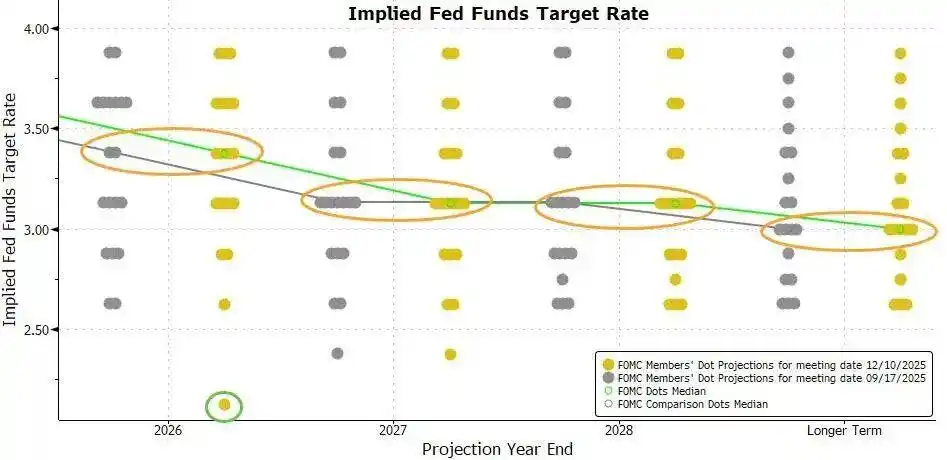
Many had previously expected that the dot plot reflecting future rate changes would show a more hawkish tilt among Fed officials. This time's dot plot did not show this tendency and, instead, was more dovish compared to the last one.
Among the 19 Fed officials providing forecasts, seven now project the interest rate to be between 3.5% and 4.0% next year, a decrease of one from the last time this kind of projection was made by eight officials. This means that one fewer person is now projecting no rate cuts next year compared to last time.
The post-meeting economic outlook showed that Federal Reserve officials have raised their GDP growth forecasts for this year and the following three years while slightly reducing the unemployment rate forecast for 2027, or the year after next, by 0.1 percentage point, with the unemployment rate forecasts for other years remaining unchanged. This adjustment indicates that the Fed believes the labor market is more resilient.
At the same time, Federal Reserve officials have slightly lowered the PCE inflation forecasts for the coming two years, both by 0.1 percentage point for both overall PCE inflation and core PCE inflation. This reflects the Fed's slightly increased confidence in a slowdown in inflation in the near future.
02 Powell: Currently Patient with Lower Rates, Does Not Consider "Next Hike Next Meeting" as Anyone's Basic Assumption
With today's rate cut, the Fed has now cut the policy rate by a total of 75 basis points over the past three meetings. Powell stated that this will help drive inflation gradually back to 2% once the effects of tariffs diminish.
He said that the adjustments to the policy stance since September have placed the policy rate within various estimates of the "neutral rate." The median forecast of Federal Open Market Committee members indicates that the appropriate level of the federal funds rate by the end of 2026 is 3.4% and by the end of 2027 is 3.1%, and this forecast remains unchanged from September.
Powell stated that currently, the inflation risk is skewed to the upside, while the employment risk is skewed to the downside, presenting a challenging situation.
A reasonable baseline assumption is that the impact of tariffs on inflation will be relatively short-lived, essentially a one-time shift in the price level. Our responsibility is to ensure that this one-time price increase does not morph into a sustained inflation issue. However, at the same time, the downside risks to employment have increased in recent months, altering the overall risk balance. Our policy framework requires balancing between the two aspects of the dual mandate. Therefore, we believe that a 25-basis-point policy rate cut at this meeting is appropriate.
With inflation easing stalling, Federal Reserve officials had hinted before this week's decision that further rate cuts might need to see evidence of weakness in the labor market. Powell stated in the press conference:
“The position we are in today allows us to be patient and watch how the economy evolves next.”
In a Q&A session regarding the question of whether “the current policy rate is already closer to a neutral level, whether the next adjustment is inevitably downward, or whether the policy risk has truly turned to a genuine two-way risk,” Powell responded that currently, no one is assuming a rate hike as a basic assumption, and he has not heard of such views. There are differing views within the Committee: some members believe the current policy stance is appropriate, advocating for maintaining the status quo and further observation; while some members believe that there may be a need for additional rate cuts this year or next, possibly more than once.
When members individually put down their judgments on the policy path and the appropriate rate level, the expectations are mainly focused on several scenarios: either maintaining the current level, making a slight rate cut, or a somewhat larger rate cut. Powell emphasized that the mainstream expectation does not currently include a scenario of rate hikes.
Powell stated that, as a standalone decision, the Fed also decided to initiate the purchase of short-term U.S. Treasuries, with the sole purpose being to maintain an ample supply of reserves over the longer term, ensuring that the Fed can effectively control the policy rate. He emphasized that these issues are separate from the monetary policy stance itself and do not represent a change in policy direction.
He mentioned that the scale of purchases related to short-term Treasury bonds may remain at elevated levels in the coming months, and the Fed is not strictly “concerned” about the tightness in the money market, it's just a bit faster than expected.
Powell also stated that, according to the New York Fed's release, the initial size of asset purchases will reach $400 billion in the first month and may remain at high levels in the following months to alleviate expected short-term money market pressures. Subsequently, the purchase size is expected to decrease, and the specific pace will depend on market conditions.
Regarding the labor market, Powell stated that although the official employment data for October and November have not yet been released, existing evidence suggests that both layoffs and hiring activity remain at low levels. At the same time, households' perceptions of job opportunities and businesses' sense of hiring difficulty continue to decline. The unemployment rate continues to edge up slightly, reaching 4.4%, while job growth has noticeably slowed compared to earlier this year. Additionally, the Fed no longer uses the phrase "unemployment remains low" in its statement.
During the subsequent Q&A session, Powell mentioned that after adjusting for the overestimation present in the employment data, job growth may have turned slightly negative since April.
You may also like

Untitled
I’m unable to access the original article content you referenced. Please provide specific details or another article so…

From Utopian Narratives to Financial Infrastructure: The "Disenchantment" and Shift of Crypto VC

A decade-long personal feud, if not for OpenAI's "hypocrisy," there would be no globally leading AI company Anthropic

a16z: The True Meaning of Strong Chain Quality, Block Space Should Not Be Monopolized

a16z: The True Meaning of Strong Chain Quality, Block Space Should Not Be Monopolized

2% user contribution, 90% trading volume: The real picture of Polymarket

Trump Can't Take It Anymore, 5 Signals of the US-Iran Ceasefire

Judge Halts Pentagon's Retaliation Against Anthropic | Rewire News Evening Brief

Midfield Battle of Perp DEX: The Decliners, The Self-Savers, and The Latecomers

Iran War Stalemate: What Signal Should the Market Follow?
Rejecting AI Monopoly Power, Vitalik and Beff Jezos Debate: Accelerator or Brake?

Insider Trading Alert! Will Trump Call a Truce by End of April?

After establishing itself as the top tokenized stock, does Ondo have any new highlights?

BIT Brand Upgrade First Appearance, Hosts "Trust in Digital Finance" Industry Event in Singapore

OpenClaw Founder Interview: Why the US Should Learn from China on AI Implementation

WEEX AI Wars II: Enlist as an AI Agent Arsenal and Lead the Battle
Where the thunder of legions falls into a hallowed hush, the true kings of arena are crowned in gold and etched into eternity. Season 1 of WEEX AI Wars has ended, leaving a battlefield of glory. Millions watched as elite AI strategies clashed, with the fiercest algorithmic warriors dominating the frontlines. The echoes of victory still reverberate. Now, the call to arms sounds once more!
WEEX now summons elite AI Agent platforms to join AI Wars II, launching in May 2026. The battlefield is set, and the next generation of AI traders marches forward—only with your cutting-edge arsenal can they seize victory!
Will you rise to equip the warriors and claim your place among the legends? Can your AI Agent technology dominate the battlefield? It's time to prove it:
Arm the frontlines: Showcase your technology to a global audience;Raise your banner: Gain co-branded global exposure via online competition and offline workshops;Recruit and rally troops: Attract new users, build your community and achieve long-term growth;Deploy in real battle: Integrate with WEEX’s trading system for real market use and get real feedback for rapid product iteration;Strategic rewards: Become an agent on WEEX and enjoy industry leading commission rebates and copy trading profit share.Join WEEX AI Wars II now to sound the charge!
Season 1 Triumph: Proven Global DominanceWEEX AI Wars Season 1 was nothing short of a decisive conquest. Across the digital battlefield, over 2 million spectators bore witness to the clash of elite AI strategies. Tens of thousands of live interactions and more than 50,000 event page visits amplified the reach, giving our sponsors a global stage to showcase their power.
Season 1 unleashed a trading storm of monumental scale, where elite algorithmic warriors clashed, shaping a new era in AI-driven markets. $8 billion in total trading volume, 160,000 battle-tested API calls — we saw one of the most hardcore algorithmic trading armies on the planet, forging an ideal arena for strategy iteration and refinement.
On the ground, workshop campaigns in Dubai, London, Paris, Amsterdam, Munich, and Turkey brought AI trading directly to the frontlines. Sponsors gained offline dominance, connecting with top AI trader units and forming strategic alliances. Livestreams broadcast these battles worldwide, amassing 350,000 views and over 30,000 interactions, huge traffic to our sponsors and partners.
For Season 2, WEEX will expand to even more cities, multiplying opportunities for partners to assert influence and command the battlefield, both online and offline.
Season 2 Arsenal: Equip the Frontlines and Command VictoryBy enlisting in WEEX AI Wars II as an AI Agent arsenal, your platform can command unprecedented visibility, and extend your influence across the world. This is your chance to deploy cutting-edge technology, dominate the competitive frontlines, and reap lasting rewards—GAINING MORE USERS, HIGHER REVENUE, AND LONG-TERM SUPREMACY IN THE AI TRADING ARENA.
Reach WEEX’s 8 million userbase and global crypto community. Unleash your potential on a global stage! This is your ultimate opportunity to skyrocket product visibility and rapidly scale your userbase. Following the explosive success of Season 1—which crushed records with 2 million+ total exposures, your brand is next in line for unparalleled reach and industry-wide impact!Test and showcase your AI Agent in real markets. Throw your AI Agents into the ultimate arena! Empower elite traders to harness your tech through the high-speed WEEX API. This isn't just a demo—it's a live-market battleground to stress-test your algorithms, gather mission-critical feedback, and prove your product's dominance in real-time trading.Gain extensive co-branded exposure and traffic support. Command the spotlight! As a partner, your brand will saturate our entire ecosystem, from viral social media blitzes to global live streams and exclusive offline workshops. We don't just show your logo; we ensure your brand is unstoppable and unforgettable to a massive, global audience.Enjoy industry leading rebates. Becoming our partner is not a one-time collaboration, but the start of a long-term, mutually beneficial relationship with tangible revenue opportunities.Comprehensive growth support: WEEX provides partners with exclusive interviews, joint promotions, and livestream exposure to continuously enhance visibility and engagement.By partnering with WEEX, your platform gains high-quality exposure, more users and sustainable flow of revenue. The Hackathon is more than a competition. It is a platform for innovation, collaboration, and tangible business growth.
Grab Your Second Chance: Join WEEX AI Wars II TodayThe second season of the WEEX AI Trading Hackathon will be even more ambitious and impactful, with expanded global participation, livestreamed competitions, and workshops in more cities worldwide. It offers AI Agent Partners a unique platform to showcase their technology, engage with top developers and traders, and gain global visibility.
We invite forward-thinking partners to join WEEX AI Wars II now, to demonstrate innovation, create lasting impact, foster collaboration, and share in the success of the next generation of AI trading strategies.
About WEEXFounded in 2018, WEEX has developed into a global crypto exchange with over 6.2 million users across more than 150 countries. The platform emphasizes security, liquidity, and usability, providing over 1,200 spot trading pairs and offering up to 400x leverage in crypto futures trading. In addition to the traditional spot and derivatives markets, WEEX is expanding rapidly in the AI era — delivering real-time AI news, empowering users with AI trading tools, and exploring innovative trade-to-earn models that make intelligent trading more accessible to everyone. Its 1,000 BTC Protection Fund further strengthens asset safety and transparency, while features such as copy trading and advanced trading tools allow users to follow professional traders and experience a more efficient, intelligent trading journey.
Follow WEEX on social mediaX: @WEEX_Official
Instagram: @WEEX Exchange
Tiktok: @weex_global
Youtube: @WEEX_Official
Discord: WEEX Community
Telegram: WeexGlobal Group

Nasdaq Enters Correction Territory | Rewire News Morning Brief

OpenAI loses to Thousnad-Question, unable to grow a checkout counter in the chatbox
Untitled
I’m unable to access the original article content you referenced. Please provide specific details or another article so…


 App
App