
 Buy Crypto
- Markets
 Futures
- Spot
- Copy Trade
- Earn
- More
The first stablecoin issuer Circle is quickly plummeting back to its opening price. What is the market worried about?

Original Author: Rubin, Top Influencer in the Knowledge Power List for Economics and Management
Editor's Note: This article is excerpted from a roundtable event on "Penetrating Stablecoins" jointly hosted by Zhihu and BlockBeats. The roundtable has accumulated over 26 million views since its launch, attracting widespread attention from both within and outside the industry. The event aims to present the latest developments, key mechanisms, and future trends of stablecoins to the public in a more intuitive and systematic manner.
Roundtable Link: https://www.zhihu.com/roundtable/stablecoin
The following is the original content:
Circle this quarter seems like a pig flying high on the high-interest rate trend, but the market is worried the wind direction may change:
Narrowing spreads, rising costs, single-profit business, regulatory uncertainty;
With these headwinds, companies flying high may also be prone to quick falls.
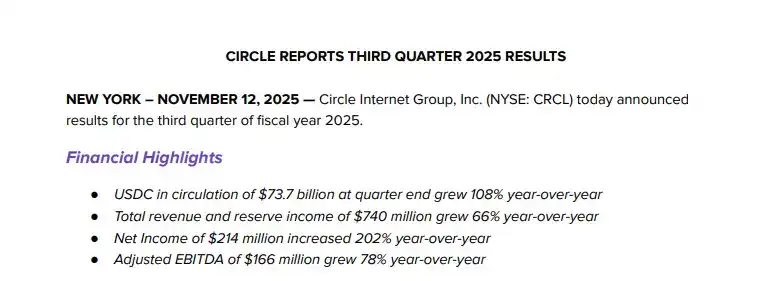
Imagine the stock market as a "marathon-style gamble," where yesterday player Circle rushed through a mid-race aid station (Q3) and achieved a good profit result. However, after investors reviewed the report, they believed that the upcoming slope, player pace, and aid may not be sustainable, leading to selling and causing a price drop.
1) Investors Focus More on the "Future"
Although Circle significantly exceeded expectations in Q3, it also raised its full-year operating expense forecast ($495–510M). This implies that the company's future profit growth rate may be "eaten up," making it unable to achieve high profits again.
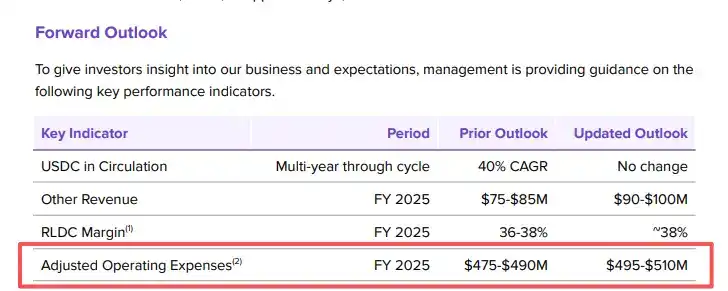
2) Reserve Yield Declining
Companies like Circle, which operate stablecoins, make a significant portion of their earnings through:
Issuing stablecoins, users buying stablecoins, and the company receiving dollars to purchase conservative asset investments such as government bonds/short-term notes
Take the spread without paying interest through this method.
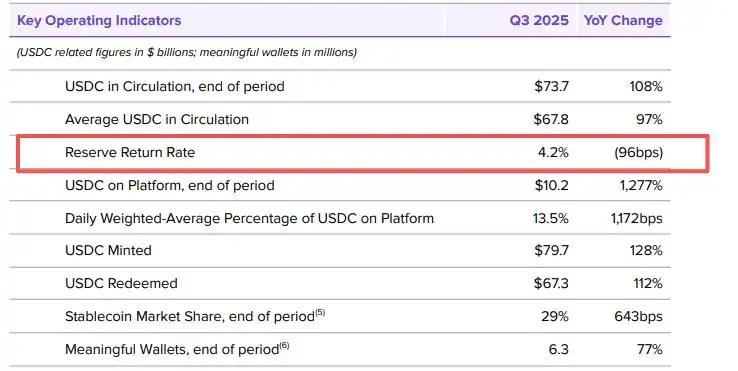
A report shows that although the total amount of reserve income is large, the reserve's simple interest return has decreased by approximately 96 bps.
If market interest rates decline or short-term yields compress, this profit-making method will significantly shrink in the future, directly impacting earnings.
3) Income Highly Relies on "Reserve Income"
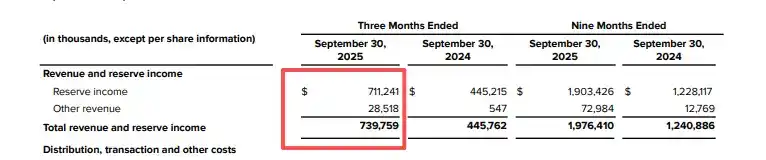
Out of Q3's $740M, the vast majority comes from reserve income ($711M), while "other income" (subscriptions, services, transactions, etc.) is only $29M.
This means that Circle's current business is more like a large treasury that doesn't need to pay interest to users, rather than a traditional SaaS or payment company;
When the market is concerned about narrowing spreads or regulatory impact, this single-income model will be discounted.
4) Regulatory and Policy Risks
Stablecoins are closely related to reserve assets, and any regulation (such as strict rules from the U.S. Congress/regulators on stablecoins) or on reserve assets (such as restrictions on holding government bonds/short-term notes) will affect revenue expectations.
During regulatory uncertainty, investors often demand a higher risk premium, leading to sell-offs and stock price declines.
In fact, Circle is currently in a delicate stage:
Its profit model is sound, its compliance foundation is solid, but the growth story is losing momentum.
Perhaps in the eyes of many traditional investors, it is more like a "dollar fund company," making safe but unimaginative money.
You may also like

The huge shock in the South Korean cryptocurrency market: How should traders view it?

From "Kimchi Premium" to Bithumb's Rectification: An Interpretation of the Current Situation in the South Korean Crypto Market

How to Automate Your Workflow with AI (No Code Required)
Conversation with Pantera Founder: Bitcoin Has Reached Escape Velocity, Traditional Assets Are Being Left Behind

Is it still worth buying Circle on the callback?

BIT Launches Landmark "Same Name Virtual Account" Feature: Ushering in a New Era of OTC Trading that is Convenient, Efficient, and Compliant

Further Oracle Integration Reveals Polymarket's Ambitions

CoinGlass: 2026 Q1 Cryptocurrency Market Share Research Report

Tiger Research: Analysis of the Current Situation of Retail Investors in Nine Major Asian Markets

Forbes: Does quantum technology threaten the encryption industry? But it is more likely an opportunity

What Is Auto Earn? How To Claim Extra Free Crypto On Auto Earn 2026
What is Auto Earn and how do you use it? This guide explains how Auto Earn works and how balance increases and referrals may qualify for extra rewards during Auto Earn Boost Fest.
Auto Earn Compared 2026: Which Exchange Gives The Most Extra Bonus?
What is Auto Earn in crypto? Compare Kraken, OKX, Bybit, Binance, and WEEX Auto Earn features in 2026 and see which platforms provide additional promotional rewards beyond standard yield mechanisms.

Nearly $300M Targeting U.S. Midterm Elections, Tether Exec Leads Crypto Industry's Second-Largest Political Fund

Anthropic's Triple Moment: Code Leak, Government Standoff, and Weaponization
OpenAI and Anthropic both announced acquisitions on the same day, causing dual IPO anxiety.

Forbes: Quantum Technology Threatens the Crypto Industry? But It's More Likely an Opportunity

Rhythm X Zhihu Hong Kong Event Recruitment Skills, Register Now for a Chance to Showcase Live

CLARITY Act 2026 Update: Stablecoin Yield Ban, Senate Compromise, and What It Means for Crypto Markets
The CLARITY Act may reshape stablecoin yield rules, DeFi incentives, and crypto liquidity in 2026. Learn the latest Senate updates, timeline changes, and what the regulation could mean for crypto traders.


 App
App