
 Buy Crypto
- Markets
 Futures
- Spot
- Copy Trade
- Earn
- More
The Trillion-Dollar Stablecoin Battle: Binance Decides to Step in Again

Original Title: "The Trillion-Dollar Stablecoin Battle, Binance Decides to Intervene Again"
Original Author: Lin Wanwan, Dongcha Beating
By 2024, the total on-chain transaction volume of stablecoins had reached $27.6 trillion, surpassing the sum of Visa and Mastercard for the first time.
This number was $300 billion five years ago and close to zero ten years ago.
On December 18, a project named United Stables launched a new type of stablecoin $U in Dubai. Its reserve is not in US dollars or treasury bonds, but in a combination of USDC, USDT, and USD1 stablecoins. Using one stablecoin as collateral for another stablecoin is referred to as "nested doll."
Binance Wallet was the first to integrate, with endorsement from the BNB Chain official, and full support from PancakeSwap and Four.Meme.
The implications of this setup in the crypto community are clear: Binance is personally intervening.
$U itself may be insignificant. But the trend it represents: stablecoins transitioning from a wild growth phase to a fragmented landscape, a new battle is unfolding.
Stablecoin 1.0 Era: The Monopoly of the Early Movers
The essence of stablecoins is the "on-chain dollar," where users deposit 1 US dollar with the issuer and receive 1 token, which can circulate 24/7 on any global blockchain, with instant transactions and minimal fees.
Compared to Alipay or bank transfers, the core advantage of stablecoins is no real-name requirement, no need for a bank account, and no regulatory permission. A wallet address is the only barrier to entry.
In 2014, when Tether issued USDT, the entire crypto market cap was less than $5 billion. The window of opportunity Tether seized was: traditional banks widely refused to serve cryptocurrency companies. For those looking to cash out after profiting from trading, the only way was to convert crypto assets into USDT to lock in profits pegged to the dollar.
The rise of USDT was not only due to its excellent product but also because users had no other choice. This "passive monopoly" has continued to this day, with USDT having a market cap of around $199 billion as of December 2025, occupying 60% of the stablecoin market share.
In 2018, Circle teamed up with Coinbase to launch USDC, focusing on the compliance card: releasing monthly reserve audit reports, funds held by regulated financial institutions, and embracing the US securities regulatory framework. The implication was that Tether's black-box model would eventually face issues.
In 2022, the market capitalization of USDC once approached 70% of USDT's. Wall Street bet on the compliance camp to eventually win.
In March 2023, Silicon Valley Bank collapsed with Circle holding $3.3 billion in reserves there. USDC briefly broke its peg to $0.87, where an asset always equal to 1 US dollar lost 13%.

The lesson learned by the market was: Compliance is a bonus point but not a moat. Banks will collapse, regulations will shift, the real barrier is network effect—when your user base and liquidity are large enough, you are effectively the standard.
The survival rule of the Stablecoin 1.0 era was only one: First-mover advantage is greater than everything.
Binance's Three Reversals
A trading platform is the traffic hub of the crypto world, and a stablecoin is the unit of account for trading. Whoever controls the mainstream stablecoin holds the pricing power. Binance could not afford to lose this position.
In 2019, Binance partnered with the New York-regulated trust company Paxos to issue BUSD. This was a compliant stablecoin regulated by the New York Department of Financial Services, peaking at a market cap of $16 billion, second only to USDT and USDC.
BUSD once accounted for 40% of Binance's trading volume. It was the core tool for Binance to establish its own "minting right."
In February 2023, the SEC issued a Wells Notice to Paxos, accusing BUSD of being an unregistered security. On the same day, the New York Department of Financial Services ordered Paxos to cease minting new BUSD. Nine months later, Binance founder CZ pleaded guilty in the US, and Binance paid a $4.3 billion fine.
A $16 billion stablecoin asset was wiped out under the regulatory crackdown.
Binance's response was swift. Shortly after BUSD was halted, Hong Kong-based First Digital introduced FDUSD, coincidentally launching during the time window of the Hong Kong virtual asset licensing regime. FDUSD quickly became one of the main stablecoins on the Binance platform, although the two parties never publicly confirmed their partnership.
From BUSD to FDUSD was a passive move for survival; from FDUSD to $U was an active deployment.
The design logic of U is radically different from the former two: it does not compete directly with USDT, USDC, or USD1, but rather incorporates them all into its reserve pool. In a sense, U is a "stablecoin of stablecoins," or a "stablecoin ETF."
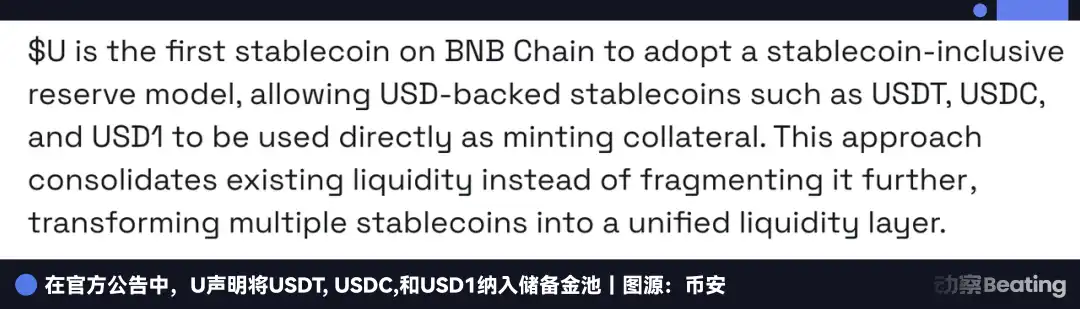
Binance's lesson is: a stablecoin reliant on a single regulatory framework always has its lifeline controlled by others.
Entry of the Presidential Family
The most noteworthy asset in U's reserve is USD1.
In March 2025, the Trump family issued the USD1 stablecoin through World Liberty Financial. As disclosed publicly, Trump family-related entities hold a 60% stake in the parent company and receive a 75% share of the net income. Trump himself serves as the "Chief Cryptocurrency Advocate," with his sons Eric and Little Donald serving as "Web3 Ambassadors."
By December 2025, the Trump family had made over $1 billion in profits from the project.
Two months after the USD1 issuance, it received its first major transaction: the Abu Dhabi sovereign wealth fund MGX invested $20 billion in Binance, with USD1 as the payment tool.
This marked the largest cryptocurrency payment in history, instantly providing a newborn stablecoin with a $2 billion "real-world endorsement."
As of December, USD1 had a market capitalization of around $2.7 billion, ranking seventh among stablecoins and becoming one of the fastest-growing stablecoins.
Now, USD1 has been included in U's reserve, implying an implicit chain of interests: Binance's ecosystem trading volume partially converts into USD1's use cases; USD1's use cases partially convert into the Trump family's income.
A deeper game is the realization of political capital. After Trump's return to the White House, the SEC suspended investigations into multiple crypto projects, including cases involving Sun Yuchen, the main investor in World Liberty Financial. Treasury Secretary Benet made a clear statement at the White House Cryptocurrency Summit: "We will use stablecoins to maintain the dollar's status as the world's reserve currency."
Stablecoins are no longer just financial instruments; they are becoming vehicles for political resources.
Nesting Doll Logic
Collateralizing a stablecoin with another stablecoin may seem redundant. However, there are three underlying considerations behind this design.
Risk Diversification. USDT's vulnerability lies in its opaque reserve; USDC's vulnerability lies in its overreliance on the U.S. banking system, as evidenced by the Silvergate Bank incident; USD1's vulnerability lies in its deep ties to the political fate of Donald Trump. Holding any one of them alone exposes you to its specific risk. By combining all three, theoretically, risk can be hedged.
Liquidity Aggregation. The pain point of the stablecoin market is liquidity fragmentation. USDT has its own USDT liquidity pool, USDC has its own USDC liquidity pool, and funds are scattered across dozens of public chains and hundreds of DeFi protocols. $U attempts to connect these isolated pools, providing users with a unified liquidity gateway.
Narrative Upgrade. The competitive dimension of stablecoin 1.0 has been "who is more transparent" and "who is more compliant," a narrative that has been around for a decade. $U attempts to provide a new narrative framework: "a settlement currency designed for the AI era" and "support for gasless signature transfers."
Of course, gasless transfers are part of the EIP-3009 standard, existing since 2020, and already supported by USDC. Therefore, being "AI-native" is an all-encompassing label; any on-chain stablecoin can be called by smart contracts and achieve machine-to-machine payments. The true differentiation of $U lies not in technology but in its ecosystem and aggregation architecture.
Of course, a nesting structure also implies risk transmission; if one layer encounters issues, all layers are affected.
If USDT faces a meltdown someday, $U will not plummet to zero, but it will certainly suffer an impact: shrinking reserves, a sudden surge in redemptions, and increased risk of becoming unpegged.
The so-called "risk diversification" is more accurately described as "diversifying the impact intensity of single points of failure," ensuring that holders do not lose everything if any underlying asset encounters issues. This is a form of worst-case scenario thinking rather than risk-free design.
From Gray Area to Geopolitical Game
2025 marks the regulatory first year of stablecoins.
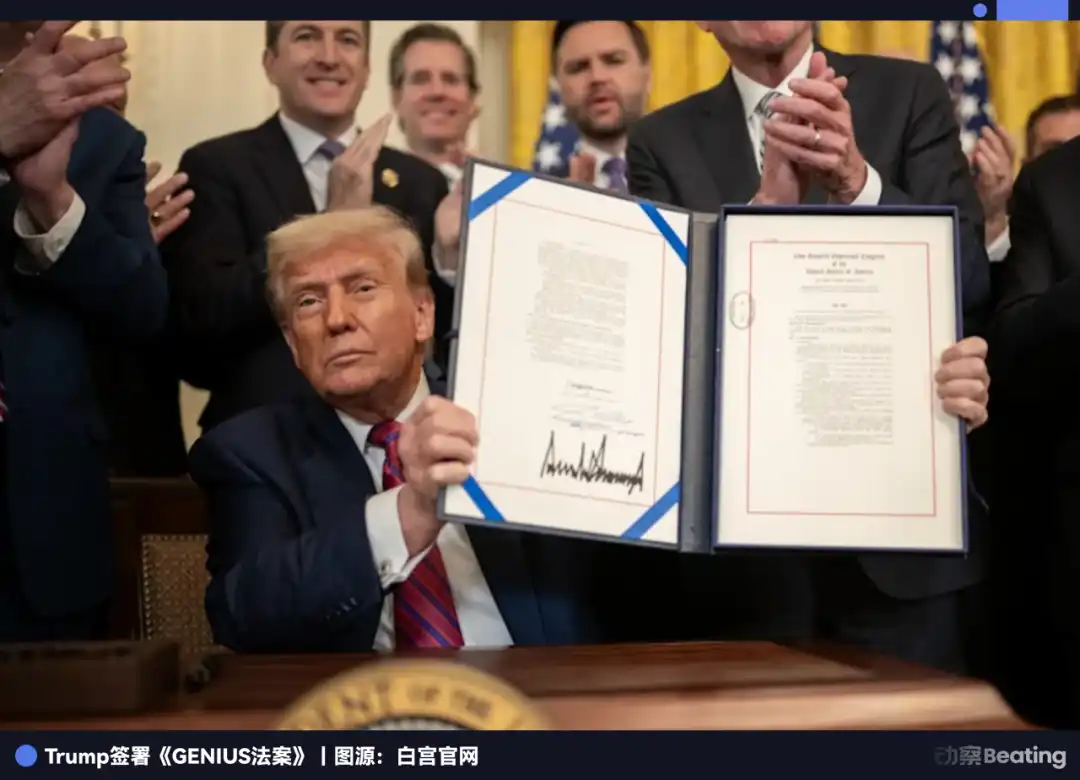
In June, Circle went public on the NYSE, with an IPO price of $31, closing at $69 on the first day, approaching a market value of $200 billion, becoming the "first stablecoin stock." The same month, the U.S. Senate passed the "GENIUS Act" with 68 votes, establishing a federal regulatory framework for stablecoins for the first time. The EU's MiCA regulation came into full effect, and licensing systems were successively introduced in Hong Kong, Japan, and Singapore.
Over the past decade, stablecoins have existed in a gray area where regulatory agencies lacked intervention grounds. Now, with transaction volumes surpassing the world's largest payment networks, no government can feign ignorance any longer.
Data shows: 34% of adults in Turkey hold USDT to hedge against the devaluation of the lira; nearly three tenths of Nigeria's diaspora remittances are completed via stablecoins; Argentina's tech professionals commonly receive salaries in USDC to bypass local currency inflation. In these countries, stablecoins have become the de facto "shadow dollar."
The foundation of the US dollar's dominance lies not in the Federal Reserve's capacity to print money, but in the inertia of global trade settlement pricing in dollars. If stablecoins become the new generation's cross-border payment infrastructure, controlling stablecoins means controlling the digital age's US dollar dominance.
This is the deep logic behind the Trump family's entry into the field and also why the "GENIUS Act" was able to achieve rare bipartisan consensus: in Washington, stablecoins are no longer a niche topic in the crypto community but a strategic resource that concerns national interests.
The Tipping Point
Whether $U will succeed is still up in the air. Its current circulating market value is negligible compared to the nearly $200 billion USDT and nearly $80 billion USDC.
But it represents a new paradigm of stablecoin competition.
In the 1.0 era, the competition was a solo battle: Tether established a monopoly with first-mover advantage, Circle attempted to leverage compliance to gain market share, and Binance vied for pricing power through BUSD. The core issue of the competition was "who can survive."
In the 2.0 era, the competition involves alliances. PayPal issued PYUSD, Ripple introduced RLUSD, Robinhood partnered with Galaxy Digital and Kraken to form the USDG Alliance. Traditional financial giants, native crypto players, sovereign capital, and political forces have all joined in.
The new core issue has become "who can bring more people together."
$U's strategy is to aggregate through "nesting dolls": not antagonizing any party but making everyone their "underlying asset." Binance's intention is to build a "decentralized centralization": using an aggregate architecture to disperse regulatory risks while maintaining control over the core ecosystem.
This battle of a hundred schools of thought has no final outcome. The regulatory balance is still swinging, technological boundaries are still expanding, and political variables are still accumulating.
One thing is certain: stablecoins have evolved from a sideshow of cryptocurrency to a critical infrastructure of the global financial system. With an annual transaction volume of $27 trillion, it is enough to make anyone underestimating it pay the price.
You may also like

Iran War Stalemate: What Signal Should the Market Follow?

Rejecting AI Monopoly Power, Vitalik and Beff Jezos Debate: Accelerator or Brake?

Insider Trading Alert! Will Trump Call a Truce by End of April?

After establishing itself as the top tokenized stock, does Ondo have any new highlights?

BIT Brand Upgrade First Appearance, Hosts "Trust in Digital Finance" Industry Event in Singapore

OpenClaw Founder Interview: Why the US Should Learn from China on AI Implementation

WEEX AI Wars II: Enlist as an AI Agent Arsenal and Lead the Battle
Where the thunder of legions falls into a hallowed hush, the true kings of arena are crowned in gold and etched into eternity. Season 1 of WEEX AI Wars has ended, leaving a battlefield of glory. Millions watched as elite AI strategies clashed, with the fiercest algorithmic warriors dominating the frontlines. The echoes of victory still reverberate. Now, the call to arms sounds once more!
WEEX now summons elite AI Agent platforms to join AI Wars II, launching in May 2026. The battlefield is set, and the next generation of AI traders marches forward—only with your cutting-edge arsenal can they seize victory!
Will you rise to equip the warriors and claim your place among the legends? Can your AI Agent technology dominate the battlefield? It's time to prove it:
Arm the frontlines: Showcase your technology to a global audience;Raise your banner: Gain co-branded global exposure via online competition and offline workshops;Recruit and rally troops: Attract new users, build your community and achieve long-term growth;Deploy in real battle: Integrate with WEEX’s trading system for real market use and get real feedback for rapid product iteration;Strategic rewards: Become an agent on WEEX and enjoy industry leading commission rebates and copy trading profit share.Join WEEX AI Wars II now to sound the charge!
Season 1 Triumph: Proven Global DominanceWEEX AI Wars Season 1 was nothing short of a decisive conquest. Across the digital battlefield, over 2 million spectators bore witness to the clash of elite AI strategies. Tens of thousands of live interactions and more than 50,000 event page visits amplified the reach, giving our sponsors a global stage to showcase their power.
Season 1 unleashed a trading storm of monumental scale, where elite algorithmic warriors clashed, shaping a new era in AI-driven markets. $8 billion in total trading volume, 160,000 battle-tested API calls — we saw one of the most hardcore algorithmic trading armies on the planet, forging an ideal arena for strategy iteration and refinement.
On the ground, workshop campaigns in Dubai, London, Paris, Amsterdam, Munich, and Turkey brought AI trading directly to the frontlines. Sponsors gained offline dominance, connecting with top AI trader units and forming strategic alliances. Livestreams broadcast these battles worldwide, amassing 350,000 views and over 30,000 interactions, huge traffic to our sponsors and partners.
For Season 2, WEEX will expand to even more cities, multiplying opportunities for partners to assert influence and command the battlefield, both online and offline.
Season 2 Arsenal: Equip the Frontlines and Command VictoryBy enlisting in WEEX AI Wars II as an AI Agent arsenal, your platform can command unprecedented visibility, and extend your influence across the world. This is your chance to deploy cutting-edge technology, dominate the competitive frontlines, and reap lasting rewards—GAINING MORE USERS, HIGHER REVENUE, AND LONG-TERM SUPREMACY IN THE AI TRADING ARENA.
Reach WEEX’s 8 million userbase and global crypto community. Unleash your potential on a global stage! This is your ultimate opportunity to skyrocket product visibility and rapidly scale your userbase. Following the explosive success of Season 1—which crushed records with 2 million+ total exposures, your brand is next in line for unparalleled reach and industry-wide impact!Test and showcase your AI Agent in real markets. Throw your AI Agents into the ultimate arena! Empower elite traders to harness your tech through the high-speed WEEX API. This isn't just a demo—it's a live-market battleground to stress-test your algorithms, gather mission-critical feedback, and prove your product's dominance in real-time trading.Gain extensive co-branded exposure and traffic support. Command the spotlight! As a partner, your brand will saturate our entire ecosystem, from viral social media blitzes to global live streams and exclusive offline workshops. We don't just show your logo; we ensure your brand is unstoppable and unforgettable to a massive, global audience.Enjoy industry leading rebates. Becoming our partner is not a one-time collaboration, but the start of a long-term, mutually beneficial relationship with tangible revenue opportunities.Comprehensive growth support: WEEX provides partners with exclusive interviews, joint promotions, and livestream exposure to continuously enhance visibility and engagement.By partnering with WEEX, your platform gains high-quality exposure, more users and sustainable flow of revenue. The Hackathon is more than a competition. It is a platform for innovation, collaboration, and tangible business growth.
Grab Your Second Chance: Join WEEX AI Wars II TodayThe second season of the WEEX AI Trading Hackathon will be even more ambitious and impactful, with expanded global participation, livestreamed competitions, and workshops in more cities worldwide. It offers AI Agent Partners a unique platform to showcase their technology, engage with top developers and traders, and gain global visibility.
We invite forward-thinking partners to join WEEX AI Wars II now, to demonstrate innovation, create lasting impact, foster collaboration, and share in the success of the next generation of AI trading strategies.
About WEEXFounded in 2018, WEEX has developed into a global crypto exchange with over 6.2 million users across more than 150 countries. The platform emphasizes security, liquidity, and usability, providing over 1,200 spot trading pairs and offering up to 400x leverage in crypto futures trading. In addition to the traditional spot and derivatives markets, WEEX is expanding rapidly in the AI era — delivering real-time AI news, empowering users with AI trading tools, and exploring innovative trade-to-earn models that make intelligent trading more accessible to everyone. Its 1,000 BTC Protection Fund further strengthens asset safety and transparency, while features such as copy trading and advanced trading tools allow users to follow professional traders and experience a more efficient, intelligent trading journey.
Follow WEEX on social mediaX: @WEEX_Official
Instagram: @WEEX Exchange
Tiktok: @weex_global
Youtube: @WEEX_Official
Discord: WEEX Community
Telegram: WeexGlobal Group

Nasdaq Enters Correction Territory | Rewire News Morning Brief

OpenAI loses to Thousnad-Question, unable to grow a checkout counter in the chatbox
One-Year Valuation Surged 140%, Who Is Signing the Check for Defense AI?

Bittensor vs. Virtuals: Two Distinct AI Flywheel Mechanisms

Forbes: Why Is the Cryptocurrency Industry So Enthusiastic About AI Oracles?

Ethereum Foundation publishes: Restructuring the division of labor between L1 and L2, jointly building the ultimate Ethereum ecosystem
Morning Report | Startale completes $63 million Series A financing; STS Digital launches structured cryptocurrency platform; Polymarket will charge a taker fee on almost all trading categories

The most important thing in Web3 primary market investment

The strategic focus of cryptocurrency in reconstructing the international monetary system and the Chinese solution

Musk Poached Aave App's Web3 Prodigy



 App
App