
 Buy Crypto
- Markets
 Futures
- Spot
- Copy Trade
- Earn
- More
Trend Research: The "Blockchain Revolution" in Progress, Ethereum Continues to Surge

Original Title: "The Ongoing 'Blockchain Revolution,' Ethereum Continues to Rise"
Original Source: Trend Research
Since the market crash of 1011, the entire crypto market has been lackluster, with market makers and investors suffering heavy losses. Recovery of funds and sentiment will take time. However, what the crypto market lacks the least is new volatility and opportunities. We remain optimistic about the future because the trend of mainstream crypto assets merging with traditional finance into new formats has not changed. Instead, it has rapidly built a moat during the market downturn.
1. Strengthening Wall Street Consensus
On December 3, U.S. SEC Chair Paul Atkins stated in an interview with FOX at the NYSE: "In the next few years, the entire U.S. financial market may migrate to the blockchain."
Atkins stated:
(1) The core advantage of tokenization is that if assets exist on the blockchain, ownership structure and asset attributes will be highly transparent. Currently, listed companies often do not know who their shareholders are specifically, where they are located, or where their shares are.
(2) Tokenization also aims to achieve "T+0" settlement, replacing the current "T+1" transaction settlement cycle. In principle, the on-chain delivery versus payment (DVP) / receipt versus payment (RVP) mechanism can reduce market risk, enhance transparency, and the time difference between current clearing, settlement, and fund delivery is one of the sources of systemic risk.
(3) Tokenization is seen as an inevitable trend in financial services, with major banks and brokerages already moving towards tokenization. It may only take the world less than 10 years... perhaps a few years later it will become a reality. We are actively embracing new technologies to ensure that the United States maintains its leading position in cryptocurrency and other areas.
In fact, Wall Street and Washington have already built a deep capital network deeply integrating into crypto, forming a new narrative chain: U.S. political and economic elites → U.S. Treasury Bonds → Stablecoins / Crypto Custody Companies → Ethereum + RWA + L2
From this chart, you can see the Trump family, traditional bond market makers, the Treasury Department, tech companies, and crypto companies intricately linked together, with the green oval line becoming the backbone:
(1) Stablecoin (USD-backed assets behind USDT, USDC, WLD, etc.)
The majority of reserve assets consist of Short-Term US Treasuries and bank deposits held through brokerages like Cantor.
(2) US Treasuries
Issued and managed by Treasury/Bessent, used by Palantir, Druckenmiller, Tiger Cubs, among others, as a low-risk rate base asset, also sought after by stablecoins/treasury companies for yield.
(3) RWA
From US Treasuries, mortgages, accounts receivable to housing finance, all tokenized through Ethereum L1/L2 protocols.
(4) ETH & ETH L2 Equity
Ethereum serves as the main chain for RWA, stablecoins, DeFi, AI-DeFi, while L2 equity/token represents a claim on future transaction volume and fee cash flow.
This chain expresses:
USD Credit → US Treasuries → Stablecoin Reserves → Various Crypto Treasuries/RWA Protocols → Ultimately settling on ETH/L2.
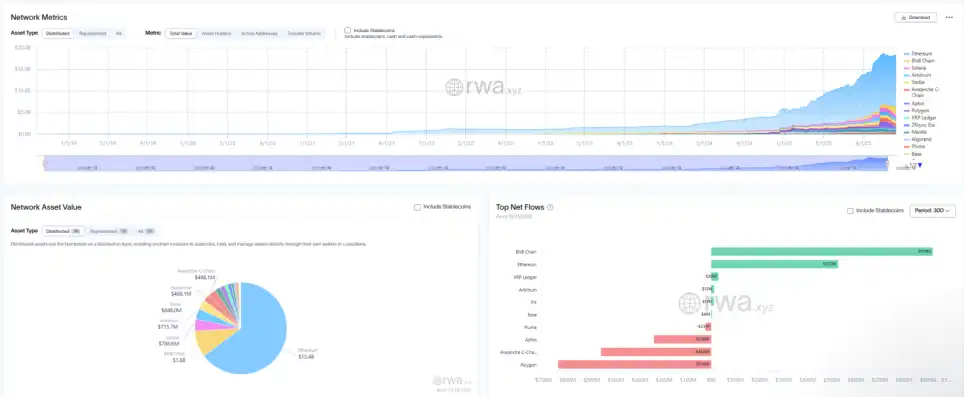
Looking at RWA's TVL: Compared to other public chains in a downtrend in 1011, ETH is the only one that quickly recovered from the drop and rose, currently at 124 billion in TVL, accounting for 64.5% of the total crypto market cap.
II. Ethereum Value Capture Exploration
The recent Ethereum Fusaka upgrade did not cause much of a market stir, but from the perspective of network structure and economic model evolution, it was a "milestone event." Fusaka not only expanded through EIPs like PeerDAS but also attempted to address the issue of insufficient L1 mainnet value capture since L2 development.
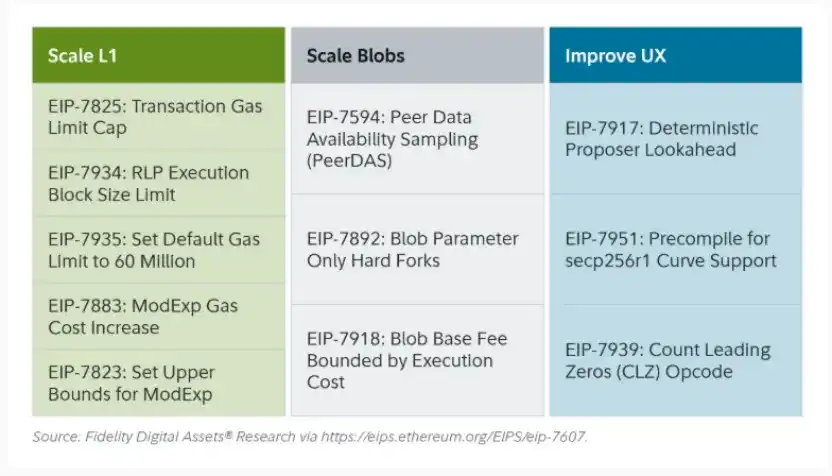
Through EIP-7918, ETH introduced a blob base fee to establish a "dynamic base rate," tying its floor to the L1 execution layer base fee, requiring that blobs pay a DA fee at a unit price of about 1/16 of the L1 base fee; this means Rollups can no longer occupy blob bandwidth almost cost-free in the long term, with corresponding fees flowing back to ETH holders in a burn mechanism.
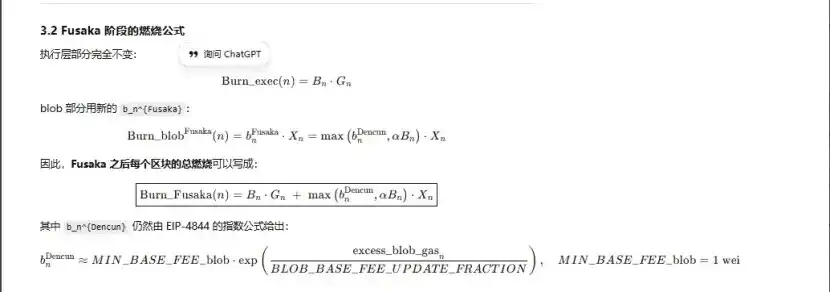
The Ethereum full upgrade is related to "burning" three times:
(1) London (single-tier): Only burns the execution layer, ETH began experiencing structural burning due to L1 usage.
(2) Dencun (dual-tier + independent blob market): Burns the execution layer + blob, L2 data written to blob also burns ETH, but the blob portion is almost 0 in times of low demand.
(3) Fusaka (dual-tier + blob linked to L1): To use L2 (blob), one must pay a fee of at least a fixed ratio of the L1 base fee and it will be burned, mapping L2 activity to ETH burning more stably.
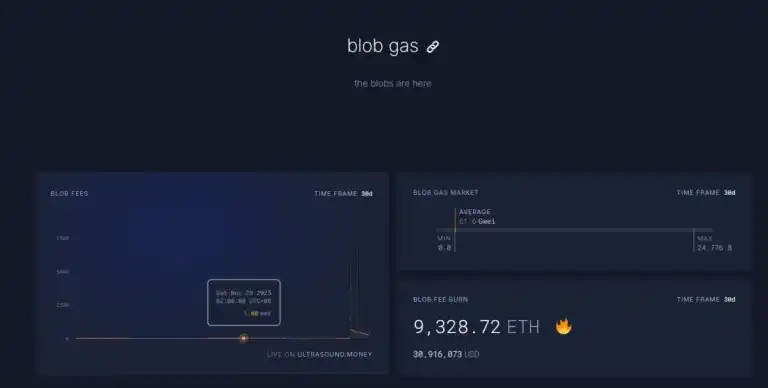
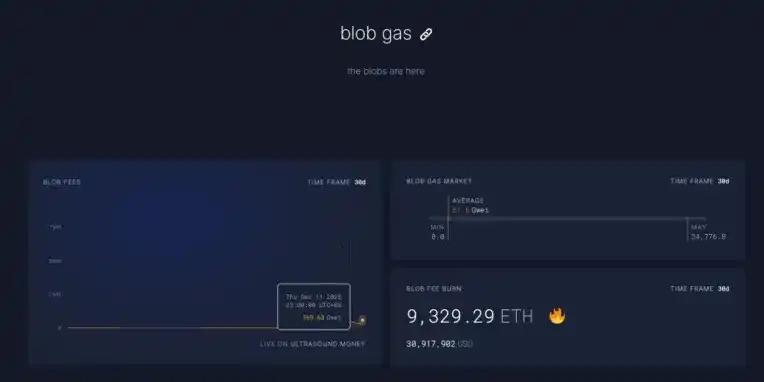
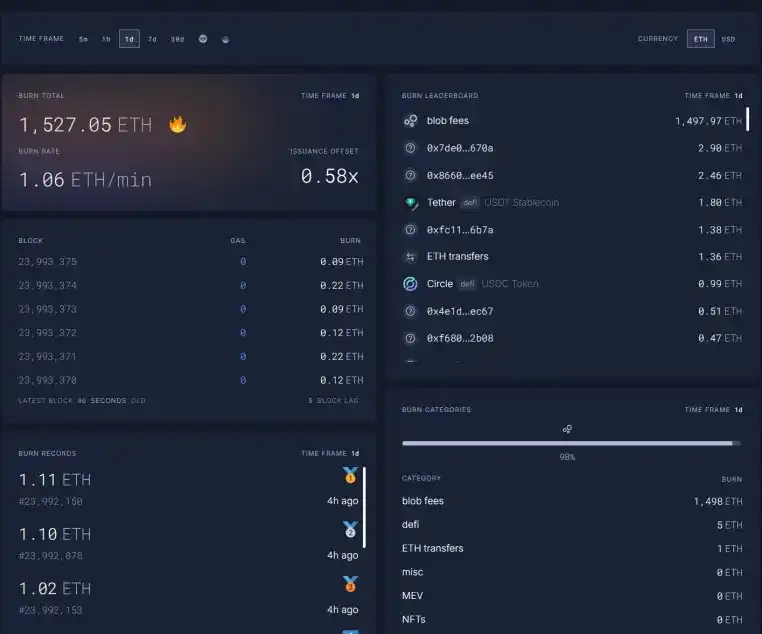
Currently, the blob fees at 23:00 on 12.11 for 1 hour have reached 569.63 billion times the fees before the Fusaka upgrade, burning 1527 ETH in a day. Blob fees have become the highest contributing part to the burning, up to 98%. As ETH L2 becomes more active, this upgrade is expected to bring ETH back to deflation.
III. Ethereum Technical Strength
During the 1011 drop, ETH's futures leverage positions were thoroughly cleared, ultimately reaching spot leverage positions. Meanwhile, many lacked faith in ETH, causing many ancient OGs to reduce positions and flee. According to Coinbase data, speculative leverage in the crypto sphere has dropped to a historic low of 4%.
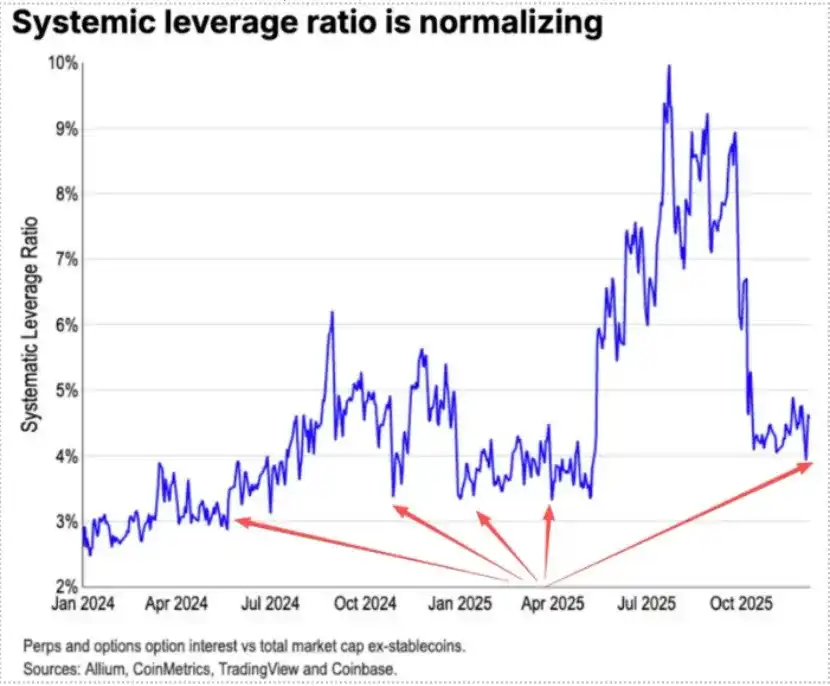
In previous ETH short positions, an important part came from traditional Long BTC/Short ETH pair trades, especially when this pair usually performs well in past bear markets. However, an unexpected event occurred this time. The ETH/BTC ratio has maintained a sideways resistance trend since November.
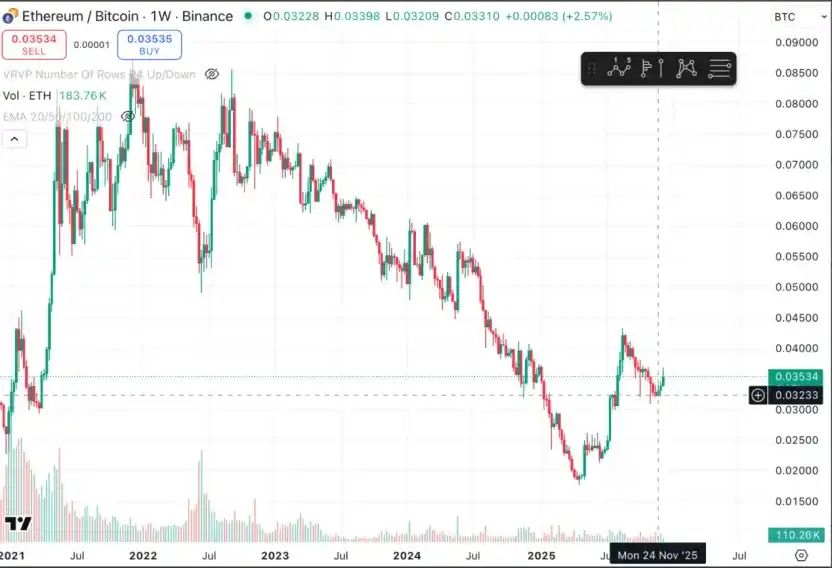
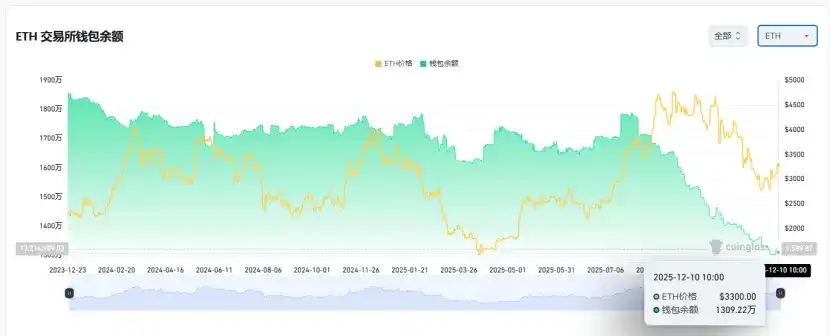
ETH currently has a trading platform stock of 13 million coins, approximately 10% of the total supply, at a historic low. With the Long BTC/Short ETH pair becoming ineffective since November and extreme market panic, there may gradually be "short squeeze" opportunities.
As the 2025–2026 interaction approaches, both the US and China have already sent friendly signals regarding future monetary and fiscal policies:
The US will be proactive in the future, with tax cuts, interest rate reductions, relaxed crypto regulations, while China will appropriately loosen, focusing on financial stability (suppressing volatility).
In the scenario of relatively loose expectations in both the US and China, suppressing asset downside volatility, and with ETH still in a good buying "dip zone" during extreme panic when funds and emotions have not fully recovered, ETH remains in a favorable position.
This article is contributed content and does not represent the views of BlockBeats.
You may also like

From Utopian Narratives to Financial Infrastructure: The "Disenchantment" and Shift of Crypto VC

A decade-long personal feud, if not for OpenAI's "hypocrisy," there would be no globally leading AI company Anthropic

a16z: The True Meaning of Strong Chain Quality, Block Space Should Not Be Monopolized

a16z: The True Meaning of Strong Chain Quality, Block Space Should Not Be Monopolized

2% user contribution, 90% trading volume: The real picture of Polymarket

Trump Can't Take It Anymore, 5 Signals of the US-Iran Ceasefire

Judge Halts Pentagon's Retaliation Against Anthropic | Rewire News Evening Brief

Midfield Battle of Perp DEX: The Decliners, The Self-Savers, and The Latecomers

Iran War Stalemate: What Signal Should the Market Follow?
Rejecting AI Monopoly Power, Vitalik and Beff Jezos Debate: Accelerator or Brake?

Insider Trading Alert! Will Trump Call a Truce by End of April?

After establishing itself as the top tokenized stock, does Ondo have any new highlights?

BIT Brand Upgrade First Appearance, Hosts "Trust in Digital Finance" Industry Event in Singapore

OpenClaw Founder Interview: Why the US Should Learn from China on AI Implementation
WEEX AI Wars II: Enlist as an AI Agent Arsenal and Lead the Battle
Where the thunder of legions falls into a hallowed hush, the true kings of arena are crowned in gold and etched into eternity. Season 1 of WEEX AI Wars has ended, leaving a battlefield of glory. Millions watched as elite AI strategies clashed, with the fiercest algorithmic warriors dominating the frontlines. The echoes of victory still reverberate. Now, the call to arms sounds once more!
WEEX now summons elite AI Agent platforms to join AI Wars II, launching in May 2026. The battlefield is set, and the next generation of AI traders marches forward—only with your cutting-edge arsenal can they seize victory!
Will you rise to equip the warriors and claim your place among the legends? Can your AI Agent technology dominate the battlefield? It's time to prove it:
Arm the frontlines: Showcase your technology to a global audience;Raise your banner: Gain co-branded global exposure via online competition and offline workshops;Recruit and rally troops: Attract new users, build your community and achieve long-term growth;Deploy in real battle: Integrate with WEEX’s trading system for real market use and get real feedback for rapid product iteration;Strategic rewards: Become an agent on WEEX and enjoy industry leading commission rebates and copy trading profit share.Join WEEX AI Wars II now to sound the charge!
Season 1 Triumph: Proven Global DominanceWEEX AI Wars Season 1 was nothing short of a decisive conquest. Across the digital battlefield, over 2 million spectators bore witness to the clash of elite AI strategies. Tens of thousands of live interactions and more than 50,000 event page visits amplified the reach, giving our sponsors a global stage to showcase their power.
Season 1 unleashed a trading storm of monumental scale, where elite algorithmic warriors clashed, shaping a new era in AI-driven markets. $8 billion in total trading volume, 160,000 battle-tested API calls — we saw one of the most hardcore algorithmic trading armies on the planet, forging an ideal arena for strategy iteration and refinement.
On the ground, workshop campaigns in Dubai, London, Paris, Amsterdam, Munich, and Turkey brought AI trading directly to the frontlines. Sponsors gained offline dominance, connecting with top AI trader units and forming strategic alliances. Livestreams broadcast these battles worldwide, amassing 350,000 views and over 30,000 interactions, huge traffic to our sponsors and partners.
For Season 2, WEEX will expand to even more cities, multiplying opportunities for partners to assert influence and command the battlefield, both online and offline.
Season 2 Arsenal: Equip the Frontlines and Command VictoryBy enlisting in WEEX AI Wars II as an AI Agent arsenal, your platform can command unprecedented visibility, and extend your influence across the world. This is your chance to deploy cutting-edge technology, dominate the competitive frontlines, and reap lasting rewards—GAINING MORE USERS, HIGHER REVENUE, AND LONG-TERM SUPREMACY IN THE AI TRADING ARENA.
Reach WEEX’s 8 million userbase and global crypto community. Unleash your potential on a global stage! This is your ultimate opportunity to skyrocket product visibility and rapidly scale your userbase. Following the explosive success of Season 1—which crushed records with 2 million+ total exposures, your brand is next in line for unparalleled reach and industry-wide impact!Test and showcase your AI Agent in real markets. Throw your AI Agents into the ultimate arena! Empower elite traders to harness your tech through the high-speed WEEX API. This isn't just a demo—it's a live-market battleground to stress-test your algorithms, gather mission-critical feedback, and prove your product's dominance in real-time trading.Gain extensive co-branded exposure and traffic support. Command the spotlight! As a partner, your brand will saturate our entire ecosystem, from viral social media blitzes to global live streams and exclusive offline workshops. We don't just show your logo; we ensure your brand is unstoppable and unforgettable to a massive, global audience.Enjoy industry leading rebates. Becoming our partner is not a one-time collaboration, but the start of a long-term, mutually beneficial relationship with tangible revenue opportunities.Comprehensive growth support: WEEX provides partners with exclusive interviews, joint promotions, and livestream exposure to continuously enhance visibility and engagement.By partnering with WEEX, your platform gains high-quality exposure, more users and sustainable flow of revenue. The Hackathon is more than a competition. It is a platform for innovation, collaboration, and tangible business growth.
Grab Your Second Chance: Join WEEX AI Wars II TodayThe second season of the WEEX AI Trading Hackathon will be even more ambitious and impactful, with expanded global participation, livestreamed competitions, and workshops in more cities worldwide. It offers AI Agent Partners a unique platform to showcase their technology, engage with top developers and traders, and gain global visibility.
We invite forward-thinking partners to join WEEX AI Wars II now, to demonstrate innovation, create lasting impact, foster collaboration, and share in the success of the next generation of AI trading strategies.
About WEEXFounded in 2018, WEEX has developed into a global crypto exchange with over 6.2 million users across more than 150 countries. The platform emphasizes security, liquidity, and usability, providing over 1,200 spot trading pairs and offering up to 400x leverage in crypto futures trading. In addition to the traditional spot and derivatives markets, WEEX is expanding rapidly in the AI era — delivering real-time AI news, empowering users with AI trading tools, and exploring innovative trade-to-earn models that make intelligent trading more accessible to everyone. Its 1,000 BTC Protection Fund further strengthens asset safety and transparency, while features such as copy trading and advanced trading tools allow users to follow professional traders and experience a more efficient, intelligent trading journey.
Follow WEEX on social mediaX: @WEEX_Official
Instagram: @WEEX Exchange
Tiktok: @weex_global
Youtube: @WEEX_Official
Discord: WEEX Community
Telegram: WeexGlobal Group

Nasdaq Enters Correction Territory | Rewire News Morning Brief

OpenAI loses to Thousnad-Question, unable to grow a checkout counter in the chatbox


 App
App