
 Buy Crypto
- Markets
 Futures
- Spot
- Copy Trade
- Earn
- More
Wall Street's Abacus: $500 Million to Buy Ripple, What Gives?

Original Article Title: "Wall Street's Abacus: $5 Billion to Buy Ripple What?"
Original Article Author: Seed.eth, BitpushNews
In November 2025, Ripple Labs announced a $5 billion new round of strategic financing, raising the company's valuation to $400 billion. This is the first public fundraising for this cryptocurrency financial company in six years and the largest capital injection since the Series C funding in 2019.
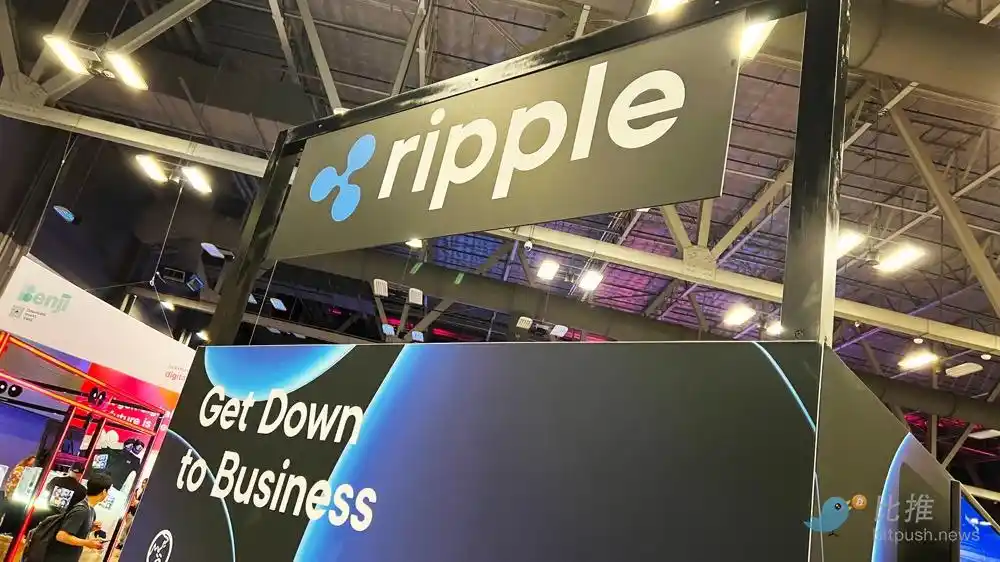
More importantly, the capital faction behind this round of financing is extraordinary: Wall Street's two giants, Fortress Investment Group and Citadel Securities, led the investment, joined by renowned institutions such as Pantera Capital, Galaxy Digital, Brevan Howard, Marshall Wace, and others.
For those familiar with Ripple, this can be considered a "comeback"—is this still the Ripple that was once deeply mired in the mud due to an SEC lawsuit, and even at one point considered a "zombie company"?
From "Master Storyteller" to "Compliance Heavyweight"
Ripple was founded in 2012 and is one of the oldest projects in the crypto community. Its core technology is the XRP Ledger, a decentralized ledger designed for cross-border payments. Ripple Labs has developed payment and settlement systems based on this ledger, and the XRP token was once popular globally from 2017 to 2018, ranking in the top three by market cap, following only Bitcoin and Ethereum.
However, as the token price plummeted and the truth about "pumped" partnerships emerged, Ripple's narrative of "bank-grade partnerships" began to crumble.
During this period, Forbes published an article directly pointing out that Ripple's core business model might be a "pump-and-dump" scheme: Ripple used its massive XRP holdings to spend money on partnerships, creating a false prosperity, and used vague language to evade regulation. Its ultimate goal was not to truly promote the technology but to inflate the value of its freely obtained tokens through marketing and hype, so that insiders could eventually cash out and profit.
In December 2020, the regulatory hammer came down.
The U.S. Securities and Exchange Commission (SEC) sued Ripple for "unregistered securities offering," alleging that it illegally raised over $1.3 billion through XRP.
This marked one of the most significant regulatory battles in the crypto industry.
The ripple effects of the lawsuit were devastating: Mainstream exchanges like Coinbase and Kraken swiftly delisted XRP; longtime partner MoneyGram terminated its relationship; XRP's price plummeted over 60% in the following month. Ripple not only suffered business-wise but was also completely blacklisted from compliance.
Strategic Transformation
While this years-long legal battle cost Ripple nearly $200 million in legal fees, it also granted the company crucial breathing room and some favorable court rulings, buying them valuable time for a strategic transformation.
In 2024, Ripple officially launched RLUSD, a USD-pegged stablecoin, focusing on compliance and targeting financial institution payments and settlements. Unlike USDT and USDC, RLUSD is not meant for inter-exchange "stablecoin" trading but aims to enter traditional credit card and cross-border settlement systems.
In 2025, Ripple announced partnerships with Mastercard, WebBank, Gemini, among others, to use RLUSD for real-time credit card settlements, becoming the world's first blockchain-based stablecoin to enter card networks.
This not only opened up the B2B channel for stablecoin applications but also paved the way for Ripple's integration with the real-world financial system.
To build a comprehensive on-chain financial capability, Ripple carried out a series of targeted acquisitions between 2023-2025:
· Acquired Metaco: Gained institutional-grade digital asset custody technology, laying the foundation to serve large financial institutions.
· Acquired Rail: Obtained stablecoin issuance and management systems, accelerating the launch of RLUSD.
· Secured Hidden Road: Completed the puzzle of institutional credit networks and cross-border settlement capabilities.
Through these acquisitions, Ripple's system capabilities have evolved from a single cross-border payment system to a full-stack financial infrastructure encompassing "stablecoin issuance + institutional custody + cross-chain settlement."
The Truth Behind the $40 Billion Valuation
On the surface, Ripple's transformation path seems to be getting wider.
However, the old players in the capital market see a different picture.
To understand the true logic behind this funding, one must see Ripple's essence: a massive "digital asset treasury."
At XRP's inception, 80% of the 100 billion tokens were placed under Ripple's custody. As of now, the company still holds 34.76 billion tokens, with a nominal value of over $80 billion based on market price—twice its funding valuation.
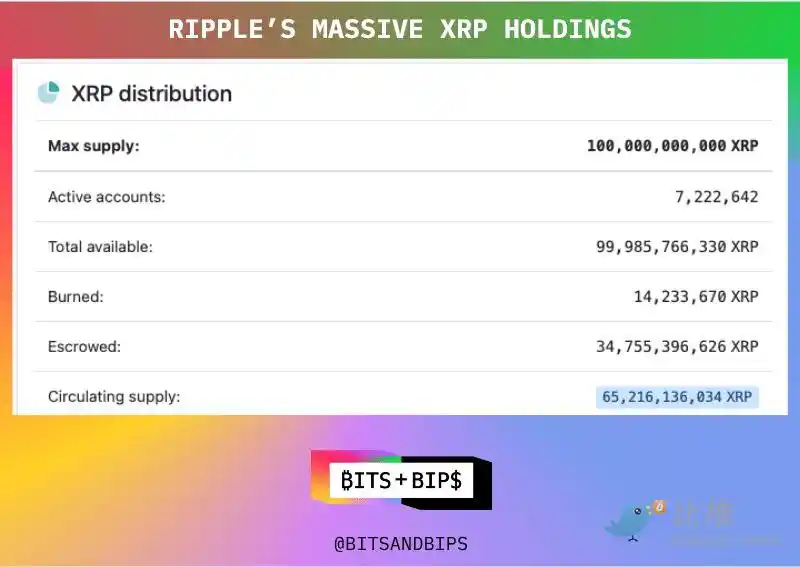
According to multiple venture capitalists, the $500 million transaction is closely tied to purchasing Ripple's XRP holdings and likely at a price far below the spot price.
From an investment perspective, investors effectively acquired an asset at 0.5x mNAV (Market Value to Net Asset Value ratio). Even with a 50% liquidity discount on XRP holdings, the value of these assets still matches the company's valuation.
An insider familiar with the situation told Unchained, "Even if they can't successfully build their own business, they can just buy another company outright."
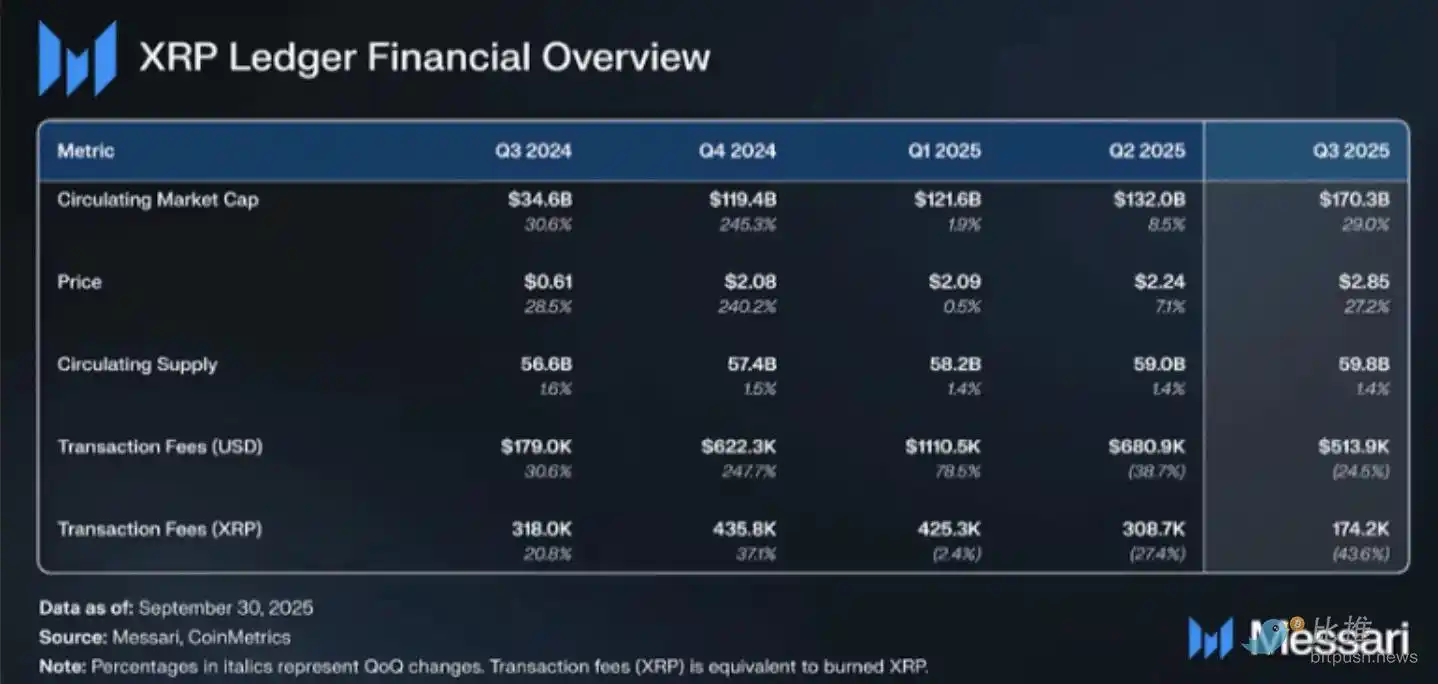
A venture capitalist stated, "This company has no value other than holding XRP. No one is using their tech, and there is no interest in their network/blockchain."
Another community member stated, "Ripple's equity itself may not be worth much, certainly not $40 billion."
A participant revealed the true logic, "The payments track is too hot right now, and investors need to bet on multiple horses on the track."
Ripple is just one horse—a horse that may have average technology but an extremely well-fed (XRP reserve) horse.
And for Ripple, this is a win-win situation:
· Solidify Valuation: Officializing the $40 billion valuation from the private market to provide a pricing benchmark for early investors to exit.
· Avoiding Dumping: Using funding cash for acquisitions to avoid selling XRP and causing market impact.
Ripple co-founder Chris Larsen's personal wealth has also surged to around $15 billion.
From this perspective, Ripple's story has turned into one of the most classical financial tales: about assets, about valuation, about liquidity management.
From the defendant's seat of the SEC to Wall Street's boardrooms, Ripple's journey is a microcosm of the entire crypto industry's transition from idealism to realism. If the past Ripple was the pinnacle of "narrative economics," today's Ripple demonstrates how, as the tide recedes, project teams rely on the most primitive capital strength to achieve a "soft landing."
You may also like

The New Yorker in-depth investigation interpretation: Why do OpenAI insiders consider Altman untrustworthy?
Two Divided Worlds: Insights from the New York Digital Asset Summit, the Most Institutionalized Blockchain Conference

Top Ten Reveals of CZ's New Book: Advance Knowledge of "94", the Inside Story of Huobi's Change of Ownership Made Public for the First Time

Ceasefire Overnight Erases War Premium, Three Fault Lines Only One Sealed | Rewire News Morning Brief

Robinhood Secures 'Trump Account': Enabling Millions of Newborns to Access the Stock Market

Afraid to Open the Pandora's Box? Anthropic's Most Powerful Model Ever Dares Not Be Disclosed

US-Iran Ceasefire: A Temporary Pause or Prelude to Renewed Conflict? Market Outlook for Oil, Gold, and Bitcoin
April 8, 2026 – A temporary ceasefire between the U.S. and Iran has provided some immediate relief to the global markets, but the fundamental question remains: Will the cessation of hostilities hold, or is this merely a brief reprieve before a resumption of conflict? As the situation unfolds, market observers are closely monitoring how key assets like oil, gold, and Bitcoin will react in the coming weeks. This article explores whether the ceasefire is a sign of lasting peace, assesses the short-term market implications, and delves into the evolving role of Bitcoin in the global financial landscape.

WEEX Market Update: U.S.-Iran Ceasefire Sparks Bitcoin Price Surge
April 8, 2026 – In a significant shift in global geopolitics, U.S. President Donald Trump has announced a temporary two-week ceasefire with Iran, resulting in a notable market reaction across various asset classes. This development comes after discussions between Trump, Pakistani Prime Minister Shahbaz Sharif, and Army Chief General Asim Munir. The announcement is already reverberating through markets, particularly in oil, gold, and cryptocurrencies.
Morning Report | South Korean financial institutions pilot stablecoin payments for foreign users; Morgan Stanley Bitcoin ETF is about to be listed; CME plans to launch AVAX and SUI futures contracts

EigenCloud Founder: AI and Cryptocurrency are Creating the Next Trillion-Dollar Asset Class
From Panic to Pumps: How Bitcoin Traders Are Playing the 2-Week US-Iran Ceasefire
For most people, the two-week US-Iran ceasefire is about geopolitics, oil prices, and whether World War III gets postponed. But for crypto traders glued to their screens late Sunday night, it was something else entirely: the clearest risk-on signal in months.

US-Iran Ceasefire Triggers Oil Plunge, Bitcoin Surge, and Gold Rally
Despite the sharp rally, caution is warranted. The $70,000–$72,000 zone has historically been strong resistance. The ceasefire is only temporary (two weeks), and any breakdown in negotiations could trigger a sell-off toward the $62,000–$65,000 support zone. For now, Bitcoin needs to close decisively above $72,500 to confirm a true breakout; failure to do so within 48–72 hours could lead to a swift retracement.

OpenAI has no "New Deal," a blueprint for AI that refuses to pay.

Wall Street Flash Mob Run? Mega-Cap Stock Plunge, Goldman's Great Escape, Illustrated Guide to Private Credit Crisis

OpenAI Feud: Power, Trust, and the Uncontrollable Boundaries of AGI
「AI Doomsday Cult」 Sends Operatives into the Strait of Hormuz: What Did They Find?
Everyone is waiting for the war to end, but is the oil price signaling a prolonged conflict?


 App
App