
 Buy Crypto
- Markets
 Futures
- Spot
- Copy Trade
- Earn
- More
Whale Effect? Stablecoins are Not Really the Enemy of Bank Deposits

Original Title: How Banks Learned To Stop Worrying And Love Stablecoins
Original Author: Christian Catalini, Forbes
Translation: Peggy, BlockBeats
Editor's Note: Whether stablecoins will impact the banking system has been one of the core debates in recent years. However, as data, research, and regulatory frameworks have gradually become clearer, the answer is becoming more sober: stablecoins have not triggered large-scale deposit outflows. Instead, under the real-world constraints of "deposit stickiness," they have become a competitive force driving banks to improve interest rates and efficiency.
This article, from a banking perspective, reinterprets stablecoins. They may not necessarily be a threat but are more likely a catalyst forcing the financial system to self-renew.
The following is the original text:

In 1983, a dollar sign flashes on an IBM computer monitor.
Fast forward to 2019, when we announced the launch of Libra, the global financial system's reaction was, without exaggeration, quite intense. The near-existential fear was: once stablecoins can be instantly used by billions of people, will banks' control over the deposit and payment system be completely shattered? If you can hold a "digital dollar" in your phone that can be instantly transferred, why would you keep your money in a zero-interest, fee-laden, weekend-"shutdown" checking account?
At that time, this was a completely reasonable question. For years, the mainstream narrative has always believed that stablecoins were "stealing banks' lunch." People were worried about an imminent "deposit run."
Once consumers realize that they can directly hold a digital cash backed by assets at the level of government bonds, the foundation that provides low-cost funding to the U.S. banking system will quickly crumble.
But a recent rigorous research paper by Cornell University's Professor Will Cong suggests that the industry may have jumped the gun into panic. By examining real evidence rather than emotional judgment, Cong puts forward a counterintuitive conclusion: under appropriate regulation, stablecoins are not the destroyers of bank deposits but rather a complementary presence to the traditional banking system.
Theory of "Deposit Stickiness"
The traditional banking model is fundamentally a bet built on "friction."
Due to the fact that a checking account is the central hub where funds truly achieve interoperability, almost any value transfer action between external services must go through the bank. The design logic of the entire system is this: as long as you don't use a checking account, operations will become more cumbersome — the bank controls the only bridge that connects the "islands" of your fragmented financial life.
Consumers are willing to accept this "toll road" not because a checking account itself is superior, but because of the power of the "bundling effect." You put your money in a checking account not because it is the best place for your funds, but because it is a central node: mortgage payments, credit cards, direct deposits — all come together and operate cohesively here.
If the assertion that "banks are about to disappear" were true, we should have already seen a significant amount of bank deposits flow into stablecoins. However, reality shows otherwise. As Cong pointed out, despite the explosive growth of stablecoin market capitalization, "existing empirical research has found little explicit link between the emergence of stablecoins and a significant outflow of bank deposits." Friction mechanisms are still effective. So far, the mainstream adoption of stablecoins has not substantially drained traditional bank deposits.
In fact, warnings about "massive outflows of deposits" are mostly exaggerated by existing stakeholders in a panic about their own positions, overlooking the most basic economic "laws of physics" in the real world. The stickiness of deposits is an extremely powerful force. For most users, the convenience value of an all-in-one service is too high to justify moving their life savings to a digital wallet just for a few extra basis points of yield.
Competition is a Feature, Not a Systemic Flaw
But real change is indeed happening here. Stablecoins may not "kill banks," but it is almost certain that they will make banks uneasy and compel them to improve. This study from Cornell University points out that even the mere existence of stablecoins constitutes a form of discipline that forces banks to no longer rely solely on user inertia but to start offering higher deposit rates and a more efficient, more sophisticated operational system.
When banks truly face a credible alternative, the costs of inertia will quickly rise. They can no longer take for granted that your funds are "locked up" but are forced to attract deposits with more competitive pricing.
In this framework, stablecoins will not "eat the small cake" but instead will drive "more credit allocation and broader financial intermediary activities, ultimately enhancing consumer welfare." As Professor Cong puts it: "Stablecoins are not meant to replace traditional intermediaries but can serve as a complementary tool to expand the business boundaries that banks are already good at."
In fact, the "Exit Threat" itself is a powerful force that drives existing institutions to improve their services.
Regulatory "Unlock"
Of course, regulators have good reason to be concerned about the so-called "bank run risk" — that is, once market confidence wavers, the reserve assets behind a stablecoin may be forced into a fire sale, triggering a systemic crisis.
However, as the paper points out, this is not some unprecedented new risk but a standard risk form long present in financial intermediation, highly similar in nature to the risks other financial institutions face. We already have a mature set of responses for liquidity management and operational risks. The real challenge is not to "invent new physical laws" but to apply existing financial engineering correctly to a new technological form.
This is where the "GENIUS Act" plays a key role. By explicitly requiring stablecoins to be fully reserved by cash, short-term U.S. treasuries, or deposits held at a depository institution, this act provides a hard rule for safety at the institutional level. As the paper states, these regulatory guardrails "seem to cover the identified core vulnerabilities in academic research, including bank run risk and liquidity risk."
The legislation sets a minimum legal standard for the industry — full reserves and enforceable redemption rights, while the specific operational details will be implemented by banking regulatory agencies. Next, the Federal Reserve and the Office of the Comptroller of the Currency (OCC) will be responsible for translating these principles into actionable regulatory rules to ensure that stablecoin issuers fully account for operational risks, the possibility of custodial failure, and the unique complexities of large-scale reserve management and integration with blockchain systems.
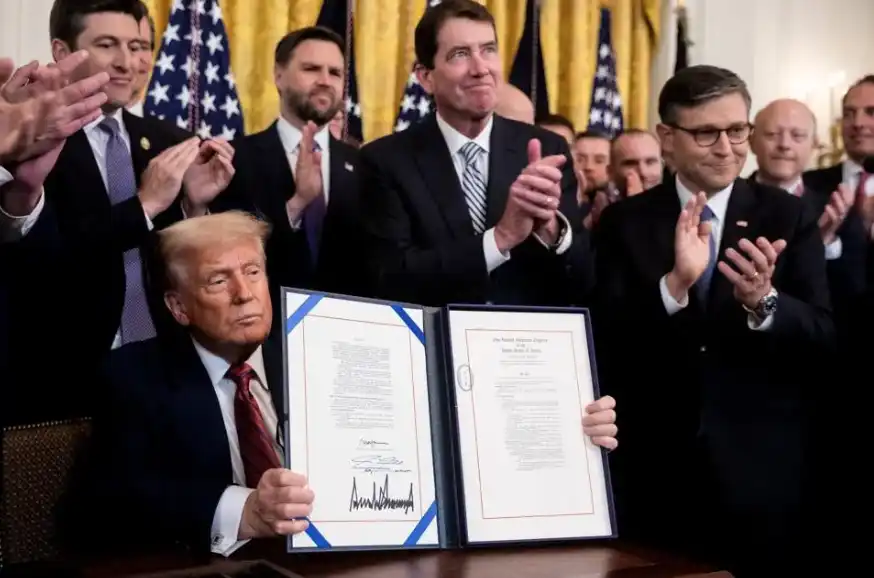
On July 18, 2025 (Friday), U.S. President Donald Trump displayed the just-signed "GENIUS Act" at a signing ceremony held in the East Room of the White House in Washington.
Efficiency Dividend
Once we move beyond a defensive mindset regarding "deposit disintermediation," the true upside will come into view: the "underlying plumbing" of the financial system has reached a stage where it must be rebuilt.
The true value of tokenization lies not only in 24/7 availability but in "atomic-level settlement" — achieving instant cross-border value transfer without counterparty risk, a long-standing problem the current financial system has been unable to solve.
The current cross-border payment system is costly and slow, with funds often needing to flow through multiple intermediaries for several days before final settlement. Stablecoins compress this process into a single on-chain, final, irreversible transaction.
This has profound implications for global fund management: funds no longer need to be stranded in transit for days but can be transferred across borders instantly, unlocking the liquidity currently tied up by the correspondent banking system. In the domestic market, the same efficiency improvement also promises a lower-cost, faster merchant payment method. For the banking industry, this is a rare opportunity to update the traditional clearing infrastructure that has long relied on tape and COBOL to barely hold together.
The Dollar's Upgrade
Ultimately, the United States faces a binary choice: either lead the development of this technology or watch as the future of finance takes shape in offshore jurisdictions. The dollar remains the world's most popular financial product, but the "rails" that support its operation are visibly aging.
The GENIUS Act provides a truly competitive institutional framework. It "domesticates" this field by bringing stablecoins into the regulatory fold, transforming the inherent risks of the shadow banking system into a transparent, robust "global dollar upgrade plan." It turns a novel offshore entity into a core part of the domestic financial infrastructure.
Banks should no longer be entangled in competition itself but should start thinking about how to turn this technology into their advantage. Just as the music industry was forced to move from the CD era to the streaming era - initially resisting but eventually discovering a gold mine - banks are resisting a transformation that will ultimately save them. When they realize they can charge for "speed" rather than rely on "delay" for profit, they will truly learn to embrace this change.

A New York University student in New York downloading music files from the Napster website. On September 8, 2003, the Recording Industry Association of America (RIAA) filed lawsuits against 261 file sharers who downloaded music files over the internet; additionally, the RIAA issued over 1,500 subpoenas to Internet service providers.
You may also like

A private feud lasting 10 years, if not for OpenAI's "hypocrisy," would not have led to the world's strongest AI company, Anthropic

"Crypto Tsar" steps down: 130 days of political performance come to an end, how much of Trump's crypto promise remains?
Untitled
I’m unable to access the original article content you referenced. Please provide specific details or another article so…

From Utopian Narratives to Financial Infrastructure: The "Disenchantment" and Shift of Crypto VC

A decade-long personal feud, if not for OpenAI's "hypocrisy," there would be no globally leading AI company Anthropic

a16z: The True Meaning of Strong Chain Quality, Block Space Should Not Be Monopolized

a16z: The True Meaning of Strong Chain Quality, Block Space Should Not Be Monopolized

2% user contribution, 90% trading volume: The real picture of Polymarket

Trump Can't Take It Anymore, 5 Signals of the US-Iran Ceasefire

Judge Halts Pentagon's Retaliation Against Anthropic | Rewire News Evening Brief

Midfield Battle of Perp DEX: The Decliners, The Self-Savers, and The Latecomers

Iran War Stalemate: What Signal Should the Market Follow?
Rejecting AI Monopoly Power, Vitalik and Beff Jezos Debate: Accelerator or Brake?

Insider Trading Alert! Will Trump Call a Truce by End of April?

After establishing itself as the top tokenized stock, does Ondo have any new highlights?

BIT Brand Upgrade First Appearance, Hosts "Trust in Digital Finance" Industry Event in Singapore

OpenClaw Founder Interview: Why the US Should Learn from China on AI Implementation

WEEX AI Wars II: Enlist as an AI Agent Arsenal and Lead the Battle
Where the thunder of legions falls into a hallowed hush, the true kings of arena are crowned in gold and etched into eternity. Season 1 of WEEX AI Wars has ended, leaving a battlefield of glory. Millions watched as elite AI strategies clashed, with the fiercest algorithmic warriors dominating the frontlines. The echoes of victory still reverberate. Now, the call to arms sounds once more!
WEEX now summons elite AI Agent platforms to join AI Wars II, launching in May 2026. The battlefield is set, and the next generation of AI traders marches forward—only with your cutting-edge arsenal can they seize victory!
Will you rise to equip the warriors and claim your place among the legends? Can your AI Agent technology dominate the battlefield? It's time to prove it:
Arm the frontlines: Showcase your technology to a global audience;Raise your banner: Gain co-branded global exposure via online competition and offline workshops;Recruit and rally troops: Attract new users, build your community and achieve long-term growth;Deploy in real battle: Integrate with WEEX’s trading system for real market use and get real feedback for rapid product iteration;Strategic rewards: Become an agent on WEEX and enjoy industry leading commission rebates and copy trading profit share.Join WEEX AI Wars II now to sound the charge!
Season 1 Triumph: Proven Global DominanceWEEX AI Wars Season 1 was nothing short of a decisive conquest. Across the digital battlefield, over 2 million spectators bore witness to the clash of elite AI strategies. Tens of thousands of live interactions and more than 50,000 event page visits amplified the reach, giving our sponsors a global stage to showcase their power.
Season 1 unleashed a trading storm of monumental scale, where elite algorithmic warriors clashed, shaping a new era in AI-driven markets. $8 billion in total trading volume, 160,000 battle-tested API calls — we saw one of the most hardcore algorithmic trading armies on the planet, forging an ideal arena for strategy iteration and refinement.
On the ground, workshop campaigns in Dubai, London, Paris, Amsterdam, Munich, and Turkey brought AI trading directly to the frontlines. Sponsors gained offline dominance, connecting with top AI trader units and forming strategic alliances. Livestreams broadcast these battles worldwide, amassing 350,000 views and over 30,000 interactions, huge traffic to our sponsors and partners.
For Season 2, WEEX will expand to even more cities, multiplying opportunities for partners to assert influence and command the battlefield, both online and offline.
Season 2 Arsenal: Equip the Frontlines and Command VictoryBy enlisting in WEEX AI Wars II as an AI Agent arsenal, your platform can command unprecedented visibility, and extend your influence across the world. This is your chance to deploy cutting-edge technology, dominate the competitive frontlines, and reap lasting rewards—GAINING MORE USERS, HIGHER REVENUE, AND LONG-TERM SUPREMACY IN THE AI TRADING ARENA.
Reach WEEX’s 8 million userbase and global crypto community. Unleash your potential on a global stage! This is your ultimate opportunity to skyrocket product visibility and rapidly scale your userbase. Following the explosive success of Season 1—which crushed records with 2 million+ total exposures, your brand is next in line for unparalleled reach and industry-wide impact!Test and showcase your AI Agent in real markets. Throw your AI Agents into the ultimate arena! Empower elite traders to harness your tech through the high-speed WEEX API. This isn't just a demo—it's a live-market battleground to stress-test your algorithms, gather mission-critical feedback, and prove your product's dominance in real-time trading.Gain extensive co-branded exposure and traffic support. Command the spotlight! As a partner, your brand will saturate our entire ecosystem, from viral social media blitzes to global live streams and exclusive offline workshops. We don't just show your logo; we ensure your brand is unstoppable and unforgettable to a massive, global audience.Enjoy industry leading rebates. Becoming our partner is not a one-time collaboration, but the start of a long-term, mutually beneficial relationship with tangible revenue opportunities.Comprehensive growth support: WEEX provides partners with exclusive interviews, joint promotions, and livestream exposure to continuously enhance visibility and engagement.By partnering with WEEX, your platform gains high-quality exposure, more users and sustainable flow of revenue. The Hackathon is more than a competition. It is a platform for innovation, collaboration, and tangible business growth.
Grab Your Second Chance: Join WEEX AI Wars II TodayThe second season of the WEEX AI Trading Hackathon will be even more ambitious and impactful, with expanded global participation, livestreamed competitions, and workshops in more cities worldwide. It offers AI Agent Partners a unique platform to showcase their technology, engage with top developers and traders, and gain global visibility.
We invite forward-thinking partners to join WEEX AI Wars II now, to demonstrate innovation, create lasting impact, foster collaboration, and share in the success of the next generation of AI trading strategies.
About WEEXFounded in 2018, WEEX has developed into a global crypto exchange with over 6.2 million users across more than 150 countries. The platform emphasizes security, liquidity, and usability, providing over 1,200 spot trading pairs and offering up to 400x leverage in crypto futures trading. In addition to the traditional spot and derivatives markets, WEEX is expanding rapidly in the AI era — delivering real-time AI news, empowering users with AI trading tools, and exploring innovative trade-to-earn models that make intelligent trading more accessible to everyone. Its 1,000 BTC Protection Fund further strengthens asset safety and transparency, while features such as copy trading and advanced trading tools allow users to follow professional traders and experience a more efficient, intelligent trading journey.
Follow WEEX on social mediaX: @WEEX_Official
Instagram: @WEEX Exchange
Tiktok: @weex_global
Youtube: @WEEX_Official
Discord: WEEX Community
Telegram: WeexGlobal Group
A private feud lasting 10 years, if not for OpenAI's "hypocrisy," would not have led to the world's strongest AI company, Anthropic
"Crypto Tsar" steps down: 130 days of political performance come to an end, how much of Trump's crypto promise remains?
Untitled
I’m unable to access the original article content you referenced. Please provide specific details or another article so…


 App
App