
What Conditions Does Bitcoin Still Need to Rise?
Last night, NVIDIA delivered a splendid report card.
In the third quarter, revenue reached $57 billion, a staggering 62% year-over-year increase, and net profit soared 65% to $31.9 billion. This marks NVIDIA's 12th consecutive earnings beat. Following the financial report, the stock price surged 4-6% in after-hours trading, continued to rise 5.1% in pre-market trading the next day, directly adding around $22 billion to the company's market cap and also lifting NASDAQ futures by 1.5-2%.
One would expect that with such positive market sentiment, Bitcoin, the digital gold, would also bask in some glory. However, reality dealt us a blow — Bitcoin not only failed to rise but instead fell, slipping to $91,363, a drop of approximately 3%.
NVIDIA Surges, Bitcoin Falls?
Those who once viewed Bitcoin as a safe haven asset are now likely feeling uneasy.
Initially portrayed as the "weapon against inflation" and the "safe haven in times of economic anxiety," Bitcoin's current performance resembles more that of a high-risk tech stock rather than a safe-haven asset like physical gold.
The data speaks volumes: after a 26% crash from its historical high in early October, Bitcoin's price has essentially returned to year-begin levels. In other words, it has been a wasted year.
Meanwhile, real gold during the same period surged by 55% in 2025. The psychological gap for Bitcoin holders is indeed substantial.
The factors driving the rise in gold prices are quite clear: potential interest rate cuts, a weakening US dollar, increased market volatility, and uncertain economic prospects. According to traditional Bitcoin logic, these conditions should have also boosted Bitcoin's price. However, the reality is quite the opposite.
Markets economist at CME Group, Mark Shore, pointed out as early as May this year that starting in 2020, the correlation between Bitcoin and US stocks turned positive and has remained so ever since. More importantly, the amount of Bitcoin flowing into the hands of institutional investors over the past year through ETFs and publicly traded cryptocurrency companies has hit a record high.
In other words, Bitcoin is becoming increasingly "mainstream," but the cost is that it is also becoming more like a traditional risky asset.
Of course, one reason for the situation where "NVIDIA surges, Bitcoin falls" lies in the flow of funds.
NVIDIA benefits from the kind of solidified demand seen in the AI sector. CEO Jensen Huang emphasized that "computing demand continues to accelerate," and the newly launched Blackwell chip sales have been "off the charts," with a $500 billion order visibility directly dispelling market concerns about an AI bubble. Super-scale cloud service providers, namely giants like Amazon and Microsoft, have spent over $380 billion in capital expenditures this year, with most of this money flowing to NVIDIA.
And what about Bitcoin? It has suffered a comprehensive blow to risk aversion sentiment. As a "high Beta risk asset," it is at the forefront in an environment of liquidity tightening. In just one week, the decline reached 12.5%. Cryptocurrency ETFs saw a single-day net outflow of $867 million on November 13, as long-term holders started selling, reducing the dormant Bitcoin supply from 8 million coins at the beginning of the year to 7.32 million coins.
So what conditions does Bitcoin still need to rise?
Although the current situation is not very optimistic, there is still room for a turnaround. To make Bitcoin soar again, it may require several key conditions to be met simultaneously.
Liquidity Injection After the U.S. Government Reopens
The 43-day government shutdown officially ended on November 18. This shutdown affected 1.25 million federal employees, resulting in approximately $16 billion in wage losses and causing the consumer confidence index to drop to a three-year low of 50.4.
Now that the government has reopened, liquidity injection has become crucial.
Here is a concept to clarify—the Treasury General Account (TGA), which is the U.S. Treasury's primary operating account at the Federal Reserve. All government receipts and disbursements go through this account. When the TGA increases, it means funds are flowing from the market to the government, reducing market liquidity; conversely, when the TGA decreases, government spending injects funds into the market, increasing liquidity.
According to data, during the 43-day period from October 1 to November 12, 2025, the TGA balance continued to accumulate, reaching a high point of $959 billion on November 14. This level is well above the cash position the Treasury usually maintains, mainly due to restricted spending during the government shutdown and continued debt issuance, leading to a significant accumulation of cash in the Treasury account.
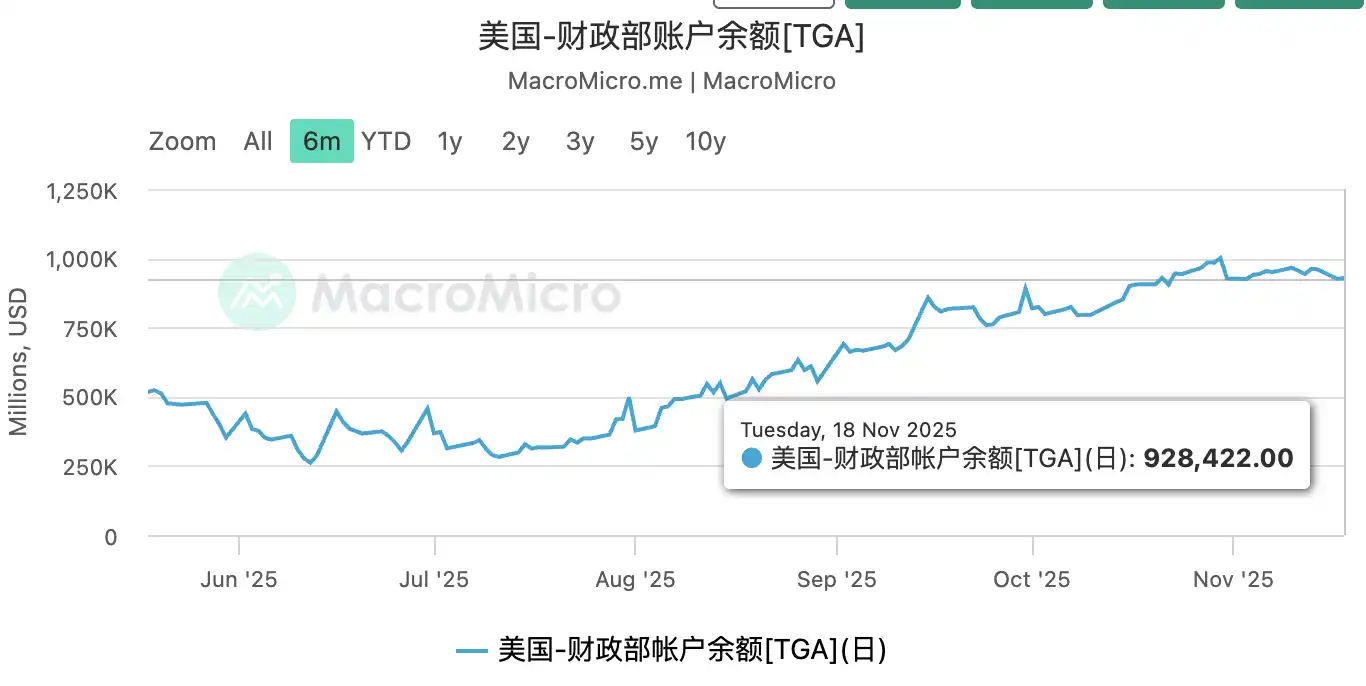
Currently, there is no significant decline in TGA data.
Based on the timing of the government reopening on November 13, 2025, and historical experience, it is estimated that in the first week, government employees will first receive back pay, injecting about $16 billion into the economy, with a relatively minor impact. This means that it will be difficult for a large amount of liquidity to enter before November 20.
Furthermore, in another 1-2 weeks, around early December, as the TGA resumes normal operations, daily government spending resumes, and seasonal tax inflows occur, the TGA balance will begin to fluctuate significantly, and liquidity will be noticeably improved in the market.
With increased interbank liquidity and institutional funding abundance, it means that Bitcoin as a risk asset will also receive inflows of funds, leading to an uptrend.
The experience at the beginning of 2019 provides an important reference point. At that time, the U.S. government also went through a long shutdown from December 22, 2018, to January 25, 2019, lasting 35 days. During the government shutdown, the Treasury General Account (TGA) balance also accumulated significantly, reaching $413 billion on January 29, 2019. When the government resumed operations, the Treasury Department quickly increased spending. From January 29 to March 1, in just one month, the TGA balance decreased by $211 billion. These funds flowed into the financial system, bringing about a significant improvement in liquidity. This drove the stock market and Bitcoin to rise by 8.5% and 35%, respectively, within 30 days of reopening.
Comparing the current situation, the Treasury General Account (TGA) balance in November 2025 reached $959 billion, much higher than the $413 billion in 2019. This implies a potentially more substantial liquidity release.
Fed Policy Shift
Speaking of the Fed, it is another key player influencing Bitcoin's trajectory.
The latest Fed meeting minutes show that officials are divided on whether there is a need for a third consecutive rate cut. Most officials believe that further rate cuts may exacerbate inflation risks. White House economic advisor Hassett even admitted that they had "lost control over inflation."
Trump once again expressed his "incompetent anger," directly attacking Fed Chair Powell, saying, "I'd like to fire him, he's extremely incompetent."
According to CME's "FedWatch," the probability of a 25-basis-point rate cut in December is only 36.2%, while the probability of keeping rates unchanged is as high as 63.8%.
What's worse, the U.S. Bureau of Labor Statistics has confirmed that household survey data for October (used to calculate key statistics such as the unemployment rate) cannot be retroactively collected. Therefore, the October employment report will not be released, and these nonfarm payroll data will be included in the November employment report, which will be published on December 16. This means that the Fed will not have key employment data at its last meeting of the year.
In addition, with U.S. bond yields rising, major treasury bond yields are generally increasing, with the 10-year yield rising by 2.5 basis points. Market expectations for a December rate cut have been largely dashed, with the rate cut probability falling to around 31%.
However, if we take a longer-term view, the situation may not be so pessimistic. The delayed November employment data will be released on December 16, and if the data is weak, it could still support expectations of the next rate cut, around January 27 next year. Currently, the probability of a rate cut is 48%, the highest for the 2026 meetings.
Expanding our view further, although the Fed's stance is ambiguous, other major central banks around the world have already taken action with a dovish bias. This undercurrent may become an important driver of Bitcoin's rise.
For example, the ECB is currently maintaining the deposit facility rate at 2.00%, but there is a high likelihood of a 25 basis point rate cut in December, as inflation has fallen to 2.1%, close to the target level. Here's an interesting fact: historically, there has been a high correlation of 0.85 between ECB rate cuts and Bitcoin's rise. Why? Because the euro area's liquidity easing spills over into global markets, boosting overall risk appetite.
Economic Recovery Is Evident
The current U.S. economy is in a very delicate state—there are bright spots, but also hidden worries.
In August, the trade deficit narrowed significantly, falling 23.8% to $596 billion, exceeding the market's expectation of $610 billion. This was mainly due to a 6.6% drop in commodity imports under the tariff effect. This change is expected to contribute 1.5-2.0 percentage points to third-quarter GDP growth, pushing growth estimates to 3.8%. Sounds good, right? But the problem is, this improvement has come at the expense of imports and may have a long-term impact on the supply chain and consumption.
Although the 43-day government shutdown has ended, the damage it caused is still lingering. $160 billion in wage losses, a consumer confidence index hitting a three-year low of 50.4, and the CBO estimating a 1.5 percentage point loss in fourth-quarter GDP—these numbers reflect the real economic pain.
Food inflation is also critical—what used to cost $100 now costs $250, and the quality is even worse. Just as the egg price surge has eased, Americans' favorite beef is facing a new wave of inflation.
The latest Consumer Price Index (CPI) released on October 24 shows that the prices of roast beef and steaks have increased by 18.4% and 16.6% respectively year-on-year. According to data from the U.S. Department of Agriculture, retail prices for ground beef have skyrocketed to $6.1 per pound, hitting a historical high. Compared to three years ago, beef prices have risen by over 50% cumulatively.
In addition, coffee prices have increased by 18.9%, natural gas prices by 11.7%, electricity prices by 5.1%, and car repair costs by 11.5%. Many American young people who are already in debt due to college education are facing even greater pressure due to further increases in the cost of living.
The "K-Shaped Recovery Warning Sign" may be the most concerning trend in the current US economic situation. Nearly 25% of American households are living paycheck to paycheck, with the wages of the low-income group stagnant, while the AI investment-driven high-income group (which accounts for 50% of consumption) continues to benefit. The risk of economic stratification is rising sharply.
Furthermore, tariff policies continue to drag down the global export-oriented economy, with Japan, Switzerland, and Mexico all experiencing contractions in the third quarter. This global economic chain reaction will eventually circle back to the US market, affecting investors' risk appetite.
However, if the US government can improve the US economy thereafter, various assets, including Bitcoin, will have an opportunity to rise.
Institutional Fund Inflows
If the previous conditions can be seen as "timing," then institutional funds are the "people." This may be the most direct and immediately effective catalyst.
It has to be said that the current data is not very optimistic. From November 13-19, ETFs saw a net outflow of $2 billion (approximately 20,000 Bitcoins), the largest weekly outflow since February of this year. The current Assets Under Management (AUM) stand at $12.23 billion, accounting for 6.6% of the total Bitcoin market cap.
What does this mean? Institutional investors are withdrawing, and at a rapid pace.
After all, in the current macro environment, institutional funds are facing multiple pressures: first, severe liquidity stratification. The tech/AI sector is receiving ample funding, traditional safe-haven assets like gold are performing well, and the liquidity of riskier assets like cryptocurrencies is drying up. The money isn't disappearing, it's just going elsewhere.
Furthermore, the typical behavior of institutional investors and fund managers is often shaped by an "avoiding mistakes" incentive structure. The industry's evaluation system focuses more on "not falling behind peers" rather than "achieving excess returns." Under such a framework, taking risks contrary to mainstream views often carries a much higher cost than the potential gain.
Therefore, most managers tend to maintain a position structure consistent with the market mainstream. For example, if Bitcoin experiences an overall pullback, and a fund manager still maintains a significant long position, the drawdown will be interpreted as a "judgment error," leading to much more criticism than the recognition brought by an equivalent gain. Ultimately, under these institutional constraints, "conservatism" becomes a rational choice.
However, history tells us that institutional money flows often suddenly reverse at a critical point. So where is this critical point? There are three clear signals:
Signal One: Consecutive 3-Day Net Inflow
This is the most important signal. Historical data shows that when ETF funds flow positive and remain in net inflow for 3 consecutive days, Bitcoin tends to rise 60-70% within an average of 60-100 days.
Why is this so magical? Because institutional investment is the area where the "herd effect" is most obvious. Once the trend reverses, subsequent funds will follow like falling dominoes. That's how the bull run at the beginning of 2024 was ignited.
Signal Two: Single-Day Inflow Exceeding $500 Million
This represents a signal of large institutions entering the market. In October 2024, a single-week $3.24 billion inflow directly propelled Bitcoin to break through its all-time high. Retail investors simply cannot generate that kind of momentum.
What does $500 million in a single day mean? It's equivalent to giants like BlackRock and Fidelity simultaneously deciding to increase their positions. Such a level of fund inflow often comes with a clear macro judgment – they see signals that ordinary investors cannot.
Signal Three: AUM Percentage Rebounds to Over 8%
The current $122.3 billion AUM accounts for 6.6% of Bitcoin's market value, a ratio that historically has been on the lower side. During the peak of 2024, this ratio reached 8-9%. When this proportion starts to rise, it means that institutions are not only buying Bitcoin but are buying at a pace faster than the Bitcoin price is rising.
So, under what circumstances will institutional funds return?
Basically, as mentioned earlier: a clear Fed interest rate cut signal appears; U.S. economic data becomes clearer; global central banks coordinate loosening policies to resonate; technical breakthrough past key resistance levels, and so on.
Possible Timing of Upsurge
After discussing these conditions, perhaps what everyone is most concerned about is: when will the surge happen?
While no one can accurately predict the market, based on the timetable of macro events, we can pinpoint a few key points.
December 10: FOMC Meeting
This is the final Fed meeting of the year and the most anticipated event in the market.
If there is indeed a rate cut, Bitcoin may experience a surge; if not, there might be another dip.
Here's a crucial point: even if there is no rate cut, if the Fed sends a dovish signal (such as emphasizing "flexibility" and "closely watching employment data"), it will also support market sentiment. On the other hand, if there is no rate cut and a strong stance is taken, be prepared for short-term pressure.
December 16: Delayed November Employment Data
This data will include a full picture of both October and November, confirming the true trend of the labor market.
If the data for two consecutive months is weak, the probability of an interest rate cut in early 2026 will significantly increase. This will provide mid-term support for Bitcoin. If the data is mixed or contradictory, the market may continue to struggle, and a range-bound pattern will persist.
The certainty of the data release is high, but the quality of the data itself may be less reliable (government shutdown leading to statistical confusion), so market reaction may be more based on interpretation rather than the data itself.
Late December to Year-End: Liquidity's "Traditional Peak Season"
This is an interesting seasonal pattern. Historically, from late December to the New Year, institutional investors will conduct year-end rebalancing, and reduced holiday trading volume will amplify price volatility.
If the preceding events align positively, there may be a year-end "Santa Claus rally." However, beware of the "sell the news" effect—profit-taking after positive news is priced in.
First Quarter of 2026: Global Liquidity's Synchronized Easing "Grand Game"
This is the most imaginative time window.
If the Federal Reserve cuts interest rates in December or January next year, and the ECB and PBOC continue to maintain loose monetary policies, a situation of synchronized global liquidity improvement will emerge. In this scenario, Bitcoin may see a rally similar to the one in 2020—rising from a low of $3,800 in March to $28,000 by the end of the year, a surge of over 600%.
Of course, it is unlikely that 2026 will fully replicate 2020 (the stimulus intensity during that time was rare due to the pandemic), but the combination of globally coordinated central bank easing, TGA fund release, and institutional funds inflow is enough to drive a decent rally.
The likelihood of synchronized global liquidity easing is moderately high (60-65%). Central banks around the world are facing economic slowdown pressures, and easing is a high-probability event.
You may also like

Token Cannot Compound, Where Is the Real Investment Opportunity?

February 6th Market Key Intelligence, How Much Did You Miss?

China's Central Bank and Eight Other Departments' Latest Regulatory Focus: Key Attention to RWA Tokenized Asset Risk
Foreword: Today, the People's Bank of China's website published the "Notice of the People's Bank of China, National Development and Reform Commission, Ministry of Industry and Information Technology, Ministry of Public Security, State Administration for Market Regulation, China Banking and Insurance Regulatory Commission, China Securities Regulatory Commission, State Administration of Foreign Exchange on Further Preventing and Dealing with Risks Related to Virtual Currency and Others (Yinfa [2026] No. 42)", the latest regulatory requirements from the eight departments including the central bank, which are basically consistent with the regulatory requirements of recent years. The main focus of the regulation is on speculative activities such as virtual currency trading, exchanges, ICOs, overseas platform services, and this time, regulatory oversight of RWA has been added, explicitly prohibiting RWA tokenization, stablecoins (especially those pegged to the RMB). The following is the full text:
To the people's governments of all provinces, autonomous regions, and municipalities directly under the Central Government, the Xinjiang Production and Construction Corps:
Recently, there have been speculative activities related to virtual currency and Real-World Assets (RWA) tokenization, disrupting the economic and financial order and jeopardizing the property security of the people. In order to further prevent and address the risks related to virtual currency and Real-World Assets tokenization, effectively safeguard national security and social stability, in accordance with the "Law of the People's Republic of China on the People's Bank of China," "Law of the People's Republic of China on Commercial Banks," "Securities Law of the People's Republic of China," "Law of the People's Republic of China on Securities Investment Funds," "Law of the People's Republic of China on Futures and Derivatives," "Cybersecurity Law of the People's Republic of China," "Regulations of the People's Republic of China on the Administration of Renminbi," "Regulations on Prevention and Disposal of Illegal Fundraising," "Regulations of the People's Republic of China on Foreign Exchange Administration," "Telecommunications Regulations of the People's Republic of China," and other provisions, after reaching consensus with the Cyberspace Administration of China, the Supreme People's Court, and the Supreme People's Procuratorate, and with the approval of the State Council, the relevant matters are notified as follows:
(I) Virtual currency does not possess the legal status equivalent to fiat currency. Virtual currencies such as Bitcoin, Ether, Tether, etc., have the main characteristics of being issued by non-monetary authorities, using encryption technology and distributed ledger or similar technology, existing in digital form, etc. They do not have legal tender status, should not and cannot be circulated and used as currency in the market.
The business activities related to virtual currency are classified as illegal financial activities. The exchange of fiat currency and virtual currency within the territory, exchange of virtual currencies, acting as a central counterparty in buying and selling virtual currencies, providing information intermediary and pricing services for virtual currency transactions, token issuance financing, and trading of virtual currency-related financial products, etc., fall under illegal financial activities, such as suspected illegal issuance of token vouchers, unauthorized public issuance of securities, illegal operation of securities and futures business, illegal fundraising, etc., are strictly prohibited across the board and resolutely banned in accordance with the law. Overseas entities and individuals are not allowed to provide virtual currency-related services to domestic entities in any form.
A stablecoin pegged to a fiat currency indirectly fulfills some functions of the fiat currency in circulation. Without the consent of relevant authorities in accordance with the law and regulations, any domestic or foreign entity or individual is not allowed to issue a RMB-pegged stablecoin overseas.
(II)Tokenization of Real-World Assets refers to the use of encryption technology and distributed ledger or similar technologies to transform ownership rights, income rights, etc., of assets into tokens (tokens) or other interests or bond certificates with token (token) characteristics, and carry out issuance and trading activities.
Engaging in the tokenization of real-world assets domestically, as well as providing related intermediary, information technology services, etc., which are suspected of illegal issuance of token vouchers, unauthorized public offering of securities, illegal operation of securities and futures business, illegal fundraising, and other illegal financial activities, shall be prohibited; except for relevant business activities carried out with the approval of the competent authorities in accordance with the law and regulations and relying on specific financial infrastructures. Overseas entities and individuals are not allowed to illegally provide services related to the tokenization of real-world assets to domestic entities in any form.
(III) Inter-agency Coordination. The People's Bank of China, together with the National Development and Reform Commission, the Ministry of Industry and Information Technology, the Ministry of Public Security, the State Administration for Market Regulation, the China Banking and Insurance Regulatory Commission, the China Securities Regulatory Commission, the State Administration of Foreign Exchange, and other departments, will improve the work mechanism, strengthen coordination with the Cyberspace Administration of China, the Supreme People's Court, and the Supreme People's Procuratorate, coordinate efforts, and overall guide regions to carry out risk prevention and disposal of virtual currency-related illegal financial activities.
The China Securities Regulatory Commission, together with the National Development and Reform Commission, the Ministry of Industry and Information Technology, the Ministry of Public Security, the People's Bank of China, the State Administration for Market Regulation, the China Banking and Insurance Regulatory Commission, the State Administration of Foreign Exchange, and other departments, will improve the work mechanism, strengthen coordination with the Cyberspace Administration of China, the Supreme People's Court, and the Supreme People's Procuratorate, coordinate efforts, and overall guide regions to carry out risk prevention and disposal of illegal financial activities related to the tokenization of real-world assets.
(IV) Strengthening Local Implementation. The people's governments at the provincial level are overall responsible for the prevention and disposal of risks related to virtual currencies and the tokenization of real-world assets in their respective administrative regions. The specific leading department is the local financial regulatory department, with participation from branches and dispatched institutions of the State Council's financial regulatory department, telecommunications regulators, public security, market supervision, and other departments, in coordination with cyberspace departments, courts, and procuratorates, to improve the normalization of the work mechanism, effectively connect with the relevant work mechanisms of central departments, form a cooperative and coordinated working pattern between central and local governments, effectively prevent and properly handle risks related to virtual currencies and the tokenization of real-world assets, and maintain economic and financial order and social stability.
(5) Enhanced Risk Monitoring. The People's Bank of China, China Securities Regulatory Commission, National Development and Reform Commission, Ministry of Industry and Information Technology, Ministry of Public Security, State Administration of Foreign Exchange, Cyberspace Administration of China, and other departments continue to improve monitoring techniques and system support, enhance cross-departmental data analysis and sharing, establish sound information sharing and cross-validation mechanisms, promptly grasp the risk situation of activities related to virtual currency and real-world asset tokenization. Local governments at all levels give full play to the role of local monitoring and early warning mechanisms. Local financial regulatory authorities, together with branches and agencies of the State Council's financial regulatory authorities, as well as departments of cyberspace and public security, ensure effective connection between online monitoring, offline investigation, and fund tracking, efficiently and accurately identify activities related to virtual currency and real-world asset tokenization, promptly share risk information, improve early warning information dissemination, verification, and rapid response mechanisms.
(6) Strengthened Oversight of Financial Institutions, Intermediaries, and Technology Service Providers. Financial institutions (including non-bank payment institutions) are prohibited from providing account opening, fund transfer, and clearing services for virtual currency-related business activities, issuing and selling financial products related to virtual currency, including virtual currency and related financial products in the scope of collateral, conducting insurance business related to virtual currency, or including virtual currency in the scope of insurance liability. Financial institutions (including non-bank payment institutions) are prohibited from providing custody, clearing, and settlement services for unauthorized real-world asset tokenization-related business and related financial products. Relevant intermediary institutions and information technology service providers are prohibited from providing intermediary, technical, or other services for unauthorized real-world asset tokenization-related businesses and related financial products.
(7) Enhanced Management of Internet Information Content and Access. Internet enterprises are prohibited from providing online business venues, commercial displays, marketing, advertising, or paid traffic diversion services for virtual currency and real-world asset tokenization-related business activities. Upon discovering clues of illegal activities, they should promptly report to relevant departments and provide technical support and assistance for related investigations and inquiries. Based on the clues transferred by the financial regulatory authorities, the cyberspace administration, telecommunications authorities, and public security departments should promptly close and deal with websites, mobile applications (including mini-programs), and public accounts engaged in virtual currency and real-world asset tokenization-related business activities in accordance with the law.
(8) Strengthened Entity Registration and Advertisement Management. Market supervision departments strengthen entity registration and management, and enterprise and individual business registrations must not contain terms such as "virtual currency," "virtual asset," "cryptocurrency," "crypto asset," "stablecoin," "real-world asset tokenization," or "RWA" in their names or business scopes. Market supervision departments, together with financial regulatory authorities, legally enhance the supervision of advertisements related to virtual currency and real-world asset tokenization, promptly investigating and handling relevant illegal advertisements.
(IX) Continued Rectification of Virtual Currency Mining Activities. The National Development and Reform Commission, together with relevant departments, strictly controls virtual currency mining activities, continuously promotes the rectification of virtual currency mining activities. The people's governments of various provinces take overall responsibility for the rectification of "mining" within their respective administrative regions. In accordance with the requirements of the National Development and Reform Commission and other departments in the "Notice on the Rectification of Virtual Currency Mining Activities" (NDRC Energy-saving Building [2021] No. 1283) and the provisions of the "Guidance Catalog for Industrial Structure Adjustment (2024 Edition)," a comprehensive review, investigation, and closure of existing virtual currency mining projects are conducted, new mining projects are strictly prohibited, and mining machine production enterprises are strictly prohibited from providing mining machine sales and other services within the country.
(X) Severe Crackdown on Related Illegal Financial Activities. Upon discovering clues to illegal financial activities related to virtual currency and the tokenization of real-world assets, local financial regulatory authorities, branches of the State Council's financial regulatory authorities, and other relevant departments promptly investigate, determine, and properly handle the issues in accordance with the law, and seriously hold the relevant entities and individuals legally responsible. Those suspected of crimes are transferred to the judicial authorities for processing according to the law.
(XI) Severe Crackdown on Related Illegal and Criminal Activities. The Ministry of Public Security, the People's Bank of China, the State Administration for Market Regulation, the China Banking and Insurance Regulatory Commission, the China Securities Regulatory Commission, as well as judicial and procuratorial organs, in accordance with their respective responsibilities, rigorously crack down on illegal and criminal activities related to virtual currency, the tokenization of real-world assets, such as fraud, money laundering, illegal business operations, pyramid schemes, illegal fundraising, and other illegal and criminal activities carried out under the guise of virtual currency, the tokenization of real-world assets, etc.
(XII) Strengthen Industry Self-discipline. Relevant industry associations should enhance membership management and policy advocacy, based on their own responsibilities, advocate and urge member units to resist illegal financial activities related to virtual currency and the tokenization of real-world assets. Member units that violate regulatory policies and industry self-discipline rules are to be disciplined in accordance with relevant self-regulatory management regulations. By leveraging various industry infrastructure, conduct risk monitoring related to virtual currency, the tokenization of real-world assets, and promptly transfer issue clues to relevant departments.
(XIII) Without the approval of relevant departments in accordance with the law and regulations, domestic entities and foreign entities controlled by them may not issue virtual currency overseas.
(XIV) Domestic entities engaging directly or indirectly in overseas external debt-based tokenization of real-world assets, or conducting asset securitization activities abroad based on domestic ownership rights, income rights, etc. (hereinafter referred to as domestic equity), should be strictly regulated in accordance with the principles of "same business, same risk, same rules." The National Development and Reform Commission, the China Securities Regulatory Commission, the State Administration of Foreign Exchange, and other relevant departments regulate it according to their respective responsibilities. For other forms of overseas real-world asset tokenization activities based on domestic equity by domestic entities, the China Securities Regulatory Commission, together with relevant departments, supervise according to their division of responsibilities. Without the consent and filing of relevant departments, no unit or individual may engage in the above-mentioned business.
(15) Overseas subsidiaries and branches of domestic financial institutions providing Real World Asset Tokenization-related services overseas shall do so legally and prudently. They shall have professional personnel and systems in place to effectively mitigate business risks, strictly implement customer onboarding, suitability management, anti-money laundering requirements, and incorporate them into the domestic financial institutions' compliance and risk management system. Intermediaries and information technology service providers offering Real World Asset Tokenization services abroad based on domestic equity or conducting Real World Asset Tokenization business in the form of overseas debt for domestic entities directly or indirectly venturing abroad must strictly comply with relevant laws and regulations. They should establish and improve relevant compliance and internal control systems in accordance with relevant normative requirements, strengthen business and risk control, and report the business developments to the relevant regulatory authorities for approval or filing.
(16) Strengthen organizational leadership and overall coordination. All departments and regions should attach great importance to the prevention of risks related to virtual currencies and Real World Asset Tokenization, strengthen organizational leadership, clarify work responsibilities, form a long-term effective working mechanism with centralized coordination, local implementation, and shared responsibilities, maintain high pressure, dynamically monitor risks, effectively prevent and mitigate risks in an orderly and efficient manner, legally protect the property security of the people, and make every effort to maintain economic and financial order and social stability.
(17) Widely carry out publicity and education. All departments, regions, and industry associations should make full use of various media and other communication channels to disseminate information through legal and policy interpretation, analysis of typical cases, and education on investment risks, etc. They should promote the illegality and harm of virtual currencies and Real World Asset Tokenization-related businesses and their manifestations, fully alert to potential risks and hidden dangers, and enhance public awareness and identification capabilities for risk prevention.
(18) Engaging in illegal financial activities related to virtual currencies and Real World Asset Tokenization in violation of this notice, as well as providing services for virtual currencies and Real World Asset Tokenization-related businesses, shall be punished in accordance with relevant regulations. If it constitutes a crime, criminal liability shall be pursued according to the law. For domestic entities and individuals who knowingly or should have known that overseas entities illegally provided virtual currency or Real World Asset Tokenization-related services to domestic entities and still assisted them, relevant responsibilities shall be pursued according to the law. If it constitutes a crime, criminal liability shall be pursued according to the law.
(19) If any unit or individual invests in virtual currencies, Real World Asset Tokens, and related financial products against public order and good customs, the relevant civil legal actions shall be invalid, and any resulting losses shall be borne by them. If there are suspicions of disrupting financial order and jeopardizing financial security, the relevant departments shall deal with them according to the law.
This notice shall enter into force upon the date of its issuance. The People's Bank of China and ten other departments' "Notice on Further Preventing and Dealing with the Risks of Virtual Currency Trading Speculation" (Yinfa [2021] No. 237) is hereby repealed.

Former Partner's Perspective on Multicoin: Kyle's Exit, But the Game He Left Behind Just Getting Started
Why Bitcoin Is Falling Now: The Real Reasons Behind BTC's Crash & WEEX's Smart Profit Playbook
Bitcoin's ongoing crash explained: Discover the 5 hidden triggers behind BTC's plunge & how WEEX's Auto Earn and Trade to Earn strategies help traders profit from crypto market volatility.

Wall Street's Hottest Trades See Exodus

Vitalik Discusses Ethereum Scaling Path, Circle Announces Partnership with Polymarket, What's the Overseas Crypto Community Talking About Today?

Believing in the Capital Markets - The Essence and Core Value of Cryptocurrency

Polymarket's 'Weatherman': Predict Temperature, Win Million-Dollar Payout
$15K+ Profits: The 4 AI Trading Secrets WEEX Hackathon Prelim Winners Used to Dominate Volatile Crypto Markets
How WEEX Hackathon's top AI trading strategies made $15K+ in crypto markets: 4 proven rules for ETH/BTC trading, market structure analysis, and risk management in volatile conditions.

A nearly 20% one-day plunge, how long has it been since you last saw a $60,000 Bitcoin?

Raoul Pal: I've seen every single panic, and they are never the end.

Key Market Information Discrepancy on February 6th - A Must-Read! | Alpha Morning Report

2026 Crypto Industry's First Snowfall

The Harsh Reality Behind the $26 Billion Crypto Liquidation: Liquidity Is Killing the Market

Why Is Gold, US Stocks, Bitcoin All Falling?

Key Market Intelligence for February 5th, how much did you miss out on?

Wintermute: By 2026, crypto had gradually become the settlement layer of the Internet economy
Token Cannot Compound, Where Is the Real Investment Opportunity?
February 6th Market Key Intelligence, How Much Did You Miss?
China's Central Bank and Eight Other Departments' Latest Regulatory Focus: Key Attention to RWA Tokenized Asset Risk
Foreword: Today, the People's Bank of China's website published the "Notice of the People's Bank of China, National Development and Reform Commission, Ministry of Industry and Information Technology, Ministry of Public Security, State Administration for Market Regulation, China Banking and Insurance Regulatory Commission, China Securities Regulatory Commission, State Administration of Foreign Exchange on Further Preventing and Dealing with Risks Related to Virtual Currency and Others (Yinfa [2026] No. 42)", the latest regulatory requirements from the eight departments including the central bank, which are basically consistent with the regulatory requirements of recent years. The main focus of the regulation is on speculative activities such as virtual currency trading, exchanges, ICOs, overseas platform services, and this time, regulatory oversight of RWA has been added, explicitly prohibiting RWA tokenization, stablecoins (especially those pegged to the RMB). The following is the full text:
To the people's governments of all provinces, autonomous regions, and municipalities directly under the Central Government, the Xinjiang Production and Construction Corps:
Recently, there have been speculative activities related to virtual currency and Real-World Assets (RWA) tokenization, disrupting the economic and financial order and jeopardizing the property security of the people. In order to further prevent and address the risks related to virtual currency and Real-World Assets tokenization, effectively safeguard national security and social stability, in accordance with the "Law of the People's Republic of China on the People's Bank of China," "Law of the People's Republic of China on Commercial Banks," "Securities Law of the People's Republic of China," "Law of the People's Republic of China on Securities Investment Funds," "Law of the People's Republic of China on Futures and Derivatives," "Cybersecurity Law of the People's Republic of China," "Regulations of the People's Republic of China on the Administration of Renminbi," "Regulations on Prevention and Disposal of Illegal Fundraising," "Regulations of the People's Republic of China on Foreign Exchange Administration," "Telecommunications Regulations of the People's Republic of China," and other provisions, after reaching consensus with the Cyberspace Administration of China, the Supreme People's Court, and the Supreme People's Procuratorate, and with the approval of the State Council, the relevant matters are notified as follows:
(I) Virtual currency does not possess the legal status equivalent to fiat currency. Virtual currencies such as Bitcoin, Ether, Tether, etc., have the main characteristics of being issued by non-monetary authorities, using encryption technology and distributed ledger or similar technology, existing in digital form, etc. They do not have legal tender status, should not and cannot be circulated and used as currency in the market.
The business activities related to virtual currency are classified as illegal financial activities. The exchange of fiat currency and virtual currency within the territory, exchange of virtual currencies, acting as a central counterparty in buying and selling virtual currencies, providing information intermediary and pricing services for virtual currency transactions, token issuance financing, and trading of virtual currency-related financial products, etc., fall under illegal financial activities, such as suspected illegal issuance of token vouchers, unauthorized public issuance of securities, illegal operation of securities and futures business, illegal fundraising, etc., are strictly prohibited across the board and resolutely banned in accordance with the law. Overseas entities and individuals are not allowed to provide virtual currency-related services to domestic entities in any form.
A stablecoin pegged to a fiat currency indirectly fulfills some functions of the fiat currency in circulation. Without the consent of relevant authorities in accordance with the law and regulations, any domestic or foreign entity or individual is not allowed to issue a RMB-pegged stablecoin overseas.
(II)Tokenization of Real-World Assets refers to the use of encryption technology and distributed ledger or similar technologies to transform ownership rights, income rights, etc., of assets into tokens (tokens) or other interests or bond certificates with token (token) characteristics, and carry out issuance and trading activities.
Engaging in the tokenization of real-world assets domestically, as well as providing related intermediary, information technology services, etc., which are suspected of illegal issuance of token vouchers, unauthorized public offering of securities, illegal operation of securities and futures business, illegal fundraising, and other illegal financial activities, shall be prohibited; except for relevant business activities carried out with the approval of the competent authorities in accordance with the law and regulations and relying on specific financial infrastructures. Overseas entities and individuals are not allowed to illegally provide services related to the tokenization of real-world assets to domestic entities in any form.
(III) Inter-agency Coordination. The People's Bank of China, together with the National Development and Reform Commission, the Ministry of Industry and Information Technology, the Ministry of Public Security, the State Administration for Market Regulation, the China Banking and Insurance Regulatory Commission, the China Securities Regulatory Commission, the State Administration of Foreign Exchange, and other departments, will improve the work mechanism, strengthen coordination with the Cyberspace Administration of China, the Supreme People's Court, and the Supreme People's Procuratorate, coordinate efforts, and overall guide regions to carry out risk prevention and disposal of virtual currency-related illegal financial activities.
The China Securities Regulatory Commission, together with the National Development and Reform Commission, the Ministry of Industry and Information Technology, the Ministry of Public Security, the People's Bank of China, the State Administration for Market Regulation, the China Banking and Insurance Regulatory Commission, the State Administration of Foreign Exchange, and other departments, will improve the work mechanism, strengthen coordination with the Cyberspace Administration of China, the Supreme People's Court, and the Supreme People's Procuratorate, coordinate efforts, and overall guide regions to carry out risk prevention and disposal of illegal financial activities related to the tokenization of real-world assets.
(IV) Strengthening Local Implementation. The people's governments at the provincial level are overall responsible for the prevention and disposal of risks related to virtual currencies and the tokenization of real-world assets in their respective administrative regions. The specific leading department is the local financial regulatory department, with participation from branches and dispatched institutions of the State Council's financial regulatory department, telecommunications regulators, public security, market supervision, and other departments, in coordination with cyberspace departments, courts, and procuratorates, to improve the normalization of the work mechanism, effectively connect with the relevant work mechanisms of central departments, form a cooperative and coordinated working pattern between central and local governments, effectively prevent and properly handle risks related to virtual currencies and the tokenization of real-world assets, and maintain economic and financial order and social stability.
(5) Enhanced Risk Monitoring. The People's Bank of China, China Securities Regulatory Commission, National Development and Reform Commission, Ministry of Industry and Information Technology, Ministry of Public Security, State Administration of Foreign Exchange, Cyberspace Administration of China, and other departments continue to improve monitoring techniques and system support, enhance cross-departmental data analysis and sharing, establish sound information sharing and cross-validation mechanisms, promptly grasp the risk situation of activities related to virtual currency and real-world asset tokenization. Local governments at all levels give full play to the role of local monitoring and early warning mechanisms. Local financial regulatory authorities, together with branches and agencies of the State Council's financial regulatory authorities, as well as departments of cyberspace and public security, ensure effective connection between online monitoring, offline investigation, and fund tracking, efficiently and accurately identify activities related to virtual currency and real-world asset tokenization, promptly share risk information, improve early warning information dissemination, verification, and rapid response mechanisms.
(6) Strengthened Oversight of Financial Institutions, Intermediaries, and Technology Service Providers. Financial institutions (including non-bank payment institutions) are prohibited from providing account opening, fund transfer, and clearing services for virtual currency-related business activities, issuing and selling financial products related to virtual currency, including virtual currency and related financial products in the scope of collateral, conducting insurance business related to virtual currency, or including virtual currency in the scope of insurance liability. Financial institutions (including non-bank payment institutions) are prohibited from providing custody, clearing, and settlement services for unauthorized real-world asset tokenization-related business and related financial products. Relevant intermediary institutions and information technology service providers are prohibited from providing intermediary, technical, or other services for unauthorized real-world asset tokenization-related businesses and related financial products.
(7) Enhanced Management of Internet Information Content and Access. Internet enterprises are prohibited from providing online business venues, commercial displays, marketing, advertising, or paid traffic diversion services for virtual currency and real-world asset tokenization-related business activities. Upon discovering clues of illegal activities, they should promptly report to relevant departments and provide technical support and assistance for related investigations and inquiries. Based on the clues transferred by the financial regulatory authorities, the cyberspace administration, telecommunications authorities, and public security departments should promptly close and deal with websites, mobile applications (including mini-programs), and public accounts engaged in virtual currency and real-world asset tokenization-related business activities in accordance with the law.
(8) Strengthened Entity Registration and Advertisement Management. Market supervision departments strengthen entity registration and management, and enterprise and individual business registrations must not contain terms such as "virtual currency," "virtual asset," "cryptocurrency," "crypto asset," "stablecoin," "real-world asset tokenization," or "RWA" in their names or business scopes. Market supervision departments, together with financial regulatory authorities, legally enhance the supervision of advertisements related to virtual currency and real-world asset tokenization, promptly investigating and handling relevant illegal advertisements.
(IX) Continued Rectification of Virtual Currency Mining Activities. The National Development and Reform Commission, together with relevant departments, strictly controls virtual currency mining activities, continuously promotes the rectification of virtual currency mining activities. The people's governments of various provinces take overall responsibility for the rectification of "mining" within their respective administrative regions. In accordance with the requirements of the National Development and Reform Commission and other departments in the "Notice on the Rectification of Virtual Currency Mining Activities" (NDRC Energy-saving Building [2021] No. 1283) and the provisions of the "Guidance Catalog for Industrial Structure Adjustment (2024 Edition)," a comprehensive review, investigation, and closure of existing virtual currency mining projects are conducted, new mining projects are strictly prohibited, and mining machine production enterprises are strictly prohibited from providing mining machine sales and other services within the country.
(X) Severe Crackdown on Related Illegal Financial Activities. Upon discovering clues to illegal financial activities related to virtual currency and the tokenization of real-world assets, local financial regulatory authorities, branches of the State Council's financial regulatory authorities, and other relevant departments promptly investigate, determine, and properly handle the issues in accordance with the law, and seriously hold the relevant entities and individuals legally responsible. Those suspected of crimes are transferred to the judicial authorities for processing according to the law.
(XI) Severe Crackdown on Related Illegal and Criminal Activities. The Ministry of Public Security, the People's Bank of China, the State Administration for Market Regulation, the China Banking and Insurance Regulatory Commission, the China Securities Regulatory Commission, as well as judicial and procuratorial organs, in accordance with their respective responsibilities, rigorously crack down on illegal and criminal activities related to virtual currency, the tokenization of real-world assets, such as fraud, money laundering, illegal business operations, pyramid schemes, illegal fundraising, and other illegal and criminal activities carried out under the guise of virtual currency, the tokenization of real-world assets, etc.
(XII) Strengthen Industry Self-discipline. Relevant industry associations should enhance membership management and policy advocacy, based on their own responsibilities, advocate and urge member units to resist illegal financial activities related to virtual currency and the tokenization of real-world assets. Member units that violate regulatory policies and industry self-discipline rules are to be disciplined in accordance with relevant self-regulatory management regulations. By leveraging various industry infrastructure, conduct risk monitoring related to virtual currency, the tokenization of real-world assets, and promptly transfer issue clues to relevant departments.
(XIII) Without the approval of relevant departments in accordance with the law and regulations, domestic entities and foreign entities controlled by them may not issue virtual currency overseas.
(XIV) Domestic entities engaging directly or indirectly in overseas external debt-based tokenization of real-world assets, or conducting asset securitization activities abroad based on domestic ownership rights, income rights, etc. (hereinafter referred to as domestic equity), should be strictly regulated in accordance with the principles of "same business, same risk, same rules." The National Development and Reform Commission, the China Securities Regulatory Commission, the State Administration of Foreign Exchange, and other relevant departments regulate it according to their respective responsibilities. For other forms of overseas real-world asset tokenization activities based on domestic equity by domestic entities, the China Securities Regulatory Commission, together with relevant departments, supervise according to their division of responsibilities. Without the consent and filing of relevant departments, no unit or individual may engage in the above-mentioned business.
(15) Overseas subsidiaries and branches of domestic financial institutions providing Real World Asset Tokenization-related services overseas shall do so legally and prudently. They shall have professional personnel and systems in place to effectively mitigate business risks, strictly implement customer onboarding, suitability management, anti-money laundering requirements, and incorporate them into the domestic financial institutions' compliance and risk management system. Intermediaries and information technology service providers offering Real World Asset Tokenization services abroad based on domestic equity or conducting Real World Asset Tokenization business in the form of overseas debt for domestic entities directly or indirectly venturing abroad must strictly comply with relevant laws and regulations. They should establish and improve relevant compliance and internal control systems in accordance with relevant normative requirements, strengthen business and risk control, and report the business developments to the relevant regulatory authorities for approval or filing.
(16) Strengthen organizational leadership and overall coordination. All departments and regions should attach great importance to the prevention of risks related to virtual currencies and Real World Asset Tokenization, strengthen organizational leadership, clarify work responsibilities, form a long-term effective working mechanism with centralized coordination, local implementation, and shared responsibilities, maintain high pressure, dynamically monitor risks, effectively prevent and mitigate risks in an orderly and efficient manner, legally protect the property security of the people, and make every effort to maintain economic and financial order and social stability.
(17) Widely carry out publicity and education. All departments, regions, and industry associations should make full use of various media and other communication channels to disseminate information through legal and policy interpretation, analysis of typical cases, and education on investment risks, etc. They should promote the illegality and harm of virtual currencies and Real World Asset Tokenization-related businesses and their manifestations, fully alert to potential risks and hidden dangers, and enhance public awareness and identification capabilities for risk prevention.
(18) Engaging in illegal financial activities related to virtual currencies and Real World Asset Tokenization in violation of this notice, as well as providing services for virtual currencies and Real World Asset Tokenization-related businesses, shall be punished in accordance with relevant regulations. If it constitutes a crime, criminal liability shall be pursued according to the law. For domestic entities and individuals who knowingly or should have known that overseas entities illegally provided virtual currency or Real World Asset Tokenization-related services to domestic entities and still assisted them, relevant responsibilities shall be pursued according to the law. If it constitutes a crime, criminal liability shall be pursued according to the law.
(19) If any unit or individual invests in virtual currencies, Real World Asset Tokens, and related financial products against public order and good customs, the relevant civil legal actions shall be invalid, and any resulting losses shall be borne by them. If there are suspicions of disrupting financial order and jeopardizing financial security, the relevant departments shall deal with them according to the law.
This notice shall enter into force upon the date of its issuance. The People's Bank of China and ten other departments' "Notice on Further Preventing and Dealing with the Risks of Virtual Currency Trading Speculation" (Yinfa [2021] No. 237) is hereby repealed.
Former Partner's Perspective on Multicoin: Kyle's Exit, But the Game He Left Behind Just Getting Started
Why Bitcoin Is Falling Now: The Real Reasons Behind BTC's Crash & WEEX's Smart Profit Playbook
Bitcoin's ongoing crash explained: Discover the 5 hidden triggers behind BTC's plunge & how WEEX's Auto Earn and Trade to Earn strategies help traders profit from crypto market volatility.