

X Pulls the Plug — the Era of “Talking Your Way to Traffic” Comes to an End.


Source: TechFlow (Shenchao)
X has shut down “tweet-to-earn.”
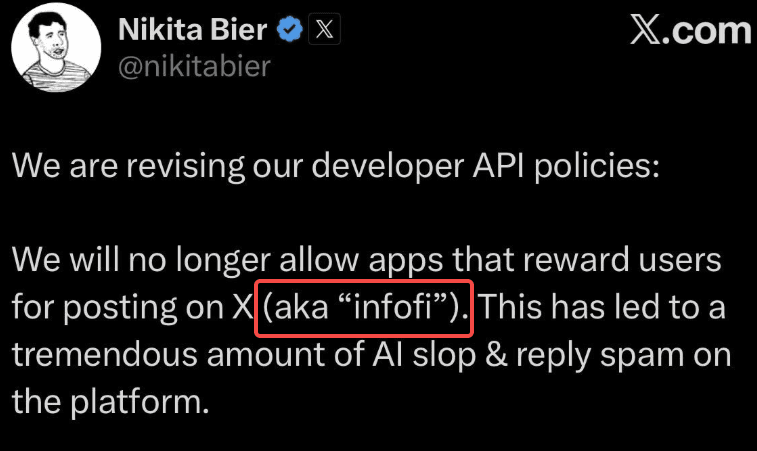
Yesterday, X’s Head of Product Nikita Bier announced that any application that rewards users for posting will have its API access revoked.
He added—almost considerately—that affected developers are welcome to contact the team, and X will help them migrate to Threads or Bluesky.
“The landlord kicks you out—and even helps arrange the moving truck.”
As soon as the news broke, the InfoFi sector collapsed across the board. KAITO fell by 20%, Cookie dropped by 20%, and the Kaito Yappers community, with 157,000 members, was shut down entirely.
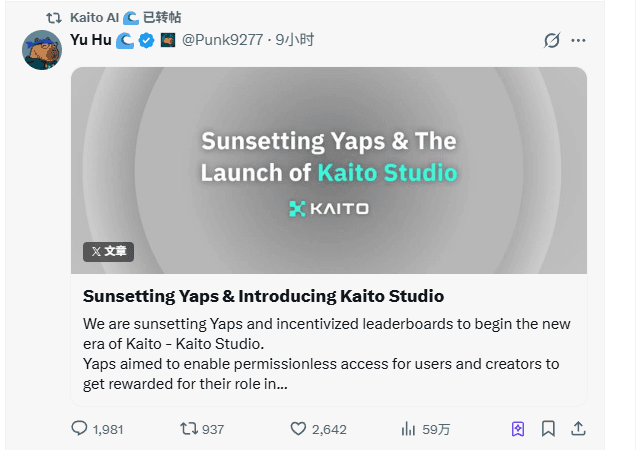
Less than an hour later, Kaito founder Yu Hu published a long-form statement.
The post contained no apology to the community and no protest against X’s policy change. Its core message was straightforward:
Move elsewhere.
Yaps is being discontinued. The new product is called Kaito Studio, which will follow a more traditional marketing model—one-to-one partnerships between brands and creators—moving away from the open, points-farming system where anyone could participate.
Twitter is no longer the priority. The focus will shift to YouTube and TikTok.
The crypto niche is no longer the sole target either; the expansion is toward finance, AI, and the broader creator economy—a market worth USD 200 billion.
The product is ready.
The direction is clear.
The data is in place.
And a new narrative has been formed.
Still, this does not feel like an emergency response written within an hour. It feels more like something prepared in advance—kept in a drawer, waiting for X to make the first move.
At the same time, there were earlier signals on-chain.
Kaito’s multisig contract previously distributed 24 million KAITO tokens to five addresses. One of those addresses transferred 5 million KAITO in full to Binance a week ago.
It looks far more like a cash-out at the right moment.
Advance communication.
Advance drafting.
Advance transfer of tokens to exchanges.
Everything that needed to be done was done.
Then, once X made the announcement, the long statement followed immediately—polished, composed, framed as a proactive pivot and an embrace of change.
In the statement, Yu Hu wrote:
“After discussions with X, both parties agreed that a fully permissionless distribution system is no longer viable.”
Agreed.
Being kicked out is reframed as “reaching consensus.”
A product being effectively terminated is repackaged as a strategic upgrade.
This kind of rhetoric is all too familiar in crypto.
Projects never say, “We failed.”
They say they are exploring new possibilities.
They say market conditions have changed.
They say this is a planned transition.
It sounds graceful—but it is also pure PR.
At its core, X’s ban was merely the final blow. The “tweet-to-earn” model was already on its way out.
Mining by posting sounds appealing: tokenizing attention, fairly compensating creators, building a decentralized information economy.
But once deployed in reality, everyone knows how it played out.
If rewards are tied to posting, people post more.
If AI can generate content at scale, AI does the posting.
If accounts are unlimited, people spin up endless alts.
According to CryptoQuant, on January 9 alone, bots generated 7.75 million crypto-related tweets on X, a year-over-year increase of 1,224%.
ZachXBT had already been criticizing this last year, calling InfoFi platforms the primary drivers of AI-generated spam. He even offered a USD 5,000 bounty for user data to identify bot networks.
Genuine discussion was drowned out by endless “GM,” “LFG,” and “bullish.” Humans and bots blended together to the point where telling them apart became nearly impossible.
X’s Head of Product, Nikita Bier, had already posted a warning last week:
“CT is dying from suicide, not from the algorithm.”
Crypto Twitter is killing itself—it isn’t being killed by the algorithm.
At the time, the crypto community mocked him for arrogance and responded with GM memes.
Looking back now, doesn’t it feel like a notice issued before an execution?
Addressing spam, Yu Hu said Kaito had tried everything: raising thresholds, adding filters, redesigning incentives.
None of it worked.
The moment you reward posting with tokens, you are effectively offering a bounty for noise. No threshold can outpace profit-driven behavior. Human incentives are straightforward: as long as rewards exist, spam will not stop.
More critically, the lifeline was never in their own hands.
What business was Kaito really in?
Leveraging X’s traffic, using tokens to incentivize content production, and selling the resulting data to projects for marketing.
X was the foundation. Kaito was the structure built on top.
The moment the owner of the foundation decides to reclaim it, the building collapses. No justification required. No negotiation needed. A single announcement is enough.
InfoFi claims to be about a decentralized attention economy. But the attention layer was never decentralized. The algorithm belongs to the platform. The API belongs to the platform. The users belong to the platform.
You can put points on-chain.
You can decentralize the token.
But you cannot decentralize Twitter.
A parasite attempting to overthrow its host does not trigger a revolution. The host simply pulls the plug.
Over the past few years, Web3 startups have repeatedly pursued this model: borrow Web2 traffic to build Web3 momentum. Users remain on Twitter. Data remains on Twitter. Attention remains on Twitter. But the token is self-issued, and the revenue flows inward.
It sounds clever—using leverage to achieve scale.
But someone else’s traffic will always belong to someone else. Platforms tolerate you only until you become inconvenient. Once you do, parasitic business models collapse instantly.
This should serve as a warning to every Web3 project built on borrowed platform traffic.
If your lifeline is controlled by someone else, then every dollar you earn exists only because it hasn’t yet been taken back.
Ask yourself whether you are building a company—or renting a room.
Renters should not think like landlords, and they certainly should not believe the house is theirs.
Kaito says it will move to YouTube and TikTok next.
But are those landlords really easier to negotiate with than Musk?
You may also like

What Is Futures Trading? Hours, Platforms, and How to Start Trade Futures(2026 Guide)
Learn how to start futures trading, understand trading hours, and choose the best futures trading platform. Includes real data, strategies, and ways to maximize returns with rebates.

The Rise of Composable RWA

MAGA Up 350% in 24 Hours, PEPE Up 46% in One Day: Which Memecoins Are Next in 2026?
MAGA +350% in 24hrs. PEPE +46% in one day. RAVE +4,500% then -90%. In 2026's memecoin market, the gains are real. So are the traps? Here's how to tell the difference before you buy.

RCD Espanyol vs Real Madrid: Can the Pericos Delay the Inevitable?
RCD Espanyol vs Real Madrid lineups, standings, and stats for May 3, 2026. Real Madrid visits RCDE Stadium as Barcelona closes in on the LALIGA title. Full preview inside.

MegaETH goes live with an FDV exceeding 2 billion USD. Which ecological projects are worth paying attention to?

Dialogue with "Wood Sister" Cathie Wood: The next bull market is about to arrive

Can prediction markets win the competition for perpetual contracts?

Who is trading on Trade.xyz?

Binance quietly placed a bet on a leading large model company

Best Crypto Discord Server 2026: Why Jacob’s Crypto Clan Is Gaining Massive Attention
Jacob’s Crypto Clan has grown into one of the most active crypto Discord communities, with over 45K members and continuing to expand. This rapid growth reflects strong demand for structured trading insights and real-time collaboration.

Tom Lee Buying ETH: Why Wall Street’s Loudest Ethereum Bull Keeps Doubling Down
Tom Lee keeps buying ETH through every dip, every drawdown, and every moment of market doubt. Inside the strategy that's turning Ethereum into a treasury asset — and what it signals for the rest of the market.

Stripe Sessions 2026: AI Agent, Global Payments, and Invisible Crypto Infrastructure

Where will South Korea's cryptocurrency taxation head?

Legendary investor Naval: Apple is dead, SaaS will follow suit, and entrepreneurs have 18 months to reshape their moats

Morning Report | Visa includes Polygon in its global stablecoin settlement program; MoonPay invests $100 million to acquire security company Sodot; Digital wallet platform Belo completes $14 million Series A financing

Full text of the Federal Reserve's decision: Holding steady for the third consecutive time but increasing divisions

Dan Bin takes action, building a position in Circle
The Impossible Triangle of DeFi Lending
What Is Futures Trading? Hours, Platforms, and How to Start Trade Futures(2026 Guide)
Learn how to start futures trading, understand trading hours, and choose the best futures trading platform. Includes real data, strategies, and ways to maximize returns with rebates.
The Rise of Composable RWA
MAGA Up 350% in 24 Hours, PEPE Up 46% in One Day: Which Memecoins Are Next in 2026?
MAGA +350% in 24hrs. PEPE +46% in one day. RAVE +4,500% then -90%. In 2026's memecoin market, the gains are real. So are the traps? Here's how to tell the difference before you buy.
RCD Espanyol vs Real Madrid: Can the Pericos Delay the Inevitable?
RCD Espanyol vs Real Madrid lineups, standings, and stats for May 3, 2026. Real Madrid visits RCDE Stadium as Barcelona closes in on the LALIGA title. Full preview inside.
MegaETH goes live with an FDV exceeding 2 billion USD. Which ecological projects are worth paying attention to?
Dialogue with "Wood Sister" Cathie Wood: The next bull market is about to arrive


