
 Buy Crypto
- Markets
 Futures
- Spot
- Copy Trade
- Earn
- More
Why Neynar Acquired Farcaster?

In crypto, the ideals of a protocol are often overestimated, while its usability is frequently underestimated.
On January 21, Farcaster co-founders Dan Romero and Varun Srinivasan announced that Neynar would acquire the platform. Farcaster was previously valued at over $1 billion with backing from a16z and Paradigm. Over the coming weeks, the protocol contracts, code repositories, official client, and Clanker will transfer to Neynar for ongoing operation and maintenance. Merkle team members and the founders will step back from daily management to pursue new ventures.
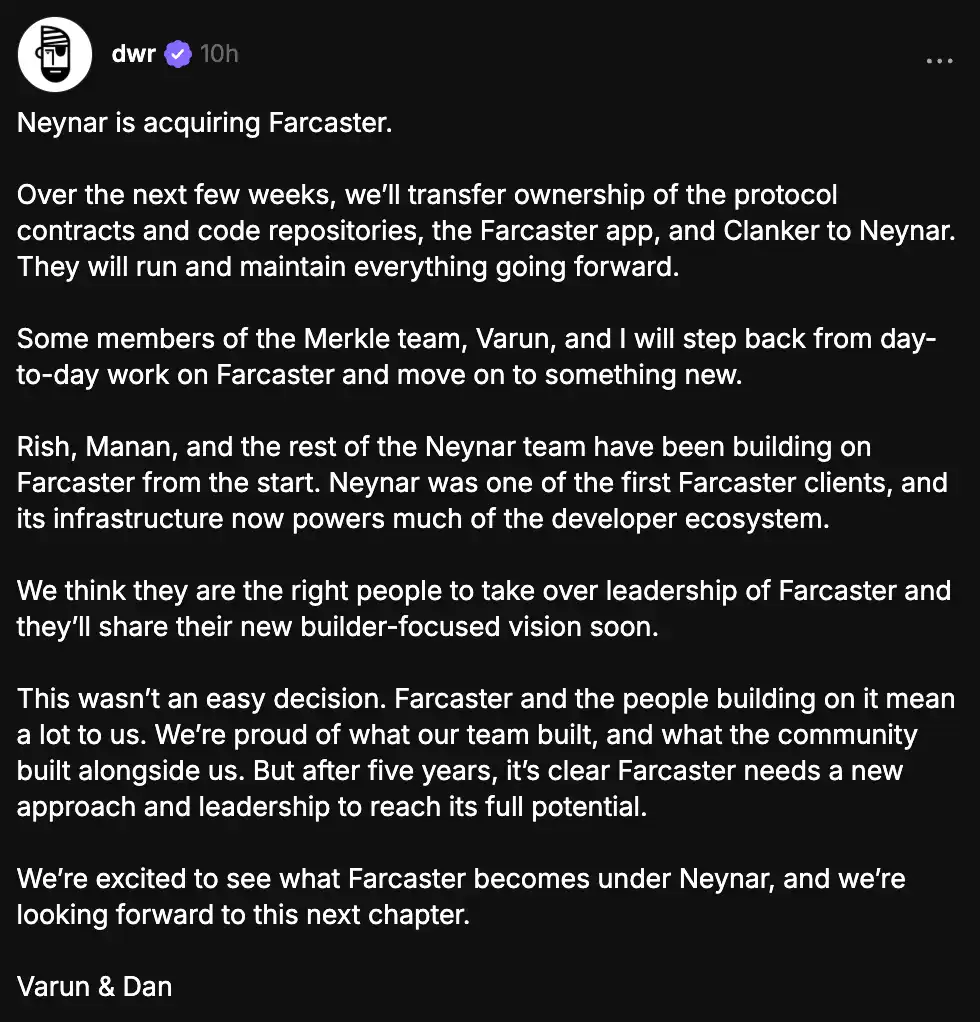
This acquisition follows a period of volatility for Farcaster. The protocol reached a $1 billion valuation in 2024 but faced severe revenue declines and user churn in the fourth quarter of 2025. While rumors suggested Coinbase might acquire Farcaster, the reality is now set. Neynar, the largest middleware and developer tool provider in the ecosystem, has completed its transition from tool provider to platform owner. This move integrates the protocol layer, application layer, and infrastructure layer vertically.
When an open protocol passes its five year trial period, its survival no longer depends on narratives or visions. It depends on who can operate it reliably as a sustainable product and platform.
The Cloud Service Layer of Farcaster
If Farcaster is an open social protocol, Neynar does not sit at the front end of content distribution. It operates at a deeper level by providing developers with hosted hubs, REST APIs, signer management, account creation tools, and webhooks. This allows external teams to read and write Farcaster social data without building their own nodes or indexing systems.
Neynar has long served a pragmatic function within the ecosystem. It turns the complex DevOps labor of building a social app into a paid service. Many apps use Neynar as their default data entry point. Even Farcaster data tables on Dune exist in a format derived from Neynar, and third party analytics often cite Neynar as their data source. This explains the perception that Neynar is merely a tool around Farcaster. In reality, it acts more like the general agent for Farcaster infrastructure.
Neynar leadership is deeply rooted in the Coinbase alumni network. This group consists of former employees from the largest US cryptocurrency exchange who have gone on to build influential Web3 startups. This background defines the corporate culture at Neynar and provided the key connections that facilitated this acquisition.
Rishav (Rish) Mukherji (CEO/Co-founder): Rishav Mukherji is a Harvard graduate and former Group Product Manager at Coinbase, where he gained experience in scaling crypto products and building compliance infrastructure.
Manan Patel (CTO/Co-founder): Manan Patel is also a Coinbase alumnus who led engineering teams. He brings experience from Uber and game development, providing the technical background needed for handling high concurrency and real time data streams.
To understand this acquisition, one must recognize that Neynar is not an outsider. It has been tied to Farcaster since the early days. It started by building applications on Farcaster before evolving into a developer platform. This growth path stems from frontline development needs rather than abstract design.
The capital structure is even more critical. In May 2024, Neynar announced an $11 million Series A round led by Haun Ventures and USV, with participation from a16z CSX and Coinbase Ventures. The early investor list included the two Farcaster founders. This implies that Neynar is not just an outsourced team. It sits on a typical Silicon Valley crypto path defined by the Coinbase talent network, top tier fund backing, and a developer tool business model. It is naturally better at building paid products and APIs than managing a purely idealistic decentralized social movement.
This relationship made Neynar and Farcaster a symbiotic ecosystem. The protocol supported the infrastructure, and as the infrastructure grew, it became the default entry point for the protocol. As Farcaster required stronger operations and monetization capabilities, this structure naturally moved toward consolidation.
Why Now?
Before the acquisition, Farcaster had already executed a major narrative shift.
In December 2025, Farcaster moved its strategic focus from "social first" to "wallet first." Dan Romero admitted the team spent over four years on the social route without finding a sustainable growth mechanism. Conversely, wallets and trading tools showed better product market fit.
Farcaster is no longer just a social protocol. It is becoming a potential financial entry point. The social feed is merely the interface. The real commercial loop lies in asset behavior, transactions, subscriptions, and payments.
This shift aligns perfectly with Neynar revenue streams. As user actions move from posting to trading, infrastructure permissions, real time events, signatures, and account systems become the heart of the network. Neynar already occupies that position.
Neynar stated in their acquisition announcement that their goal is to maintain the protocol, run the client, and operate Clanker. They want to help builders move from ideas to recurring revenue. Providing key infrastructure gives a company insight into volume and data paths, but it remains limited by the direction of the protocol. If the protocol pushes for wallet integration and transactions, an infrastructure company remaining an outsider creates friction. This acquisition is a vertical integration. It upgrades control over the infrastructure layer into formal responsibility for the protocol and client. This reduces internal friction and clears up ownership issues for future commercialization.
What's Next for Farcaster
Neynar indicates that Farcaster will not shut down or undergo drastic immediate changes. They emphasized that there would be no immediate shifts while they sort through priorities. The focus will be on the builder network to enable easier construction, smoother distribution, and more direct revenue loops. This suggests Farcaster may become a programmable social economic operating system. The social graph provides distribution, wallets provide valuation tools, and Frames allow actions to occur within content. The infrastructure layer then standardizes and monetizes these actions.
Dan and Varun did not reveal their next steps, stating only that they would leave daily operations at Farcaster to pursue new things.
From a business perspective, this makes sense. As Farcaster moves from protocol exploration to product operation, it requires strong execution and commercial discipline rather than idealistic stories about open social networks. Handing the wheel to a team skilled in developer tools and monetization moves Farcaster from an experiment to a manageable asset.
The founders leaving does not mean they are abandoning the field. They are simply switching roles. They proved a paradigm could work and are now handing the system to those who can run it as a business while they look for the next structural opportunity. This is common in the history of Silicon Valley tech startups and especially prevalent in the crypto industry.
You may also like

Electric Capital: Tracking 501 types of yield-generating RWA assets, we discovered these patterns

Those who are cut off by AI will not disappear; they will become the creators of the next round of the economy

Stablecoins reshaping cross-border payments in Asia? Strategic panorama and investment opportunity analysis

Zuckerberg is building an AI agent to help him as CEO

Bloomberg: Swiss Private Bank Old Guard Rifts, Is Bitcoin the Spark?

Zuckerberg is building an AI assistant to help him be CEO

Join WEEX AI Wars II: How WEEX API, Trader Skills Empower AI Trading Innovations
Join WEEX AI Wars II and be part of a global AI trading revolution. Compete with top AI agents and bots, showcase your strategies, and leverage WEEX API and Trader Skill to innovate, automate, and gain exposure in the AI trading ecosystem. Onboard your AI agent to WEEX AI Wars II NOW.

What kind of scenario will Backpack's TGE today play out in the bear market opening?

Polymarket Ten Million Dollar Winner Retrospective: 40 Addresses, 100,000 Transactions, Only Three Ways to Make Money

The Most Brutal Single-Month Plunge in 43 Years, Gold's Every Top Looks Like This
Jiang Xueqin's Latest Interview Transcript: How to View the Current Global Changes
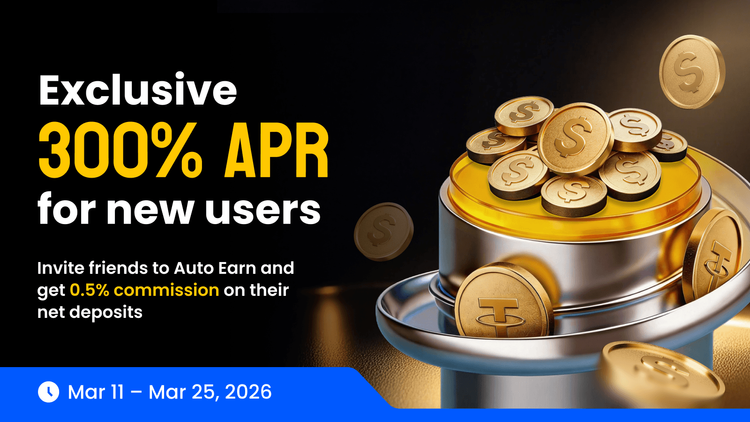
Maximize Your USDT Yield: The Weex Auto Earn Strategy for Passive Crypto Income
Learn how to earn interest on USDT with WEEX Auto Earn. Discover how stablecoins can generate passive income and why some platforms now offer up to 300% APR.
1 million investment yields over 1 billion return, Airwallex co-founder Liu Yueting reviews key life investments

Polymarket Millionaire Review: 40 addresses, 100,000 transactions, only three ways to make money

Four Key Truths and Cost Traps Behind Polymarket LP Market Making Incentives
San Francisco Stablecoin Weekly Insights: The XYZ Coordinate System of 2026
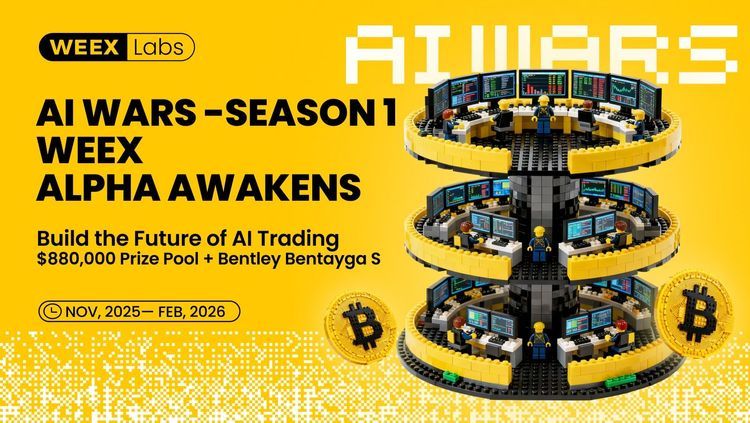
Asia's Next Great Dog Coin Debuts at the Weex AI Trading Hackathon
A BNB Chain meme token inspired by the Shih Tzu dog, blending community culture, creativity, and long‑term loyalty in Web3.
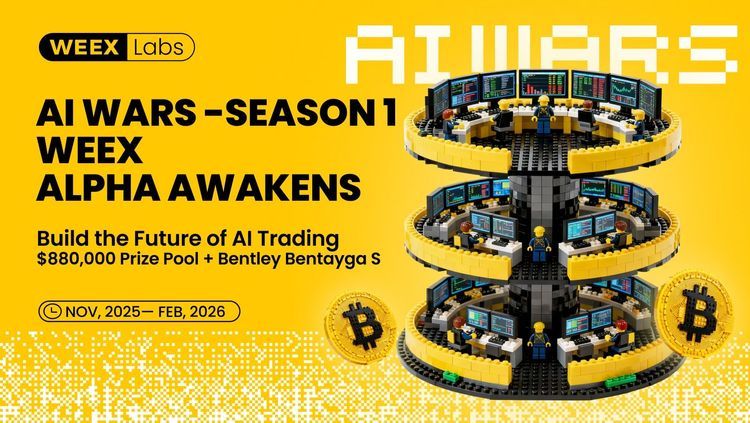
Fluxor: Connecting Global Builders With the WEEX AI Trading Hackathon
A hackathon platform connecting builders and creators to collaborative opportunities and innovation in Web3, enabling AI-oriented developers to experiment and create at scale.
The growth of AI-driven tools and community collaboration in Web3 has created new opportunities for developers worldwide. As a community partner and sponsor of the WEEX AI Trading Hackathon, Fluxor's mission to unify hackathon experiences and foster creative partnerships aligns with this spirit of collective innovation.


 App
App